

Roller coasters can be a lot of fun, but investors generally prefer that their stocks don’t trade on a similar up-and-down track.
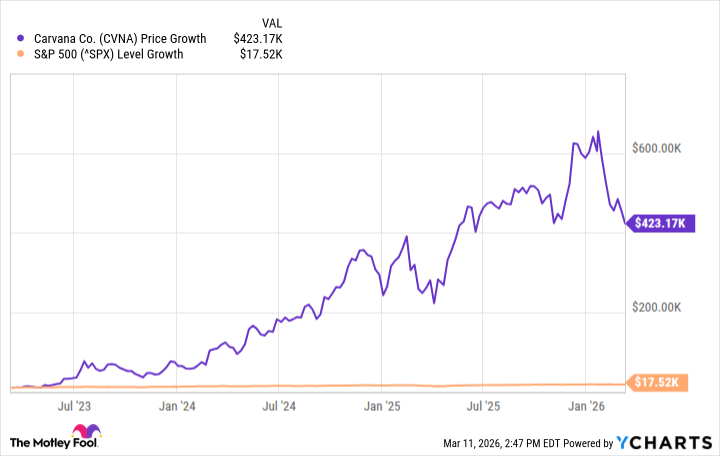
Over the past few years, however, a roller coaster is exactly what Carvana‘s (NYSE: CVNA) stock has been. In late 2022, Carvana was on the brink of bankruptcy thanks to massive debt, poor timing on purchasing large inventory, significant cash burn, and worsening macroeconomic conditions.
Will AI create the world’s first trillionaire? Our team just released a report on the one little-known company, called an “Indispensable Monopoly” providing the critical technology Nvidia and Intel both need. Continue »
Carvana went into complete survival mode and has emerged years later, setting record after record for its financials. Here’s why recent gains could be just the starting line.

CVNA data by YCharts.
You’ve likely heard of Carvana, perhaps even seen one of its eye-catching car vending machines. If not, the company is primarily a used car retailer attempting to drive value through better selection via its national inventory and distribution, faster delivery times, and lower costs. Glancing at Carvana’s fourth-quarter results, investors likely wouldn’t guess the company almost closed its doors only a few years ago.
Last year, Carvana produced record full-year retail units sold of 596,641, good enough for a 43% gain over the prior year. That increase in retail units drove its top-line full-year revenue 49% higher to a record $20.3 billion, compared to the prior year. Carvana’s bottom line wasn’t far behind, with full-year net income increasing more than $1 billion compared to the prior year, up to $1.9 billion, yet another record.
In the distant past, Carvana was no stranger to posting massive growth figures, with consecutive quarters boasting triple-digit growth in retail units, compared to the prior year. That said, growth early for Carvana was extraordinarily expensive, and when times got tough, the company had to focus on reversing losses. Years later, as a much healthier company emerged, it planned to again accelerate its increasingly profitable growth.
Last year, Carvana made significant progress in units sold, industry-leading margins, and expanded its reconditioning and digital auction capabilities. This year, Carvana plans to continue improving those areas while intensifying its focus on driving profitable growth at scale: It expects significant growth in both retail units sold and adjusted earnings before interest, taxes, depreciation, and amortization (EBITDA).