

The child is being treated at the Indira Gandhi Institute of Child Health, Bengaluru. File photograph
A recent paper in the peer-reviewed journal Clinical Dysmorphology has presented the first detailed case report of a new kind of gene mutation in a child, with a rare condition – pseudo-TORCH Syndrome Type 2. Using exome sequencing, a genetic test that analyses the protein coding regions of the DNA, researchers have identified a novel variant in the USP18 gene, known to cause pseudo- TORCH syndrome and its variants.
Exome sequencing revealed a hitherto undetected variant in exon four of the USP18 gene, coming as a surprise to the researchers. Primary author Vykuntaraju K. Gowda, of the department of paediatric neurology, Indira Gandhi Institute of Child Health, Bengaluru, said based on clinical suspicion, a gene test had been ordered four times, but it is only in the recent test that both the pseudo-TORCH variant diagnosis and the gene mutation was discovered. The child, now over 12, who was born of a consanguineous marriage between close relatives. had been coming to the hospital since she was eight months of age, with repeated fevers and encephalopathy (where brain function has been affected).
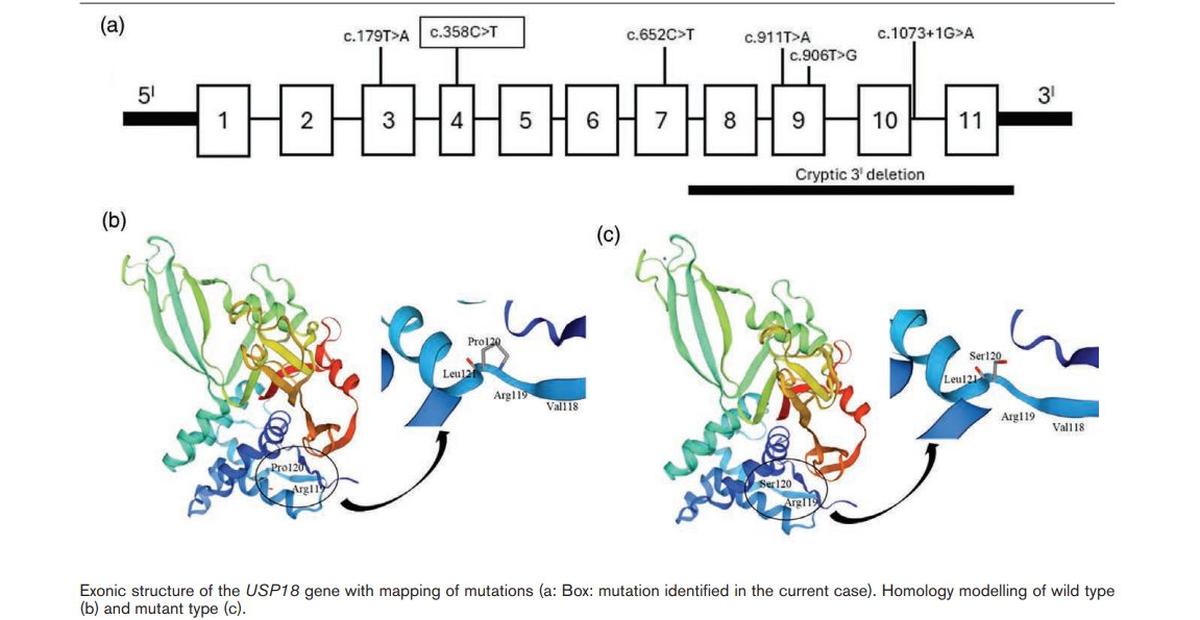
Exonic structure of the USP18 gene with mapping of mutations a) Box: mutation identified in the current case. Homology modelling of wild type (b) and mutant type (c).
| Photo Credit:
Special Arrangement
A puzzling case
“We treated her for many conditions including TB, brain fever. But she kept coming back, with seizures, recurrent fever, developmental delays, microcephaly (small head), organomegaly (abnormal enlargement of organs such as the heart, lungs and liver) and thrombocytopenia (platelet deficiencies),” Dr. Vykuntaraju explains. Putting all this together, correlating the symptoms and noting the death of an earlier sibling from the same illness, doctors suspected pseudo-TORCH syndrome, but the results were not illuminating, until recently, he added.
While TORCH syndrome is a group of congenital infections that a foetus can contract during pregnancy, leading to a range of birth defects, pseudo-TORCH mimics the clinical symptoms of TORCH, but without an underlying infection. “One other reason we suspected pseudo-TORCH is because of the older sibling dying from the same causes, and consanguinity. If it was just TORCH, it won’t affect subsequent pregnancies,” Dr. Vykuntaraju explained.
A new finding
Co-author Himani Pandey, lab head, genomics, Redcliffe Labs, said: “The DNA was isolated from the peripheral blood and subjected to exome sequencing. We found a homozygous missense variant (c.358C>T, p.Pro120Ser) in the USP18 gene, something that has not been noted before. There have been only 11 other cases of USP18-related disorders globally, nine of whom have died.
She added, ”The genetic analysis among the parents revealed that both parents, were asymptomatic, but had a copy of the abnormal gene, but the child had inherited both copies. It is possible to counsel the parents, and during a subsequent pregnancy test the child through amniocentesis to test for this genetic defect. In other children, who exhibit this mutation, the treatment that seems to work well for this patient may be initiated early, she explained. Dr. Vyuntaraju added that establishing a pseudo-TORCH diagnosis will help avoid unnecessary long-term antiviral therapy, besides providing appropriate genetic counseling for the family.
Finally, a treatment
The patient is among only three children who possess the genetic mutation and have survived beyond childhood. Thanks to the diagnosis, she has been put on a JAK inhibitor Baricitinib, at a dose that keeps her symptoms under control. Repetitive hospital visits were not required, except for follow up, her doctors say. The entire genetic testing was done free of cost for the family.
Published – November 24, 2025 08:06 pm IST