
In a tense
exchange that mirrored a sporting match more than a typical financial panel,
two of the FX and CFD industry’s veterans faced off on whether the booming retail
prop trading sector is a viable evolution of the market or a regulatory
disaster in waiting.
The debate,
held at the Finance Magnates London Summit (FMLS:25), pitted Drew Niv, Chief Strategy
Officer (CSO) at ATFX, against Brendan Callan, CEO of Tradu.
By the end
of the session, an audience that opened overwhelmingly in favour of the motion
“Prop trading is good for the trading industry” had changed its mind and voted
against it, handing a narrow win to the skeptic in the room.
You can
watch the full debate here, and below the video you’ll find a play-by-play of
how the sentiment shifted.
[Minute
00:00 – 10:00]
The session
opened with Jonathan Fine, the moderator, polling the room. The result was a
landslide: 71% of the audience believed prop trading was net-positive for
the industry.
Drew Niv
opened the defense. Acknowledging the sector’s “Wild West”
reputation, he drew parallels to the retail FX market of 1999. His argument
hinged on the sheer volume of users the model attracts. Niv posited that prop
trading solves the brokerage industry’s most expensive problem: the cost of
acquisition .
- Will Event Contracts Be Prop Firms’ Next Target? My Funded Futures’ Hint Indicates So
- “Less Than 1% of Traders Can Bankrupt a Prop Firm”: Former The5ers Risk Chief Launches Props Advisory
“It’s
that value proposition for the client that has drawn an audience, just in the
last three years, that far surpasses the audience in the retail FX industry in
terms of numbers,” Niv said. He conceded the current economics are flawed
but argued the influx of users creates a “great seeding ground” for
future sophisticated traders.
It is worth
noting that ATFX
entered the prop-trading space in 2024. According to the company, some of
the clients acquired through this channel were later converted
into brokerage accounts.
Brendan
Callan wasted no time tackling the opposition, dismissing the idea that these
firms are proprietary trading operations at all. “As a company, you are
what your revenue is. These companies – as bizarre as this is to say – sell
demo accounts,” Callan said.
Callan targeted
the marketing tactics prevalent in the sector, referencing a specific
advertisement featuring breakdancers and luxury cars.
“No
offense to Honda, but if you’re going to pretend to be a baller, even the good
people at Honda would suggest you try harder than that,” he quipped,
warning the audience that sending money to such firms is essentially
“donating it to them”.
Second Half: Arbitrage
Tactics and Solvency Concerns
[Minute
10:00 – 25:00]
The debate
intensified as the executives dug into the mechanics of the trade. Callan
outlined a strategy he dubbed the “four-challenge arbitrage,”
detailing how traders can hedge positions across multiple accounts to game the
system.
He argued
that because the
model relies on failure fees rather than market execution, firms are
incentivized to deny payouts based on technicalities.
“They’re
using other information… ‘You made too much of your profits on one single
day’… Any slew of reasons they can come up with to deny profit-share
payments,” Callan argued, describing the environment as a “cesspool
of cat-and-mouse gamesmanship”.
Niv did not
shy away from the flaws, admitting that the current “no risk, high
reward” offers are unsustainable.
“It is
mathematically unrealistically good, and therefore even I would say
dishonest,” Niv said. However, he maintained that capitalism would act as
a “fixing mechanism,” weeding out firms that fail to pay while the
model matures into a legitimate funnel for regulated brokers.
Late Game: The “Ponzi”
Allegations
[Minute
25:00 – 35:00]
The tone
darkened during the Q&A session when the discussion turned to firm
solvency. Responding to questions about firms delaying payouts, Callan read a
written statement from The Funded Trader (TFT), which admitted being behind on
profit payments for 3,300 people, some
overdue for more than a year.
The
statement said: “More revenues equals more payouts equals more testimonials
equals more profit for TFT. More funds to pay back owed payouts and accounts
leads to reputation restored.” Callan told the room this amounted to the firm
acknowledging a Ponzi‑like structure: using new challenge
fees to catch up on old obligations .
“He’s
saying himself: I need to sell more challenges so I can pay the overdue payouts
that I’m past due,” he added.
An audience
member attempted to reframe prop trading as a “home game” of poker, a
low-stakes environment for learning, compared to the “casino” of
high-leverage brokerage accounts.
While Niv
agreed that the “home game” appeal explains the traffic, Callan
rejected the analogy, insisting that buying an option to “gamify a
system” is not real trading.
Final Score: The Sentiment
Flip Against Prop
[Minute
35:00 – End]
With time
running out, Fine called for a second vote. The pre‑debate poll had shown roughly 71% in favor of the motion that prop
trading is good for the trading industry and 29% against. After nearly 40
minutes of back‑and‑forth, live questions and a tour through everything from arbitrage
tactics to regulatory loopholes, the post‑debate vote moved into “disagree” territory, with the audience deciding that prop
trading is not, on balance, good for the industry.
“After
hearing Brendan making the case, after hearing Drew talking about the value for
the industry, you have decided again that prop trading is not good for the
industry,” Fine announced, noting the “disagree” camp had taken
the lead.
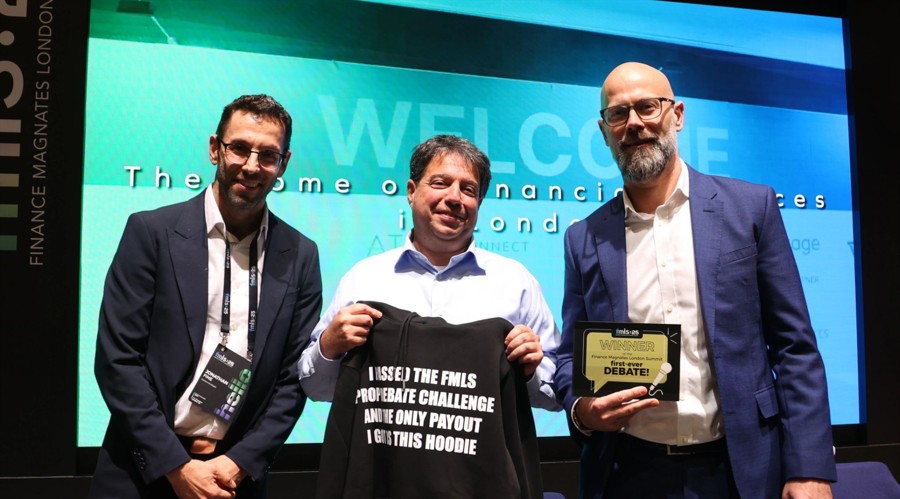
To close,
he handed out a tongue‑in‑cheek hoodie reading: “I passed the
FMLS prop debating challenge and the only payout I got is this hoodie,” before sending attendees off to the awards
ceremony.
While the
“prop” model continues
to generate massive volume, the London debate suggests that industry
insiders are becoming increasingly wary of the reputational risks and financial
stability of the unregulated firms driving the trend.
In a tense
exchange that mirrored a sporting match more than a typical financial panel,
two of the FX and CFD industry’s veterans faced off on whether the booming retail
prop trading sector is a viable evolution of the market or a regulatory
disaster in waiting.
The debate,
held at the Finance Magnates London Summit (FMLS:25), pitted Drew Niv, Chief Strategy
Officer (CSO) at ATFX, against Brendan Callan, CEO of Tradu.
By the end
of the session, an audience that opened overwhelmingly in favour of the motion
“Prop trading is good for the trading industry” had changed its mind and voted
against it, handing a narrow win to the skeptic in the room.
You can
watch the full debate here, and below the video you’ll find a play-by-play of
how the sentiment shifted.
[Minute
00:00 – 10:00]
The session
opened with Jonathan Fine, the moderator, polling the room. The result was a
landslide: 71% of the audience believed prop trading was net-positive for
the industry.
Drew Niv
opened the defense. Acknowledging the sector’s “Wild West”
reputation, he drew parallels to the retail FX market of 1999. His argument
hinged on the sheer volume of users the model attracts. Niv posited that prop
trading solves the brokerage industry’s most expensive problem: the cost of
acquisition .
- Will Event Contracts Be Prop Firms’ Next Target? My Funded Futures’ Hint Indicates So
- “Less Than 1% of Traders Can Bankrupt a Prop Firm”: Former The5ers Risk Chief Launches Props Advisory
“It’s
that value proposition for the client that has drawn an audience, just in the
last three years, that far surpasses the audience in the retail FX industry in
terms of numbers,” Niv said. He conceded the current economics are flawed
but argued the influx of users creates a “great seeding ground” for
future sophisticated traders.
It is worth
noting that ATFX
entered the prop-trading space in 2024. According to the company, some of
the clients acquired through this channel were later converted
into brokerage accounts.
Brendan
Callan wasted no time tackling the opposition, dismissing the idea that these
firms are proprietary trading operations at all. “As a company, you are
what your revenue is. These companies – as bizarre as this is to say – sell
demo accounts,” Callan said.
Callan targeted
the marketing tactics prevalent in the sector, referencing a specific
advertisement featuring breakdancers and luxury cars.
“No
offense to Honda, but if you’re going to pretend to be a baller, even the good
people at Honda would suggest you try harder than that,” he quipped,
warning the audience that sending money to such firms is essentially
“donating it to them”.
Second Half: Arbitrage
Tactics and Solvency Concerns
[Minute
10:00 – 25:00]
The debate
intensified as the executives dug into the mechanics of the trade. Callan
outlined a strategy he dubbed the “four-challenge arbitrage,”
detailing how traders can hedge positions across multiple accounts to game the
system.
He argued
that because the
model relies on failure fees rather than market execution, firms are
incentivized to deny payouts based on technicalities.
“They’re
using other information… ‘You made too much of your profits on one single
day’… Any slew of reasons they can come up with to deny profit-share
payments,” Callan argued, describing the environment as a “cesspool
of cat-and-mouse gamesmanship”.
Niv did not
shy away from the flaws, admitting that the current “no risk, high
reward” offers are unsustainable.
“It is
mathematically unrealistically good, and therefore even I would say
dishonest,” Niv said. However, he maintained that capitalism would act as
a “fixing mechanism,” weeding out firms that fail to pay while the
model matures into a legitimate funnel for regulated brokers.
Late Game: The “Ponzi”
Allegations
[Minute
25:00 – 35:00]
The tone
darkened during the Q&A session when the discussion turned to firm
solvency. Responding to questions about firms delaying payouts, Callan read a
written statement from The Funded Trader (TFT), which admitted being behind on
profit payments for 3,300 people, some
overdue for more than a year.
The
statement said: “More revenues equals more payouts equals more testimonials
equals more profit for TFT. More funds to pay back owed payouts and accounts
leads to reputation restored.” Callan told the room this amounted to the firm
acknowledging a Ponzi‑like structure: using new challenge
fees to catch up on old obligations .
“He’s
saying himself: I need to sell more challenges so I can pay the overdue payouts
that I’m past due,” he added.
An audience
member attempted to reframe prop trading as a “home game” of poker, a
low-stakes environment for learning, compared to the “casino” of
high-leverage brokerage accounts.
While Niv
agreed that the “home game” appeal explains the traffic, Callan
rejected the analogy, insisting that buying an option to “gamify a
system” is not real trading.
Final Score: The Sentiment
Flip Against Prop
[Minute
35:00 – End]
With time
running out, Fine called for a second vote. The pre‑debate poll had shown roughly 71% in favor of the motion that prop
trading is good for the trading industry and 29% against. After nearly 40
minutes of back‑and‑forth, live questions and a tour through everything from arbitrage
tactics to regulatory loopholes, the post‑debate vote moved into “disagree” territory, with the audience deciding that prop
trading is not, on balance, good for the industry.
“After
hearing Brendan making the case, after hearing Drew talking about the value for
the industry, you have decided again that prop trading is not good for the
industry,” Fine announced, noting the “disagree” camp had taken
the lead.
To close,
he handed out a tongue‑in‑cheek hoodie reading: “I passed the
FMLS prop debating challenge and the only payout I got is this hoodie,” before sending attendees off to the awards
ceremony.
While the
“prop” model continues
to generate massive volume, the London debate suggests that industry
insiders are becoming increasingly wary of the reputational risks and financial
stability of the unregulated firms driving the trend.