


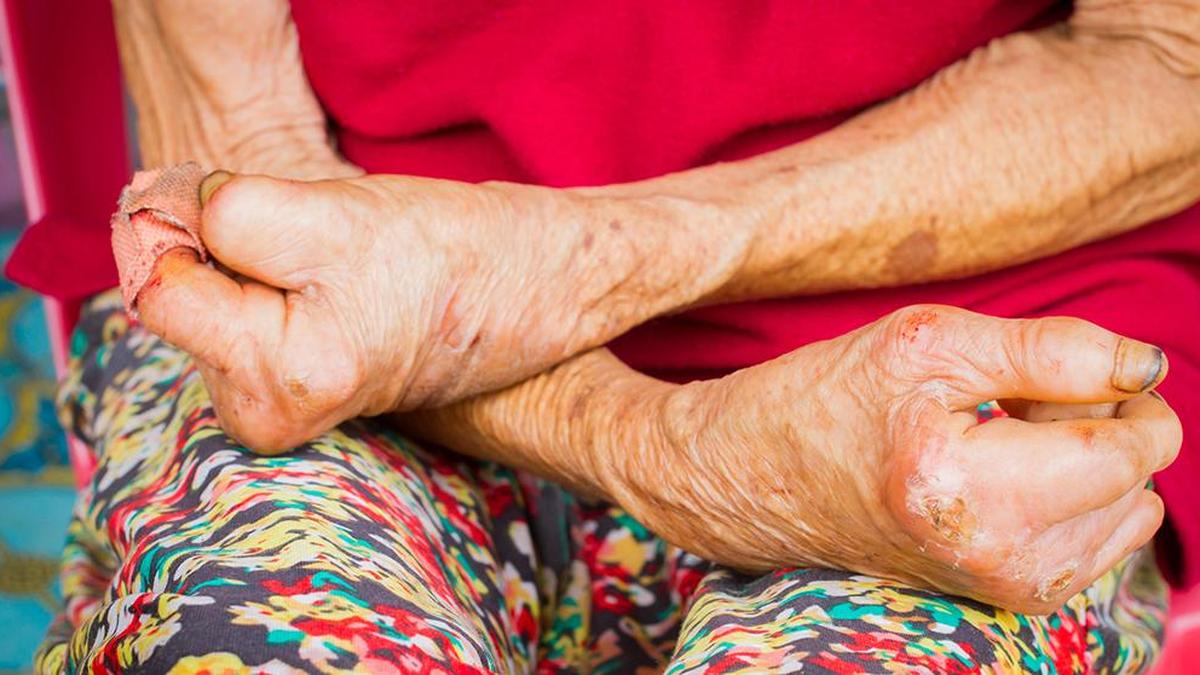
Paucibacillary leprosy was more common among children, while multibacillary leprosy, a more severe and infectious form having nerve involvement, accounted for over half of all detections.
| Photo Credit: Getty Images/iStockphoto
Over a five-year period, 515 new cases of leprosy have been detected in Chennai. Though the overall Annual New Case Detection Rate (ANCDR) remained largely stable, persistent hotspots were identified in industrial and border zones. These areas also recorded higher new case rates among children, ranging from 3.5 to 11.5 per 1,00,000, indicating ongoing transmission likely linked to migrant populations, a study has found.
The findings of the study on ‘Urban Hotspots Of Leprosy: Child And Migrant-linked Transmission In Chennai, 2021–2025’ were published in the Tamil Nadu Journal of Public Health and Medical Research. The study was conducted by Sridevi Govindarajan, Vasanthi Thangasamy, and Dharmalingam Vedanayagam of the Directorate of Medical and Rural Health Services (Leprosy).
The authors conducted a descriptive cross-sectional study using secondary programme data from 15 administrative zones of Chennai district. The overall ANCDR ranged from 1.0 per 1,00,000 in 2021 to 1.3 in 2025, with a transient spike to more than 2.0 in 2022-2023. Six zones recorded ANCDR above 2.0 [range of 2.0 to 4.9] – three major industrial hubs and three located at district borders. Child ANCDR was disproportionately high particularly in industrial zones, adjoining residential zones, and border zones.
“We have been conducting Leprosy Case Detection Campaigns and have been covering several zones in Chennai throughout this year. During door-to-door checks, we are observing hidden cases of leprosy, especially in industrial and adjoining residential areas. In particular, cases have been observed in Ambattur, Valsaravakkam, Manali, Madhavaram, Sholinganallur, and Perungundi zones,” the study’s author Dr. Sridevi Govindarajan said.
Paucibacillary leprosy, an early and less infectious form having one to five skin patches, was more common among children, while multibacillary leprosy, a more severe and infectious form having nerve involvement, accounted for over half of all detections.
“Most of the persons affected were migrant workers from other States. For instance, during screening, we found a few new cases in some small industries in Ambattur. When we checked in Valsaravakkam, an adjacent zone where many of them lived, we found a large number of child cases. We found child cases in Manali as well. While this is based on our observations, we understood that the cases were linked to the migrant population, and the infection was spreading in places they lived,” she said.
She added that follow-up of the migrant workers and continuity of treatment is a challenge. There is a need to focus on the unorganised sector workers and their workplaces.
The findings suggest that migrant populations, particularly those concentrated in industrial hubs and border settlements, play a central role in sustaining urban transmission, the authors concluded.
The study recommended measures to strengthen leprosy control efforts in urban and migrant-dense settings. It recommended prioritising targeted surveillance in industrial hubs and border areas through regular, community-based screening to enable early detection and prevent ongoing transmission. They also called for workplace interventions for migrant workers, including health education, dermatological screening, and integrating leprosy awareness into occupational health services.
Detection of leprosy in children should be used as a key sentinel indicator of ongoing transmission, they said, urging a shift from conventional household-based surveillance towards more innovative, migrant-focused and community-driven approaches to sustain leprosy elimination goals in urban settings.
Published – December 11, 2025 05:30 am IST


