


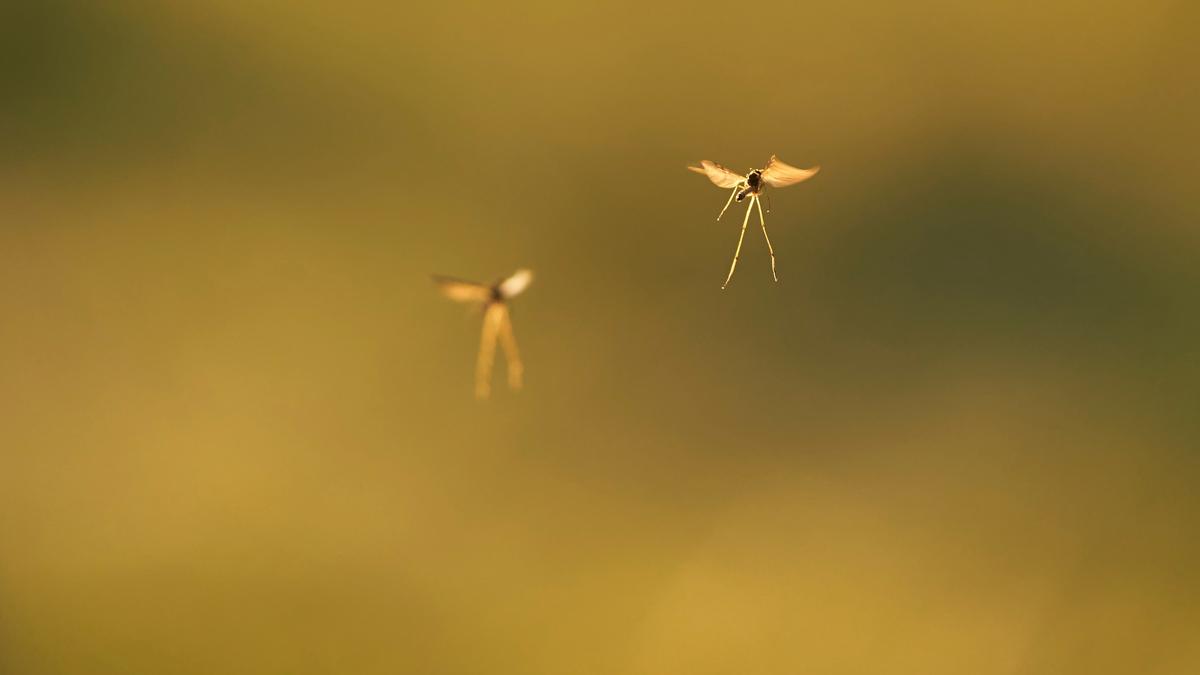
Scientists have suspected for decades that high-flying mosquitoes could move pathogens far from where the mosquitoes first took an infected blood meal.
| Photo Credit: Wolfgang Hasselmann/Unsplash
Mosquitoes spread diseases such as malaria and dengue, and these diseases affect billions of people worldwide. Many public health plans assume that pathogens borne by mosquitoes spread over long distances when infected people or animals travel. But there’s another possible route: some mosquitoes regularly fly high above the ground and get carried by winds for tens to hundreds of kilometres in a night.
Scientists have suspected for decades that these high-flying mosquitoes could move pathogens far from where the mosquitoes first took an infected blood meal. Until recently, this idea hasn’t been tested directly by screening mosquitoes caught at altitude for the pathogens they carry.
Research from China, Ghana, Mali, and the USA set out to test this idea in West Africa by collecting mosquitoes in the air, instead of near homes or breeding sites. They used nets attached to helium balloons and suspended them about 120 to 290 m above the ground at sites in Mali and Ghana in Africa. They flew these balloons for 191 nights between 2018 and 2020 to capture mosquitoes actively moving with the wind. The team then identified the mosquito species using DNA sequencing and tested individual females for several major pathogen groups using PCR-based methods.
The researchers also separated some mosquitoes into abdomen and head and thorax sections. This was done because pathogens may first be present in the gut after a blood meal, but a mosquito is more likely to be able to transmit a pathogen after it spreads through the body and reaches tissues in the head and thorax.
In all, the researchers screened 1,017 female mosquitoes of 61 species. Many were gravid (carrying mature eggs). They found that the high-flying mosquitoes were commonly infected with pathogens, including those that could infect vertebrates. About 8% carried Plasmodium parasites (including malaria parasites), about 3.5% carried flaviviruses, and about 1.6% carried filarial worms.
When the team specifically looked for signs of disseminated infection in head and thorax tissues, the rates were 4.6% for Plasmodium, 1.1% for flaviviruses, and 0.6% for filariae. Per the team members, these detections are proof that a fraction of the high-flying mosquitoes weren’t just exposed but were likely capable of infecting a new host after landing.
The findings were published in Proceedings of the National Academy of Sciences in November.
The team also identified 21 mosquito-borne pathogen types infecting vertebrates. These included dengue virus, West Nile virus, and M’Poko virus; 15 bird-infecting Plasmodium species; and filarial nematodes including a Pelecitus species. The study also found that many of the detected pathogens were sylvatic, meaning they circulate among wild animals rather than mainly among humans.
If high-altitude movement is routine, then monitoring only at ground level may miss part of the picture, especially for sylvatic pathogens that are hard to track in wild hosts. The authors have argued that public health schemes could benefit from paying attention to the prevailing wind corridors, surveilling downwind areas during transmission seasons, and preparing rapid response when infections appear in new locations.
Published – December 25, 2025 06:00 pm IST

