


Capital spending by these CPSEs and Railway Board, National Highways Authority of India (NHAI), Delhi Metro Rail Corporation and Damodar Valley Corporation jumped 62% year-on-year to ₹1.10 lakh crore in March, showed the latest Department of Public Enterprises data.
The surge complements the government’s efforts to boost broader public capex to spur economic growth amid external turmoil, said a senior finance ministry official.
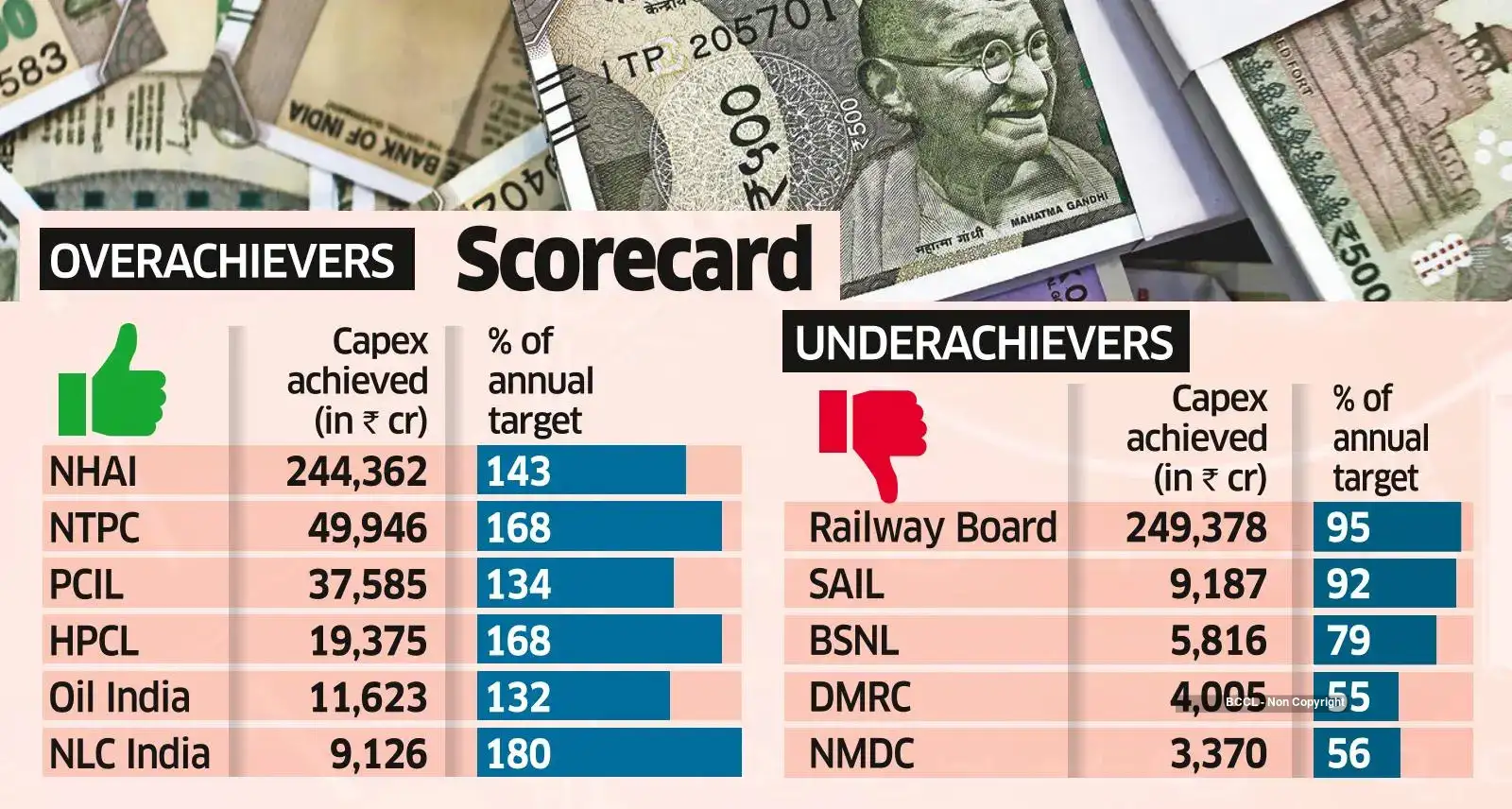
The capex touched ₹8.50 lakh crore in 2025-26, up 14% from the targeted ₹7.47 lakh crore and compared with ₹8.07 lakh crore a year before. In 2024-25, such spending had exceeded the annual target by nearly 3%.
Each of these entities has an annual capex target of at least ₹100 crore.
Public capex, including that of CPSEs, remains critical to India’s economic growth, as the West Asia conflict, on top of uncertainties caused by US tariffs, continues to weigh on domestic private investments, experts said.

NHAI shines, key energy COS beat target
With its massive capital outlay, the Railway Board remained the top spender last fiscal with an expenditure of ₹2.49 lakh crore, slightly undershooting the target of ₹2.60 lakh crore. However, the NHAI beat the target by a wide margin, with a spending of ₹2.44 lakh crore in 2025-26 against the goal of ₹1.70 lakh crore.Major power and petroleum firms, too, exceeded their 2025-26 targets. NTPC led the pack with a capex of ₹46,947 crore, followed by PowerGrid (₹37,585 crore), Indian Oil Corporation (₹36,327 crore), ONGC (₹35,186 crore), Bharat Petroleum Corporation (₹21,685 crore), Hindustan Petroleum Corporation (₹19,375 crore) and GAIL India (₹10,168 crore).
The Centre, too, stepped up its capital spending last fiscal. Its total capex increased almost 15% between April 2025 and February 2026 to ₹9.29 lakh crore.
The economy is estimated to have grown 7.6% last fiscal. But there are considerable downside risks to the projected 2026-27 expansion rate of 7-7.4% if the West Asia conflict persists, causing the global oil price to remain elevated for a longer period, the finance ministry has cautioned.
