


Artificial intelligence (AI) stocks have skyrocketed in recent years, but that has created a double-edged sword for the broader market.
The S&P 500 (^GSPC +0.43%) and Nasdaq Composite (^IXIC +0.43%) have surged by around 82% and 100%, respectively, over the last three years alone, thanks in large part to the AI boom. But major indexes are becoming increasingly dominated by mega-cap tech stocks, and that concentration increases risk.
The 10 largest stocks in the U.S. account for around 40% of the S&P 500, and most of those stocks are betting big on AI. Amazon, Alphabet, Microsoft, and Meta Platforms have spent a combined $303 billion on data centers just in the first half of 2026, a figure that has tripled over the last five years.
While these companies argue that demand for AI will deliver returns that justify the spending, there’s no guarantee that these build-outs will pay off. If they don’t, it could threaten the entire stock market. Here’s what Warren Buffett suggests investors do.

Image source: The Motley Fool.
Will the AI bubble burst in 2026?
It’s uncertain whether we’re actually in an AI bubble right now, but there are some similarities to the dot-com bubble of the early 2000s.
Multiple valuation metrics — such as the S&P 500 Shiller CAPE Ratio and the Buffett indicator — suggest that the market may be overvalued. The CAPE ratio measures the S&P 500’s 10-year inflation-adjusted earnings, while the Buffett indicator compares the total value of U.S. stocks to GDP. With both metrics, higher figures imply the market is more richly valued.
The S&P 500 Shiller CAPE Ratio peaked in late 1999 at around 44, just a few months before the dot-com bubble officially popped. As of August 2026, it’s over 41 — its second-highest point in history.
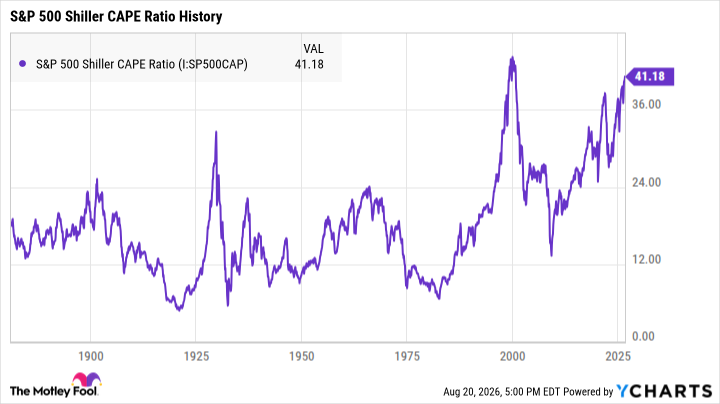
S&P 500 Shiller CAPE Ratio data by YCharts
The Buffett indicator is also at a record high of around 238%. When Warren Buffett popularized this metric back in 2001, he famously noted that when it nears 200%, investors are “playing with fire.”
To be clear, this doesn’t necessarily mean we’re in an AI bubble, and even the best stock market indicators can’t predict when a downturn will begin. However, it does suggest that many stocks are trading at a premium, and with multiple headwinds facing the AI sector, investors should exercise caution.
Warren Buffett says this is the key to investing
During the dot-com bubble, the stock market was soaring. The S&P 500 was up by nearly 200% between 1995 and 1999, fueled by excitement around the internet’s growth potential. In a 1999 essay for Fortune, however, Warren Buffett warned about the risks of investing in any industry for the wrong reasons.
Using the airline industry as an example, Buffett pointed out that although air travel had transformed the world, 129 airlines had filed for bankruptcy in the previous 20 years. The dot-com bubble proved his point, as many tech companies crashed and burned in the early 2000s despite the revolutionary impact the internet as a whole had on society.
“The key to investing,” Buffett explained in the Fortune piece, “is not assessing how much an industry is going to affect society, or how much it will grow, but rather determining the competitive advantage of any given company and, above all, the durability of that advantage.”
AI technology could change the world, and some companies will win big. But this doesn’t necessarily mean all AI stocks will thrive. If investors make just one move right now, it’s to ensure they’re purposefully choosing stocks with strong competitive advantages and long-term growth potential.
