

Three days into 2026, the United States military seized a foreign leader: Nicolás Maduro. Four days after that, the U.S. health department freed a longtime prisoner of war: saturated fats.
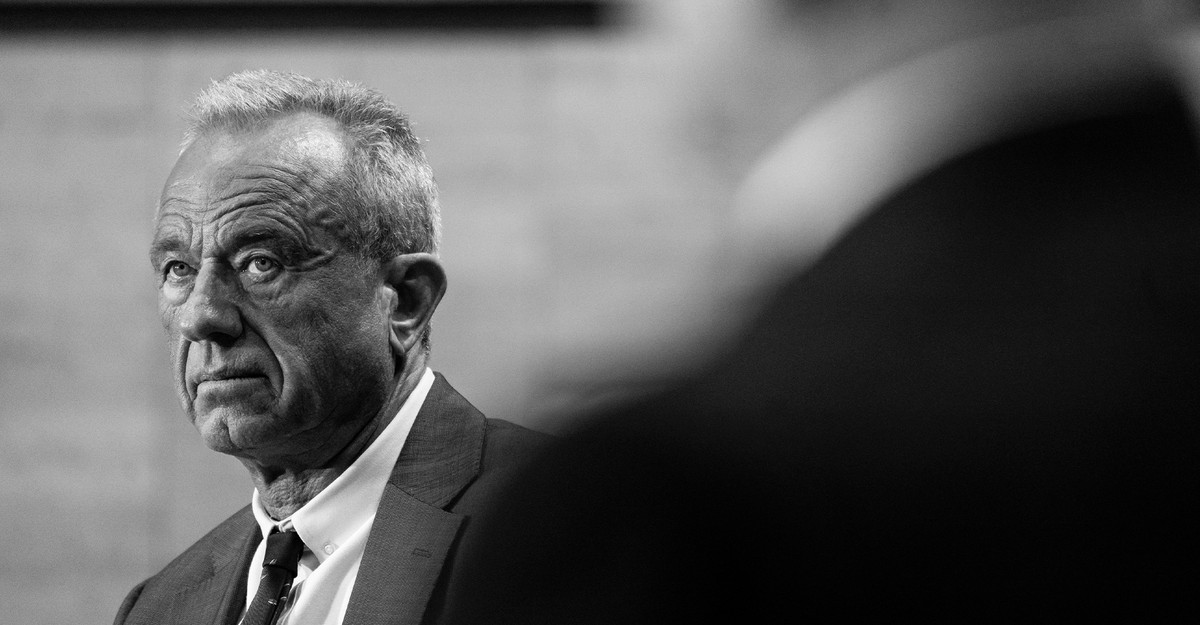
At a recent press conference announcing the publication of the government’s new dietary guidelines, Health and Human Services Secretary Robert F. Kennedy Jr. declared two different military operations in the span of less than a minute: The nation would be retreating from its war on fatty steaks and whole milk, he said, and redeploying for another war, this one on added sugars. News about a third campaign arrived a few days later, when the White House shared a dark and menacing photo of Kennedy with the caption “WE ARE ENDING THE WAR ON PROTEIN.”
This appears to be what happens when someone who has spent years fighting mainstream medicine suddenly finds himself at the center of it. Like a revolutionary turned generalissimo, Kennedy has transformed the former palace into a military command center. He has promised to defeat his enemies in Big Pharma and to purge conflicts of interest from the agencies he leads, so as to end what he has referred to as a “war on public health.” Elsewhere he has promised to withdraw from the “war on alternative medicine,” the “war on stem cells,” the “war on chelating drugs,” the “war on peptides,” the “war on vitamins,” and the “war on minerals.” Anything that his administration hopes to do may now be put in terms of martial conflict: Under Kennedy, policy making and saber rattling go hand in hand.
Kennedy’s deputies and chief advisers are culture warriors in their own right, and they seem to share their leader’s bellicosity. Jim O’Neill, the second in command at HHS, has talked about the need to fight back against gender-affirming medical care, which he describes as being part of an evil war on biology; Mehmet Oz, now in charge of Medicare and Medicaid, says that he will “wage a war on fraud, waste, and abuse”; and Calley Means, a top Kennedy advisor, points to an admittedly less catchy “war on the American public having transparency,” which the secretary intends to halt.
This repeated phrasing is more than just a rhetorical tic, and it extends far beyond the typical military analogies—like the wars on cancer and smoking—that have long been embedded in health discussions. As Kennedy and his aides press their case in public, they adopt a persistently antagonistic tone not only toward disease but also toward the medical and scientific establishment. It is as if anyone who has disagreed with the administration must be an enemy combatant. The current HHS regime has already taken shots at supposedly corrupt pediatricians, conflicted ob-gyns, “fake news” science journalists, and “sock puppet” regulators. (In response to questions about the department’s aggressive posture, HHS press secretary Emily Hilliard asserted that Americans’ trust in public health has been declining, and that Kennedy is restoring it.)
RFK Jr. has, in this regard, been a rather effective secretary of war. He has quickly put the old medical establishment on the defensive. My colleagues in academia and medicine are worried about what might happen to them if they write one of the government’s newly forbidden words in a scientific grant or provide the wrong sort of medical care to their transgender patients; venerable scientific outlets such as The New England Journal of Medicine have had to deal with letters from a government lawyer accusing them of bias; and earlier this month, an ex-FDA official nervously joked that he hoped that the IRS wouldn’t audit his taxes as punishment for criticizing agency operations.
When it comes to public-health advice, Kennedy’s agenda has proved to be more focused on attacking previous suggestions than promoting new ones. “Prior guidelines were driven not by health interests,” Kennedy said in a Fox News interview this month, “but by mercantile interests of the food industry.” FDA Commissioner Marty Makary frames his agency’s actions as “setting the record straight” after years of dogma, and NIH Director Jay Bhattacharya—an author of the anti-lockdown “Great Barrington Declaration”—remains engaged in a heated struggle against COVID-related restrictions that ended years ago. On the whole, the administration appears to have adopted a Promethean view of science and medicine: New knowledge is not gradually discovered, but rather rescued from the grasp of special interests by an elite squadron of iconoclasts.
The contrarian brigade sometimes seems to be waging a war on irony itself. Despite the secretary’s repeated promises to wipe out conflicts of interest, some of the experts who advised on the new dietary guidelines have financial ties to the meat and dairy industries. (When those ties were first reported, HHS responded with a statement calling it “absurd to suggest that anything other than gold standard science guided our work on this presidential priority.”) Makary, an avid podcast guest, has used his airtime to issue devastating takedowns of nutrition education, only to be interrupted by advertisements for unproven dietary supplements. Vinay Prasad, another top FDA official and medical provocateur, has joined Makary on the agency’s FDA Direct podcast for what they called a “bashing session” of The Wall Street Journal’s opinion desk—which has a long history of publishing Makary, Bhattacharya, and Kennedy.
Rousing citizens with patriotic calls to battle is a tried-and-true political strategy, but the hostility generated by this public-health administration may not be sustainable. Adrenaline surges don’t last forever, and overreliance on extreme rhetoric will flatten important differences between public-health problems. Repeated attempts to discredit trusted medical experts may also backfire. Earlier this month, a federal judge temporarily prevented the government from terminating millions of dollars in public-health grants awarded to the American Academy of Pediatrics. In her ruling, Judge Beryl Howell cited multiple combative social-media posts made by HHS officials and advisers against the physician group. At the very least, the MAHA strategy of picking fights against the nation’s primary care doctors, news outlets, and career officials is unlikely to inspire a resurgence of the public’s trust. Outrage over skim milk and Froot Loops can only go so far, and Americans may soon grow tired of Kennedy’s forever wars.