
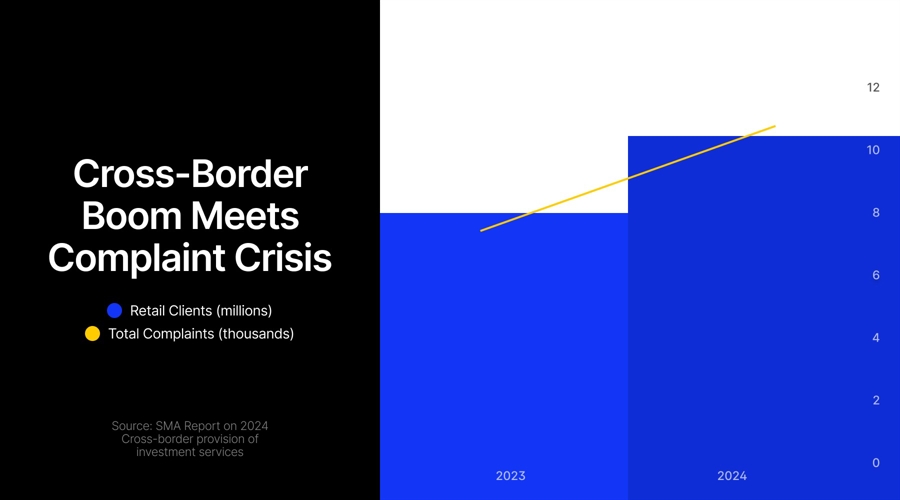

The number
of retail clients using cross-border investment services in Europe climbed to
about 10.5 million in 2024, even as complaints from those clients jumped by
46%, according to new data from the European Securities and Markets Authority
(ESMA).
ESMA’s
latest annual review of passported activity shows firms operating under the
“freedom to provide services” regime served roughly 10.5 million retail clients
in 2024, up from 8 million a year earlier, a 32% increase in
cross‑border clients. The analysis covers investment firms and credit
institutions providing services into other EU/EEA countries without using
branches, and only includes firms that have more than 50 retail clients in a
given host market.
In total,
370 firms across 30 EU/EEA jurisdictions met that threshold in 2024, down from
386 in 2023, marking a 4% drop in the number of active providers. On average,
each firm served about 28,000 cross‑border retail clients, up from 20,000 the
previous year, underlining how activity is consolidating into fewer, larger
players.
It is worth noting that the 10.5 million counts only clients receiving investment services from firms in other member states, not clients trading with firms in their home country. For example, a German trader using a German broker is excluded, but a
German trader using a Cyprus-based broker is included.
CFDs were
held by about 1.4 million cross‑border retail clients in 2024, around 11% of
the total, while crypto‑assets within the MiCA perimeter were held by nearly 1
million cross‑border clients, or about 7%. Overall, shares were the most common
product, with 4.6 million clients, roughly 36% of the total.
Cyprus Dominate Supply
On the
supply side, ESMA ’s data point to a highly concentrated market. Firms based in
Cyprus, Lithuania, Germany and Ireland together accounted for about 86% of all
cross‑border retail clients, around 9 million of the 10.5 million total.
Cyprus‑based
firms, 79 in total, reported servicing about 3.6 million cross‑border retail
clients, or roughly a third of the EU/EEA total. Lithuanian firms followed with
about 2.6 million clients, up sharply from 1 million in 2023, while German
firms served around 2 million clients and Irish firms about 939,000. All other
firms – 235 entities spread across 24 member states – jointly reported about
1.46 million cross‑border retail clients.
Investment
firms made up the majority of providers, accounting for 59% of the 370 firms,
with credit institutions representing the remaining 41%. Cyprus hosted the
largest pool of investment firms, while France and Germany were home to the
biggest numbers of credit institutions active cross‑border.
Germany, France, Spain,
Italy Are Key Destinations
On the
demand side, a small group of large markets attracted most of the incoming
activity. Germany, France, Spain and Italy together accounted for about 52% of
all retail clients receiving cross‑border investment services.
Roughly
1.62 million Germany‑based clients received services from 187 foreign firms,
broadly in line with 2023 levels. France, Spain and Italy together added about
3.9 million cross‑border retail clients in 2024, up by 1.3 million year‑on‑year
and representing around 37% of the total client base.
On average,
firms in each home member states provided services into 17.5 other EU/EEA
countries, underscoring the breadth of passporting links. In some cases,
individual firms based in Austria, Cyprus, Ireland and Lithuania reported
providing services to retail clients in all 29 other member states.
Complaints Jump 46% But
Look Less Extreme In Relative Terms
ESMA
recorded 10,968 complaints from cross‑border retail clients in 2024, up from
7,507 in 2023, a 46% rise in absolute numbers. Given the strong growth in the
client base, the average number of complaints per 100,000 retail clients
increased more moderately, from 94 to 104, equivalent to a 9.6% rise.
Germany‑based
firms received the largest share of complaints, accounting for about 45% of the
EU/EEA total, or 4,936 complaints in 2024 compared with 2,595 a year earlier.
Firms in Lithuania and Ireland each accounted for about 14% of complaints,
while Cyprus‑based firms were linked to about 10% and Dutch firms about 6%.
From the
host‑country perspective, clients in Austria, Spain and Italy filed the highest
numbers of complaints about cross‑border services, together making up about 46%
of all complaints lodged by retail clients. Austrian clients stood out in
relative terms, with 1,909 complaints from about 248,000 clients – roughly
7,674 complaints per million clients, around 656% above the EU/EEA average of
1,015 per million.
ESMA
cautioned that the complaint definition – “a statement of dissatisfaction by
the client” – is broad and may be interpreted differently across firms and
jurisdictions.
The
exercise is part of ESMA’s broader push to monitor how cross‑border business
affects retail investors and how home and host supervisors coordinate
oversight. The regulator plans to repeat the data collection in 2026,
continuing its focus on firm behavior, complaint patterns and concentrations in
specific products and jurisdictions.
The number
of retail clients using cross-border investment services in Europe climbed to
about 10.5 million in 2024, even as complaints from those clients jumped by
46%, according to new data from the European Securities and Markets Authority
(ESMA).
ESMA’s
latest annual review of passported activity shows firms operating under the
“freedom to provide services” regime served roughly 10.5 million retail clients
in 2024, up from 8 million a year earlier, a 32% increase in
cross‑border clients. The analysis covers investment firms and credit
institutions providing services into other EU/EEA countries without using
branches, and only includes firms that have more than 50 retail clients in a
given host market.
In total,
370 firms across 30 EU/EEA jurisdictions met that threshold in 2024, down from
386 in 2023, marking a 4% drop in the number of active providers. On average,
each firm served about 28,000 cross‑border retail clients, up from 20,000 the
previous year, underlining how activity is consolidating into fewer, larger
players.
It is worth noting that the 10.5 million counts only clients receiving investment services from firms in other member states, not clients trading with firms in their home country. For example, a German trader using a German broker is excluded, but a
German trader using a Cyprus-based broker is included.
CFDs were
held by about 1.4 million cross‑border retail clients in 2024, around 11% of
the total, while crypto‑assets within the MiCA perimeter were held by nearly 1
million cross‑border clients, or about 7%. Overall, shares were the most common
product, with 4.6 million clients, roughly 36% of the total.
Cyprus Dominate Supply
On the
supply side, ESMA ’s data point to a highly concentrated market. Firms based in
Cyprus, Lithuania, Germany and Ireland together accounted for about 86% of all
cross‑border retail clients, around 9 million of the 10.5 million total.
Cyprus‑based
firms, 79 in total, reported servicing about 3.6 million cross‑border retail
clients, or roughly a third of the EU/EEA total. Lithuanian firms followed with
about 2.6 million clients, up sharply from 1 million in 2023, while German
firms served around 2 million clients and Irish firms about 939,000. All other
firms – 235 entities spread across 24 member states – jointly reported about
1.46 million cross‑border retail clients.
Investment
firms made up the majority of providers, accounting for 59% of the 370 firms,
with credit institutions representing the remaining 41%. Cyprus hosted the
largest pool of investment firms, while France and Germany were home to the
biggest numbers of credit institutions active cross‑border.
Germany, France, Spain,
Italy Are Key Destinations
On the
demand side, a small group of large markets attracted most of the incoming
activity. Germany, France, Spain and Italy together accounted for about 52% of
all retail clients receiving cross‑border investment services.
Roughly
1.62 million Germany‑based clients received services from 187 foreign firms,
broadly in line with 2023 levels. France, Spain and Italy together added about
3.9 million cross‑border retail clients in 2024, up by 1.3 million year‑on‑year
and representing around 37% of the total client base.
On average,
firms in each home member states provided services into 17.5 other EU/EEA
countries, underscoring the breadth of passporting links. In some cases,
individual firms based in Austria, Cyprus, Ireland and Lithuania reported
providing services to retail clients in all 29 other member states.
Complaints Jump 46% But
Look Less Extreme In Relative Terms
ESMA
recorded 10,968 complaints from cross‑border retail clients in 2024, up from
7,507 in 2023, a 46% rise in absolute numbers. Given the strong growth in the
client base, the average number of complaints per 100,000 retail clients
increased more moderately, from 94 to 104, equivalent to a 9.6% rise.
Germany‑based
firms received the largest share of complaints, accounting for about 45% of the
EU/EEA total, or 4,936 complaints in 2024 compared with 2,595 a year earlier.
Firms in Lithuania and Ireland each accounted for about 14% of complaints,
while Cyprus‑based firms were linked to about 10% and Dutch firms about 6%.
From the
host‑country perspective, clients in Austria, Spain and Italy filed the highest
numbers of complaints about cross‑border services, together making up about 46%
of all complaints lodged by retail clients. Austrian clients stood out in
relative terms, with 1,909 complaints from about 248,000 clients – roughly
7,674 complaints per million clients, around 656% above the EU/EEA average of
1,015 per million.
ESMA
cautioned that the complaint definition – “a statement of dissatisfaction by
the client” – is broad and may be interpreted differently across firms and
jurisdictions.
The
exercise is part of ESMA’s broader push to monitor how cross‑border business
affects retail investors and how home and host supervisors coordinate
oversight. The regulator plans to repeat the data collection in 2026,
continuing its focus on firm behavior, complaint patterns and concentrations in
specific products and jurisdictions.