

“Cancer care isn’t just about removing tumours—it is about preserving function and well-being,” says Arvind Krishnamurthy, head of surgical Oncology at the Cancer Institute, WIA. Speech, swallowing and breathing are functions we tend to take for granted when they function smoothly, but realise their value only when they are compromised.
Speech Language Pathologists (SLP) or speech therapists are trained to identify, assess, treat and rehabilitate communication and swallowing dysfunction, arising from a wide range of disorders. In patients afflicted with head, neck, oesophageal, lung, or brain cancers, this co-ordination of breathing, swallowing and speaking may be affected by disease or treatment. A hoarse voice, difficulty in swallowing, or choking while taking a sip of water may indicate possible SLP intervention.
Speech therapists working alongside oncologists and surgeons, help strengthen a patient’s ability to communicate and eat confidently, restoring independence and human connection. Thus, SLPs are an integral component of a well-established head and neck cancer unit.

Airway gate keeper
The larynx is a tiny organ sitting at the intersection of the airway and food passages. The food we eat and the air we breathe travel side by side like parallel railway tracks with an intersection. The proximity of our larynx to the food pipe (oesophagus) and its strategic position at the origin of the wind pipe (trachea) allows it to be the chief gate keeper of the airway. The larynx acts as a lever that opens for breathing, vibrates for speech and closes the airway during coughing and swallowing thereby protecting the airway from the descending bolus of food and liquids by blocking its entry into the wind pipe. When this function is compromised, food can enter the wrong passage and then our lungs (a complication known as aspiration) and may potentially lead to life-threatening complications including choking and pneumonia.
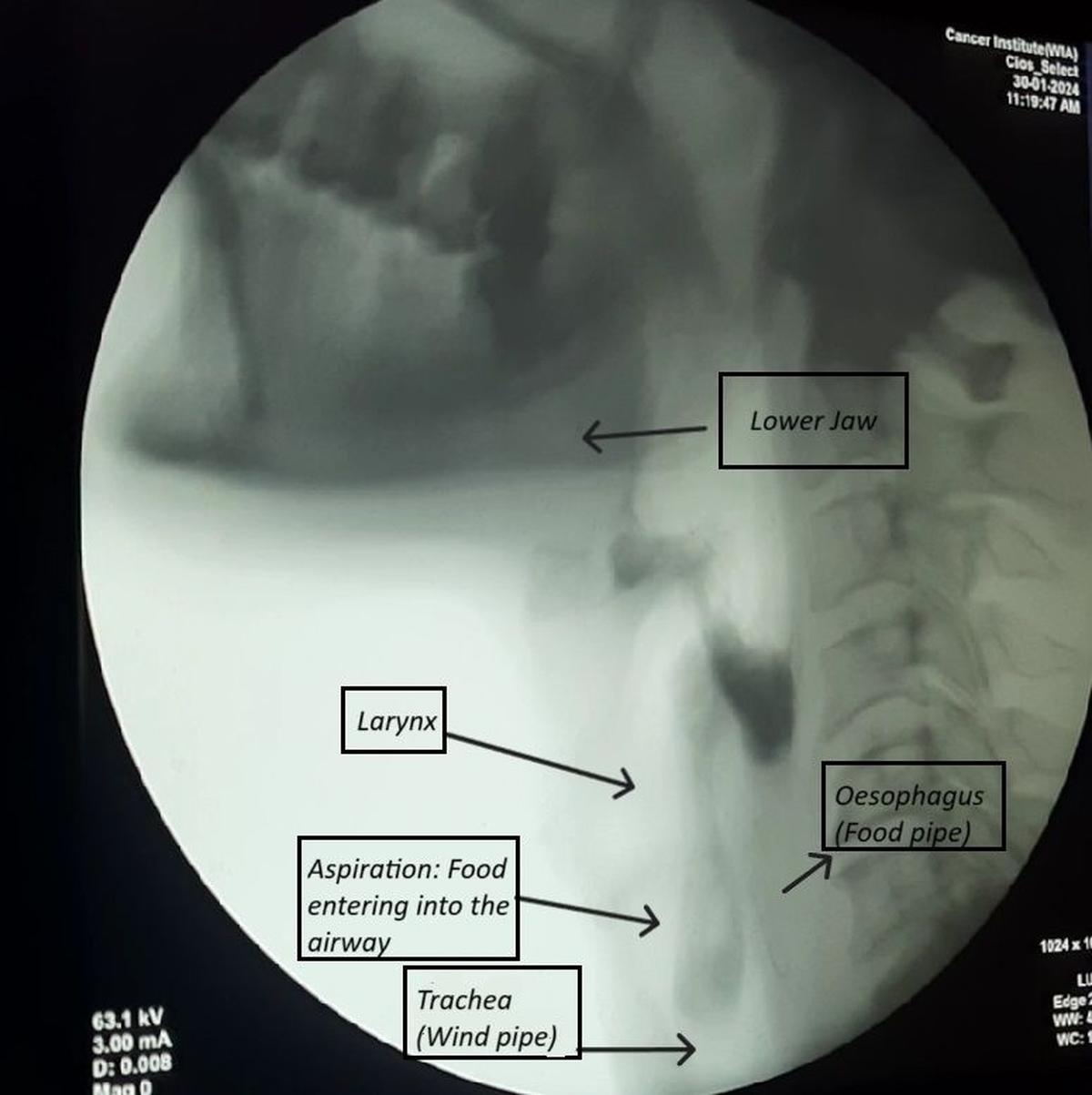
Video-fluoroscopic swallow study (VFSS) is considered a golden standard of swallowing evaluation capable of visualising all stages of food transit during real time swallowing process. This image captures food bolus presented to a patient with a radiographic contrast, image in lateral (side-view) view of the head and neck region. After the completion of swallow, ideally no food should remain in the throat. However, this image depicts residual food in the throat at the end of swallowing causing aspiration as food material spills into the airway. This is one of the advanced instrumental assessments conducted by SLPs to gain accurate diagnosis.
Swallowing therapy
Modern research emphasises the need to start rehabilitation before cancer treatment begins. Speech therapists assess patients using advanced tools such as the Fibreoptic Endoscopic Evaluation of Swallowing (FEES), Video Fluoroscopic Swallow Study (VFSS) as well as stroboscopic, and acoustic voice analyses to predict the extent of functional setbacks, and to tailor strategies to improve critical functions.
Subtle issues of choking (silent aspiration) and swallowing delays or vocal cord weaknesses are detected well before patients notice; thus, early detection can potentially save the patient from ICU admissions. When patients face an aspiration risk, SLPs insert gastric feeding tubes to safeguard nutrition and bypass the airway.

Patients may also need a tracheostomy (a small opening in the neck), when a life-saving tube is placed by surgeons into the wind-pipe directly for easy passage of air to the lungs and to bypass obstructions of the airway above (e.g.: aerodigestive tract tumours, swelling or constrictions of vocal cords). SLPs work to improve the breathing-swallow functions and help wean patients off from feeding tubes and tracheostomy tubes when functions stabilise, swelling diminishes and tumours are removed.
In patients with oral cancer, jaw opening can also be affected (condition called trismus from pan powder chewing and or as a result of radiation therapy), SLPs focus on jaw opening range, mobility and tongue strength to maintain speech intelligibility. The overall goal: preserve function and adapt to changes.
Home exercises form a cornerstone in successful outcomes for SLPs who invest time to teach patients and their families – safe feeding techniques, and communication strategies, empowering them to support recovery. Technology, including mobile-apps, tele-practice, and digital tracking tools, enables patients to continue therapy at home, benefiting those from remote areas or with mobility issues.

Voice rehabilitation
For laryngeal cancer (cancer of the voice box), patients may have to undergo surgery that entails the removal of the entire voice-box or larynx (laryngectomy). Major changes patients need to adapt to are the loss of natural voice, the inability to smell and the presence of a stoma (hole) in the neck for breathing.
SLPs provide pre-treatment counselling to help prepare patients understand the extent of changes, including options for voice restoration. Patients are trained to produce a new form of voice (called alaryngeal speech) with the help of voice prosthesis, electrolarynx or oesophageal speech. “Voice-rehabilitation involves getting the patient back to work and resuming social activities. Survivorship is about adding life to years, not just years to life. Restoring speech and swallowing is about more than function—it’s about identity and confidence,” says V. Venktesh, senior surgical oncologist.
“Patients face fears and frustration during their diagnosis and treatment journey and small wins, like sipping water without aspiration or making a phone call, can boost their morale tremendously,” says Surendran Veeraiah, head of psycho-oncology.
As oncology embraces holistic care, rehabilitation must be a core component. Early involvement of SLPs is no longer optional—it is essential. By prioritising comprehensive rehabilitation, we help cancer survivors not just endure but thrive, reclaiming their voice and a place at the table.
(Vilasini Raman is a speech and swallowing therapist at Cancer Institute (WIA), Adyar. vilasiniaslp@gmail.com)
Published – September 05, 2025 06:00 am IST