
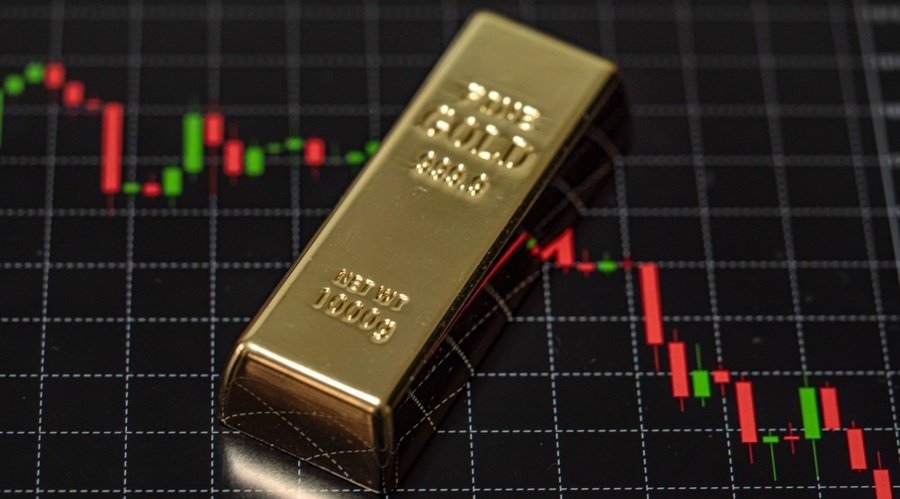

Gold prices
tested record highs above $4,380 per ounce in mid-October 2025 before
correcting approximately 11%, dropping below the psychological $4,000
threshold. Today (Thursday), 6 November 2025, the price is rising 0,8% and
moving back above the important resistance.
Despite the recent pullback, major financial institutions, including UBS, ING, and Goldman Sachs, maintain aggressively bullish gold price predictions, with targets ranging from $4,200 to an extraordinary $5,600 per ounce.
In this
article, I address why gold has been falling in recent weeks, how far it may
rebound, and provide a technical analysis of the XAU/USD chart, based on more
than ten years of experience as a retail investor and analyst.
The current
correction reflects technical factors rather than fundamental
weakness, according to Sagar Khandelwal from UBS Global Wealth Management who
stated: “Outside technical factors, we see no fundamental reason for the
sell-off”.
The November
2025 pullback below $4,000 stems from multiple temporary pressures
converging simultaneously.
Profit-taking
dominated trading after
gold’s meteoric rise to $4,381 in October, with traders systematically
locking in gains accumulated during the 47% year-to-date rally. The U.S. Dollar
Index surged to its highest levels since mid-2024, making gold more expensive
for international buyers and triggering automatic selling. Federal Reserve
officials hinted at a “higher for longer” interest rate stance,
temporarily reducing the appeal of non-yielding assets like gold.
Gold Price Correction Metrics
Metric | Data (November 6, 2025) |
Current Spot Price | $4,012.11/oz |
Daily Change | +$42.00 (+0.80%) |
Previous Session (Nov 5) | $3,970.13/oz (+0.97%) |
Year-High (October 2025) | $4,381.58/oz |
Decline from Peak | -8.4% (-$369.47) |
UBS noted
that “fading price momentum triggered a second leg down in futures open
interest,” but emphasized underlying demand remains exceptionally strong.
The correction was accompanied by short-term ETF withdrawals following record
Q3 inflows of $24 billion. However, ING commodities strategist Ewa Manthey
characterized the decline as “healthy rather than a trend reversal”.
Gold traded
at $4,016.85 per ounce on November 6, 2025, showing signs of stabilization.
How High Can Gold Price
Go?
My Own Technical Analysis Targets
$5,600
After
testing historical highs in mid-October just below $4,400, gold corrected to
levels that align with critical technical support zones. The precious metal has
found strong support around $3,800-$3,900 per ounce, a zone
determined by local lows combined with the 50-day exponential moving
average.
My
technical picture suggests two distinct scenarios. If the $3,800-$3,900 support
zone fails to hold, the next major support lies at $3,270-$3,440 per ounce, the
consolidation range observed from April through late August 2025, where the
200-day EMA also resides, separating downtrend from uptrend territory.
However,
applying Fibonacci extension analysis to the trend from August’s
local low through October’s correction reveals significantly bullish potential.
The 100% Fibonacci extension points to $5,000 per ounce in the long term,
aligning with targets from Goldman Sachs and other major institutions.
More
remarkably, the 161.8% extension level falls at $5,600, representing potential
upside of over 40% from current levels.
How high can gold price go according to my prediction? Source: Tradingview.com
UBS Maintains Bullish
Conviction Despite Pullback
Switzerland’s
banking giant UBS published a comprehensive research note on November 3, 2025,
reassuring investors that gold’s trajectory remains intact. “The current
pullback in the gold market is only temporary, and the yellow metal’s price is
still on track to reach $4,200 per ounce, with an upside scenario of
intensifying geopolitical or market risks driving it as high as $4,700,”
according to UBS analysts.
The
institution explicitly stated: “The much-anticipated correction has taken
a breather. Outside technical factors, we see no fundamental reason for the
sell-off”. UBS strategist Sagar Khandelwal elaborated on October 20, 2025:
“Lower real interest rates, a weaker dollar, rising government debt, and
geopolitical turmoil could push the yellow metal to $4,700 per ounce by Q1
2026, and mining stocks will do even better”.
Perhaps
most tellingly, UBS recommended aggressive positioning: “We like to buy
the dip in gold,” the analysts said, adding that investors “remain
underallocated” to the metal. The bank suggests a mid-single-digit
allocation to gold within investor portfolios, arguing that while
volatility may increase, gold remains a valuable component of a resilient
investment strategy.
ING: Fundamentals Point to
Further Upside
ING
commodities strategist Ewa Manthey published an equally optimistic outlook on
November 5, 2025, emphasizing structural demand factors. “Despite the
recent pullback in prices, we remain positive on our gold outlook, with macro
tailwinds and fundamentals pointing to further upside in 2026,” Manthey
wrote.
She
highlighted that key supports remain intact: “Key supports, including
central bank and haven demand, remain in place. ETF buying should also resume
as the US Federal Reserve is likely to continue cutting interest rates”.
ING expects rates traders see better than 70% odds for an interest-rate cut in
December, which would reduce the opportunity cost of holding non-yielding gold.
ING’s
specific price forecasts show confidence in gold’s near-term trajectory:
“We expect gold’s downside to be limited and see prices averaging
$4,000/oz this quarter and $4,100/oz in 1Q next year, although short-term
volatility could remain in place”. Crucially, Manthey characterized
current weakness as opportunity: “We view the correction as healthy rather
than a trend reversal, with any further weakness likely to attract renewed
interest from both retail and institutional buyers”.
You can also check my previous gold and silver price predictions articles here:
Major Institutional Gold
Price Predictions 2025-2026 Table
Institution | Q4 2025 Target | 2026 Target | Peak/Upside Scenario | Forecast Date |
Goldman Sachs | $4,000-$4,200 | $5,055 | $5,055 by December 2026 | October 2025 |
Bank of America | $4,000-$4,200 | $5,000 (avg $4,400) | $5,000 with 14% investment demand increase | October 2025 |
UBS | $4,200 | $4,700 (Q1 2026) | $4,700 if geopolitical risks intensify | October 2025 |
ING | $4,000 average | $4,100 (Q1 2026) | Further upside through 2026 | November 2025 |
Morgan Stanley | — | $4,500 (mid-2026) | $4,500 by June 2026 | October 2025 |
J.P. Morgan | $3,675 average | $4,000 (Q2 2026) | $4,000+ by mid-2026 | October 2025 |
Standard Chartered | — | $4,488 average | $4,488 for full year 2026 | 2025 |
HSBC | — | $5,000 | $5,000 by end-2026 | October 2025 |
Metals Focus | — | $4,560 average | Test of $5,000 level in 2026 | October 2025 |
ANZ | — | $4,600 | Peak at $4,600 by June 2026 | 2025 |
Societe Generale | — | $5,000 | $5,000 by end-2026 | 2025 |
My Analysis | $3,800-$4,000 support | $5,000-$5,600 | 161.8% Fibonacci extension at $5,600 (+40%) | November 2025 |
Record Demand Fundamentals
Contradict Price Weakness
Global gold
demand hit an unprecedented 1,313 tonnes in Q3 2025, the strongest
quarterly total on record, according to the World Gold Council. This surge was
driven by exceptional investment demand through exchange -traded funds, bars and
coins, plus significant central bank buying.
ETF
investors added 222 tonnes of gold holdings in Q3, marking the biggest
quarterly inflow in years and representing a staggering 134% increase
year-over-year. In value terms, the quarter brought a record $24 billion in
gold ETF inflows. Year-to-date, gold ETF inflows reached 619 metric tons valued
at $64 billion, with North America leading at 346 metric tons, followed by
Europe at 148 metric tons.
Bar and
coin demand remained robust at 316 tonnes in Q3, demonstrating strong retail
investor appetite despite record prices. Total investment demand for gold in Q3
2025 reached 537.2 metric tons, up 13% over Q2 and 47% from Q3 in the previous
year.
Jewellery
demand declined 19% year-over-year to 371 tonnes as high prices curbed
consumption volumes. However, in value terms, spending on jewellery actually
rose 13% to $41 billion, with higher prices offsetting weaker
volumes—demonstrating gold’s maintained purchasing power.
Gold Prices, FAQ
Why is gold falling right
now in November 2025?
Gold is
experiencing a technical correction, not a fundamental reversal, according
to UBS analysts. The 11% pullback from October’s $4,381 peak stems from
profit-taking after the 47% year-to-date rally, a stronger U.S. Dollar Index
reaching mid-2024 highs, and Federal Reserve officials hinting at “higher
for longer” rates.
How high can gold price go
in 2026?
Gold price
forecasts for 2026 range from $4,100 to $5,600 per ounce across major
institutions. Goldman Sachs projects $5,055 by Q4 2026, Bank of America targets
$5,000 (averaging $4,400), UBS forecasts $4,200 baseline with $4,700 upside
scenario, and ING expects $4,100 in Q1 2026. Technical analysis using Fibonacci
extensions suggests potential for $5,000-$5,600, representing over 40% upside
from current levels.
What is driving gold price
predictions higher?
Multiple
structural factors support bullish forecasts: central banks purchasing 760
tonnes annually in 2025-2026 (nearly double pre-2022 averages), record ETF
inflows of 360 tonnes driving institutional demand, Federal Reserve rate cuts
reducing opportunity cost of non-yielding gold, and persistent geopolitical
uncertainty.
Should I buy gold during
this correction?
Yes. Major
institutions view current levels as buying opportunities rather than
warning signals. UBS explicitly stated “We like to buy the dip in
gold,” recommending mid-single-digit portfolio allocation (3-7%). ING’s
Ewa Manthey wrote that “any further weakness likely to attract renewed
interest from both retail and institutional buyers”.
Is the gold rally over or
just pausing?
The rally
is pausing, not over, according to institutional consensus. UBS titled
their November 3 research note “The gold correction is technical and
temporary”. ING stated: “We view the correction as healthy rather
than a trend reversal”. Goldman Sachs expects “de-risking and profit
taking by investors to be met by dip buying from other segments of demand
including central banks and other physical buyers, ultimately keeping reversals
relatively shallow”.
How does gold compare to
other investments right now?
Gold has
gained 47-49% year-to-date through early November despite the recent
correction, outperforming most traditional asset classes. The precious metal’s
low correlation with equities and bonds provides diversification benefits,
especially during market stress periods.
Gold prices
tested record highs above $4,380 per ounce in mid-October 2025 before
correcting approximately 11%, dropping below the psychological $4,000
threshold. Today (Thursday), 6 November 2025, the price is rising 0,8% and
moving back above the important resistance.
Despite the recent pullback, major financial institutions, including UBS, ING, and Goldman Sachs, maintain aggressively bullish gold price predictions, with targets ranging from $4,200 to an extraordinary $5,600 per ounce.
In this
article, I address why gold has been falling in recent weeks, how far it may
rebound, and provide a technical analysis of the XAU/USD chart, based on more
than ten years of experience as a retail investor and analyst.
The current
correction reflects technical factors rather than fundamental
weakness, according to Sagar Khandelwal from UBS Global Wealth Management who
stated: “Outside technical factors, we see no fundamental reason for the
sell-off”.
The November
2025 pullback below $4,000 stems from multiple temporary pressures
converging simultaneously.
Profit-taking
dominated trading after
gold’s meteoric rise to $4,381 in October, with traders systematically
locking in gains accumulated during the 47% year-to-date rally. The U.S. Dollar
Index surged to its highest levels since mid-2024, making gold more expensive
for international buyers and triggering automatic selling. Federal Reserve
officials hinted at a “higher for longer” interest rate stance,
temporarily reducing the appeal of non-yielding assets like gold.
Gold Price Correction Metrics
Metric | Data (November 6, 2025) |
Current Spot Price | $4,012.11/oz |
Daily Change | +$42.00 (+0.80%) |
Previous Session (Nov 5) | $3,970.13/oz (+0.97%) |
Year-High (October 2025) | $4,381.58/oz |
Decline from Peak | -8.4% (-$369.47) |
UBS noted
that “fading price momentum triggered a second leg down in futures open
interest,” but emphasized underlying demand remains exceptionally strong.
The correction was accompanied by short-term ETF withdrawals following record
Q3 inflows of $24 billion. However, ING commodities strategist Ewa Manthey
characterized the decline as “healthy rather than a trend reversal”.
Gold traded
at $4,016.85 per ounce on November 6, 2025, showing signs of stabilization.
How High Can Gold Price
Go?
My Own Technical Analysis Targets
$5,600
After
testing historical highs in mid-October just below $4,400, gold corrected to
levels that align with critical technical support zones. The precious metal has
found strong support around $3,800-$3,900 per ounce, a zone
determined by local lows combined with the 50-day exponential moving
average.
My
technical picture suggests two distinct scenarios. If the $3,800-$3,900 support
zone fails to hold, the next major support lies at $3,270-$3,440 per ounce, the
consolidation range observed from April through late August 2025, where the
200-day EMA also resides, separating downtrend from uptrend territory.
However,
applying Fibonacci extension analysis to the trend from August’s
local low through October’s correction reveals significantly bullish potential.
The 100% Fibonacci extension points to $5,000 per ounce in the long term,
aligning with targets from Goldman Sachs and other major institutions.
More
remarkably, the 161.8% extension level falls at $5,600, representing potential
upside of over 40% from current levels.
How high can gold price go according to my prediction? Source: Tradingview.com
UBS Maintains Bullish
Conviction Despite Pullback
Switzerland’s
banking giant UBS published a comprehensive research note on November 3, 2025,
reassuring investors that gold’s trajectory remains intact. “The current
pullback in the gold market is only temporary, and the yellow metal’s price is
still on track to reach $4,200 per ounce, with an upside scenario of
intensifying geopolitical or market risks driving it as high as $4,700,”
according to UBS analysts.
The
institution explicitly stated: “The much-anticipated correction has taken
a breather. Outside technical factors, we see no fundamental reason for the
sell-off”. UBS strategist Sagar Khandelwal elaborated on October 20, 2025:
“Lower real interest rates, a weaker dollar, rising government debt, and
geopolitical turmoil could push the yellow metal to $4,700 per ounce by Q1
2026, and mining stocks will do even better”.
Perhaps
most tellingly, UBS recommended aggressive positioning: “We like to buy
the dip in gold,” the analysts said, adding that investors “remain
underallocated” to the metal. The bank suggests a mid-single-digit
allocation to gold within investor portfolios, arguing that while
volatility may increase, gold remains a valuable component of a resilient
investment strategy.
ING: Fundamentals Point to
Further Upside
ING
commodities strategist Ewa Manthey published an equally optimistic outlook on
November 5, 2025, emphasizing structural demand factors. “Despite the
recent pullback in prices, we remain positive on our gold outlook, with macro
tailwinds and fundamentals pointing to further upside in 2026,” Manthey
wrote.
She
highlighted that key supports remain intact: “Key supports, including
central bank and haven demand, remain in place. ETF buying should also resume
as the US Federal Reserve is likely to continue cutting interest rates”.
ING expects rates traders see better than 70% odds for an interest-rate cut in
December, which would reduce the opportunity cost of holding non-yielding gold.
ING’s
specific price forecasts show confidence in gold’s near-term trajectory:
“We expect gold’s downside to be limited and see prices averaging
$4,000/oz this quarter and $4,100/oz in 1Q next year, although short-term
volatility could remain in place”. Crucially, Manthey characterized
current weakness as opportunity: “We view the correction as healthy rather
than a trend reversal, with any further weakness likely to attract renewed
interest from both retail and institutional buyers”.
You can also check my previous gold and silver price predictions articles here:
Major Institutional Gold
Price Predictions 2025-2026 Table
Institution | Q4 2025 Target | 2026 Target | Peak/Upside Scenario | Forecast Date |
Goldman Sachs | $4,000-$4,200 | $5,055 | $5,055 by December 2026 | October 2025 |
Bank of America | $4,000-$4,200 | $5,000 (avg $4,400) | $5,000 with 14% investment demand increase | October 2025 |
UBS | $4,200 | $4,700 (Q1 2026) | $4,700 if geopolitical risks intensify | October 2025 |
ING | $4,000 average | $4,100 (Q1 2026) | Further upside through 2026 | November 2025 |
Morgan Stanley | — | $4,500 (mid-2026) | $4,500 by June 2026 | October 2025 |
J.P. Morgan | $3,675 average | $4,000 (Q2 2026) | $4,000+ by mid-2026 | October 2025 |
Standard Chartered | — | $4,488 average | $4,488 for full year 2026 | 2025 |
HSBC | — | $5,000 | $5,000 by end-2026 | October 2025 |
Metals Focus | — | $4,560 average | Test of $5,000 level in 2026 | October 2025 |
ANZ | — | $4,600 | Peak at $4,600 by June 2026 | 2025 |
Societe Generale | — | $5,000 | $5,000 by end-2026 | 2025 |
My Analysis | $3,800-$4,000 support | $5,000-$5,600 | 161.8% Fibonacci extension at $5,600 (+40%) | November 2025 |
Record Demand Fundamentals
Contradict Price Weakness
Global gold
demand hit an unprecedented 1,313 tonnes in Q3 2025, the strongest
quarterly total on record, according to the World Gold Council. This surge was
driven by exceptional investment demand through exchange -traded funds, bars and
coins, plus significant central bank buying.
ETF
investors added 222 tonnes of gold holdings in Q3, marking the biggest
quarterly inflow in years and representing a staggering 134% increase
year-over-year. In value terms, the quarter brought a record $24 billion in
gold ETF inflows. Year-to-date, gold ETF inflows reached 619 metric tons valued
at $64 billion, with North America leading at 346 metric tons, followed by
Europe at 148 metric tons.
Bar and
coin demand remained robust at 316 tonnes in Q3, demonstrating strong retail
investor appetite despite record prices. Total investment demand for gold in Q3
2025 reached 537.2 metric tons, up 13% over Q2 and 47% from Q3 in the previous
year.
Jewellery
demand declined 19% year-over-year to 371 tonnes as high prices curbed
consumption volumes. However, in value terms, spending on jewellery actually
rose 13% to $41 billion, with higher prices offsetting weaker
volumes—demonstrating gold’s maintained purchasing power.
Gold Prices, FAQ
Why is gold falling right
now in November 2025?
Gold is
experiencing a technical correction, not a fundamental reversal, according
to UBS analysts. The 11% pullback from October’s $4,381 peak stems from
profit-taking after the 47% year-to-date rally, a stronger U.S. Dollar Index
reaching mid-2024 highs, and Federal Reserve officials hinting at “higher
for longer” rates.
How high can gold price go
in 2026?
Gold price
forecasts for 2026 range from $4,100 to $5,600 per ounce across major
institutions. Goldman Sachs projects $5,055 by Q4 2026, Bank of America targets
$5,000 (averaging $4,400), UBS forecasts $4,200 baseline with $4,700 upside
scenario, and ING expects $4,100 in Q1 2026. Technical analysis using Fibonacci
extensions suggests potential for $5,000-$5,600, representing over 40% upside
from current levels.
What is driving gold price
predictions higher?
Multiple
structural factors support bullish forecasts: central banks purchasing 760
tonnes annually in 2025-2026 (nearly double pre-2022 averages), record ETF
inflows of 360 tonnes driving institutional demand, Federal Reserve rate cuts
reducing opportunity cost of non-yielding gold, and persistent geopolitical
uncertainty.
Should I buy gold during
this correction?
Yes. Major
institutions view current levels as buying opportunities rather than
warning signals. UBS explicitly stated “We like to buy the dip in
gold,” recommending mid-single-digit portfolio allocation (3-7%). ING’s
Ewa Manthey wrote that “any further weakness likely to attract renewed
interest from both retail and institutional buyers”.
Is the gold rally over or
just pausing?
The rally
is pausing, not over, according to institutional consensus. UBS titled
their November 3 research note “The gold correction is technical and
temporary”. ING stated: “We view the correction as healthy rather
than a trend reversal”. Goldman Sachs expects “de-risking and profit
taking by investors to be met by dip buying from other segments of demand
including central banks and other physical buyers, ultimately keeping reversals
relatively shallow”.
How does gold compare to
other investments right now?
Gold has
gained 47-49% year-to-date through early November despite the recent
correction, outperforming most traditional asset classes. The precious metal’s
low correlation with equities and bonds provides diversification benefits,
especially during market stress periods.