

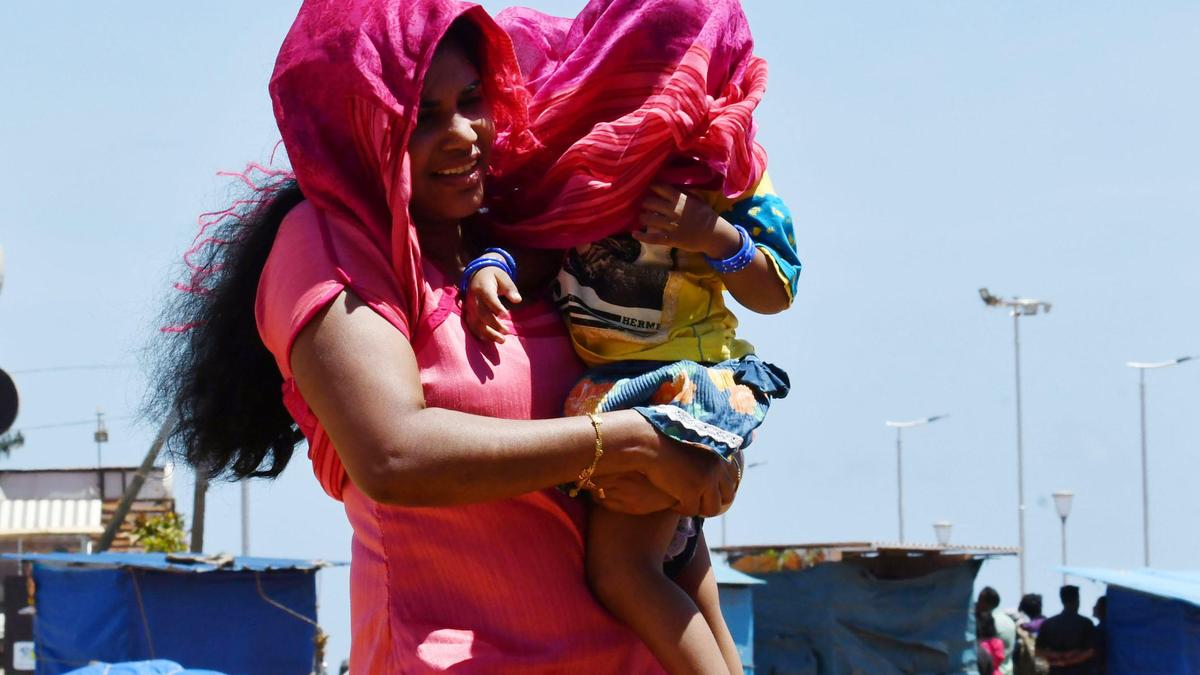
Researchers looked at how exposure to extremely hot, humid conditions during pregnancy can impact children’s health in the populous continent |Image used for representational purpose only
| Photo Credit: GOPAKUMAR S
Hot and humid conditions driven by climate change could increase cases of stunting in South Asia’s children by over three million by 2050, a study has estimated.
Heat humidity effects
Researchers at the U.S.’ University of California Santa Barbara looked at how exposure to extremely hot, humid conditions during pregnancy can impact children’s health in the populous continent.
‘Height-for-age’ — a commonly-used indicator of chronic health status for children aged under five — was analysed. It is the ratio of a one’s height to what is average for their age.
Pregnant women are known to be especially susceptible to heat stress due to the added weight and hormonal changes, which makes them vulnerable to overheating.

Risks during pregnancy
The findings published in the journal Science show that humidity can worsen impacts of exposure to heat, in part because it prevents pregnant women from cooling down.
The worst times were found to be very early and very late in pregnancy.
“At the beginning of pregnancy, the fetus is very vulnerable, while at the end of pregnancy, the mother is more vulnerable,” lead author Katie McMahon, a doctoral student, said.
Looking at exposure during the third trimester revealed that health outcomes due to heat and humidity were about four times worse than those from heat alone, explained Kathy Baylis, a professor in the department of geography at the University of California Santa Barbara.
Wet-bulb globe temperature accounts for three additional factors beyond air temperature that influence heat stress: humidity, radiant heat, and airflow.
The researchers also found that each additional day with a maximum wet-bulb globe temperature exceeding 29 degrees Celsius was associated with a reduced number of live births six to 12 months later.
However, each extra day with a maximum temperature of more than 35 degrees Celsius was found to be associated with an increased birth rates up to three months of exposure.
The results are in line with those from previous studies linking heat exposure with premature births — hotter temperatures are shifting births earlier, while hot-humid conditions could be bringing down overall conception rates, increasing rates of early-stage pregnancy loss, or both, the researchers said.
“Exposure to hot, humid conditions in-utero is dangerous for child health, and more dangerous than just hot temperatures alone,” McMahon said.
Hot and humid conditions are projected to increase under continued global warming, with South Asia expected to be among the world’s worst hit regions — the most densely populated places on the planet, the researchers said.

Addressing risks
“We find that hot-humid exposures are much more detrimental to health than hot temperatures alone, with the potential to increase stunting in South Asia by over three million children by 2050,” they wrote.
Therefore, by focusing on effects of temperature alone, researchers, doctors and public health officials may be underestimating the true impacts of extreme weather, the team said.
Child health data was taken from the Demographic and Health Surveys (DHS), a large-scale and comprehensive household survey of public health and demographics. Daily weather data was produced by the Climate Hazards Center at the University of California Santa Barbara.
Published – December 22, 2025 11:31 pm IST