

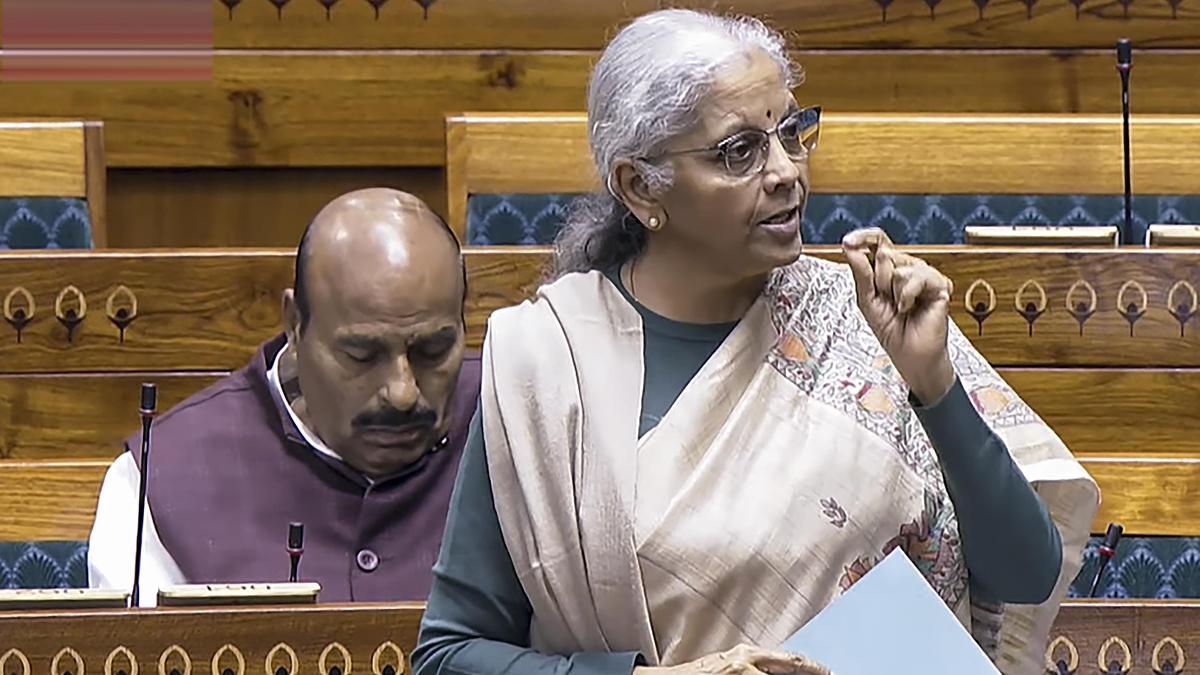
Union Finance Minister Nirmala Sitharaman speaks in the Lok Sabha during the Winter session of Parliament, in New Delhi, on December 3, 2025. Photo: Sansad TV via PTI Photo
Finance Minister Nirmala Sitharaman on Wednesday (December 3, 2025) clarified that the tax hikes she was proposing on cigarettes was not a cess but an excise duty, which would be part of the divisible pool of taxes that are shared with the States.
The Lok Sabha passed the Central Excise (Amendment) Bill, 2025 on Wednesday (December 3).
Also Read: Parliament Winter session Day 3 LIVE
Delivering her reply to the debate on the Bill in the Lok Sabha, Ms. Sitharaman said that the duty on cigarettes had been higher in the pre-Goods and Services Tax (GST) regime. It was then reduced to a “nominal” rate under GST, as cigarettes also attracted a compensation cess.
With that compensation cess set to be withdrawn soon, once the government repays the interest on loans it had taken to compensate States during the COVID-19 pandemic period, the Centre has introduced this Bill to increase the base excise duty on cigarettes so that the tax incidence on them does not fall.

“This is not a new law, this is not an additional tax or something that the Centre is taking away,” Ms. Sitharaman said. “Many MPs here observed that this is a cess. This is not a cess; this is excise duty. Excise duty existed before GST. The amount will be redistributed to the States as per the Finance Commission’s recommendations.”
The Finance Minister also sought to address some MPs’ concerns that the new tax would increase the price of beedis and thereby harm the lakhs of beedi workers in the country.
“There is no change in the tax incidence on beedi,” Ms. Sitharaman clarified. “Not even a single paisa of tax has been increased.”
She went on to highlight the various schemes and programmes the government has to help beedi workers, such as health facilities, housing subsidies, and scholarships for studies.
The Finance Minister also spoke about how tax rates on tobacco were increased annually in the pre-GST period, and how tobacco farmers needed to move away from growing tobacco.

“Efforts have been made in the past and continue to be made to raise awareness among farmers about the harms of tobacco farming,” she explained. “Under the National Agricultural Development Scheme, the crop diversification programme has been covering 10 major tobacco-producing States—Andhra Pradesh, Bihar, Gujarat, Karnataka, Maharashtra, Odisha, Tamil Nadu, Telangana, Uttar Pradesh, and West Bengal—since 2015, and other efforts have been ongoing for decades.”
She said that, between 2018 and 2021-22, more than 1.12 lakh acres of land were shifted away from tobacco cultivation to other crops.
Published – December 03, 2025 07:55 pm IST