

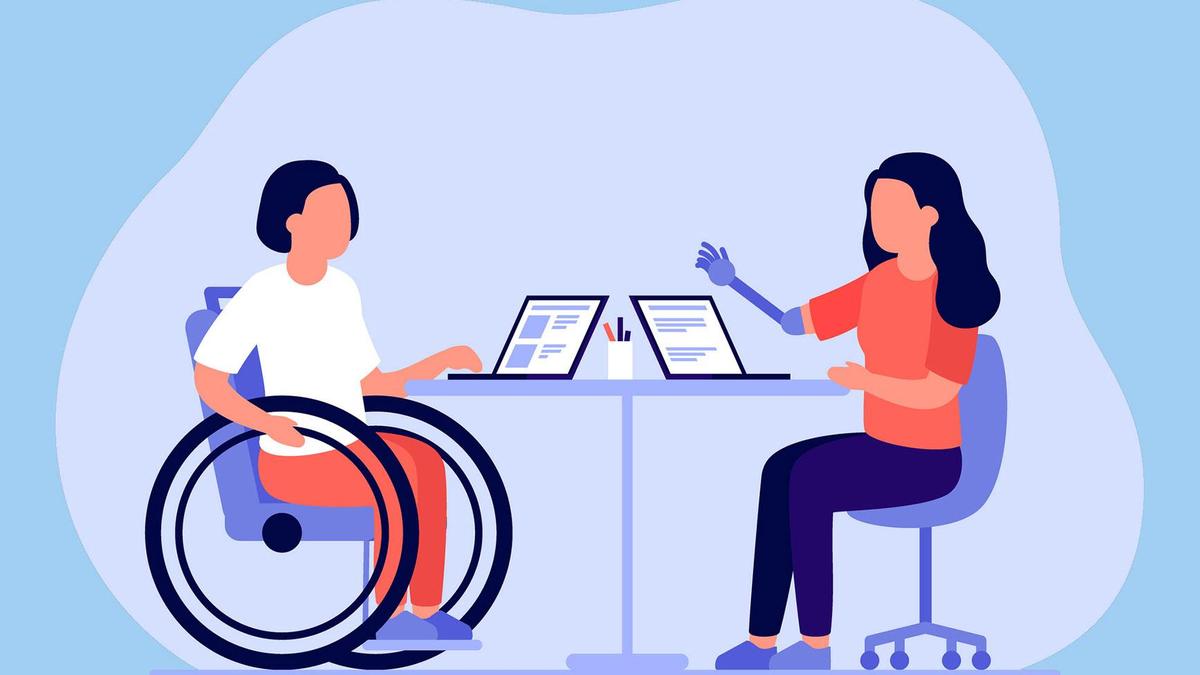

Sirisha K.V., has severe osteogenesis imperfecta, a genetic disorder causing brittle bones. The condition requires a person to help the 36-year-old out of a vehicle and into her wheelchair to go to her office in Chittoor, Andhra Pradesh. Since the disorder can cause bones to break easily she needs to be constantly careful while moving.
“While my office is mostly flat and there are lifts, I need support to access the toilet and to transfer into my wheelchair when I reach work. My company already had support staff in place to help persons with disabilities, and one of them was assigned to help me,” Sirisha said.
Emphasising that these reasonable accommodations at the workplace make it easier for her to work, Sirisha added that she never feels stressed at her job. “These accommodations have helped me explore my capability to its fullest,” she said.
Also Read: Persons with disabilities in India face widespread exclusion from healthcare, education and employment: Report
What are reasonable accommodations?
Under the Rights of Persons with Disabilities Act, 2016 ‘reasonable accommodations’ refer to the necessary and appropriate adjustments made to ensure that persons with disabilities can enjoy their rights equally with others.
This month marks nine years of the Act, and persons with disabilities say some progress has been made with regard to reasonable accommodations. The private sector, they note has been forthcoming with implementing reasonable accommodations at the workplace, which has to an improved quality of life and better mental health for persons with disabilities.
For 29-year-old Akshata Mali, from Maharashtra, who has visual impairment, adjustments made at her workplace, a private organisation, included a low-light section of the office with minimal direct lighting and a bigger monitor, all of which helped her work at her full potential, stay focused, and contribute more efficiently to the team. “For me, accommodations are not about special treatment—they simply create an environment where I can deliver my best work,” she added.
R. Srinvasan, 37, who is deaf, had asked for a sign language interpreter, Zoom meetings with transcripts and a camera and Microsoft Teams chat, to help with his work. “My colleagues were very supportive and understanding of my needs,” he said.
Another employee Roshan (name changed on request) who was diagnosed with Attention-Deficit/Hyperactivity Disorder (ADHD) recalls that his company gave him an accountability partner. Stating that executive dysfunction, a symptom in his invisible disability disrupts the brain’s ability to control thoughts, emotions and behavior, Roshan required work from home flexibility and noise cancelling headphones. “I was given an accountability partner to start out with and now with medication, I no longer require this accommodation,” he said.
Corporate lawyer and accessibility professional Amar Jain said that the private sector has formulated proper guidelines for reasonable accommodations. “While accessibility is something everyone has to be forthcoming about, reasonable accommodations pertain to persons with disability functioning on a par with any other person. In this area, multi-national corporations are doing quite well,” he said.

Enhancing, physical, mental health
Senior consultant, general medicine, Kauvery Hospitals, Chennai, K. Subha noted that when a person can work without stress about the impact of their work, it helps in a number of ways, including in in combating lifestyle diseases such as diabetes and hypertension, as chronic stress is a risk factor for both, and employee comfort boosts wellbeing.
Lakshmi Venkatraman, psychiatrist at Schizophrenia Research Foundation (SCARF), Chennai, said that when reasonable accommodations are made, it significantly improves the quality of life at work, as well as mental health. “From flexible work timings to conducive environments, these accommodation correlate not just to strengthening productivity but also mean that employees with disabilities are more likely to stay longer at their companies,” she said.
Research has indicated that there is a strong link between finances and mental health: financial strain can impact mental health, while financial independence can improve mental health outcomes, making the provision of reasonable accommodations crucial to help enable persons with disabilities function to their full potential at work, said experts.

Sandhya Ramesh, head of diversity, equity and inclusion, Godrej Consumer Products Limited, said that the company worked over two years to strengthen systems for persons with disability. “We ensure that there is an extended period of time given to them when they are relocating from another city or State, we help with finding disabled-friendly accommodation; for the hearing impaired, we have lights in our alarm systems at our Chengalpattu factory and we have also introduced a safety watch that vibrates,” she said. Apart from ensuring there are fulltime sign language interpreters, the company also sensitised employees about disabilities and appointed liaison officers to ensure that further needs could also be taken care of.

What needs doing
The government sector, however, is lagging behind. “The guidelines aren’t there for reasonable accommodations and hence, there may not be any liaison officers to look at the needs of a person with a disability. The knowledge about it is also lacking. There needs to be strong employee-employer understanding and bureaucratic bottlenecks have to be removed for employees to be able to access such reasonable accommodations,” Mr. Jain pointed out
P. Rajasekharan, co-founder of v-sesh, an organisation that provides recruitment services for disability inclusion attributes this to the attitude of those in charge. “A lot of times, the workplace team leads have to be sensitised to ensure that persons with disability can carry out their work properly. Their reasonable demands can in fact be accommodated if there is the will to do so,” he said.
Echoing these sentiments, Raghuraman Kalyanaraman, assistant professor at Government Arts College, Nandanam, in Chennai, said that these accommodations first need to be seen as a means for a person to do their job to the best of their ability. “It is not charity; it is not a quota to be filled. Persons with disabilities have time and again proved that they can work without reasonable accommodations. But these accommodations are necessary to provide them with the best environment possible to work without stress.”
Published – December 20, 2025 10:00 am IST


