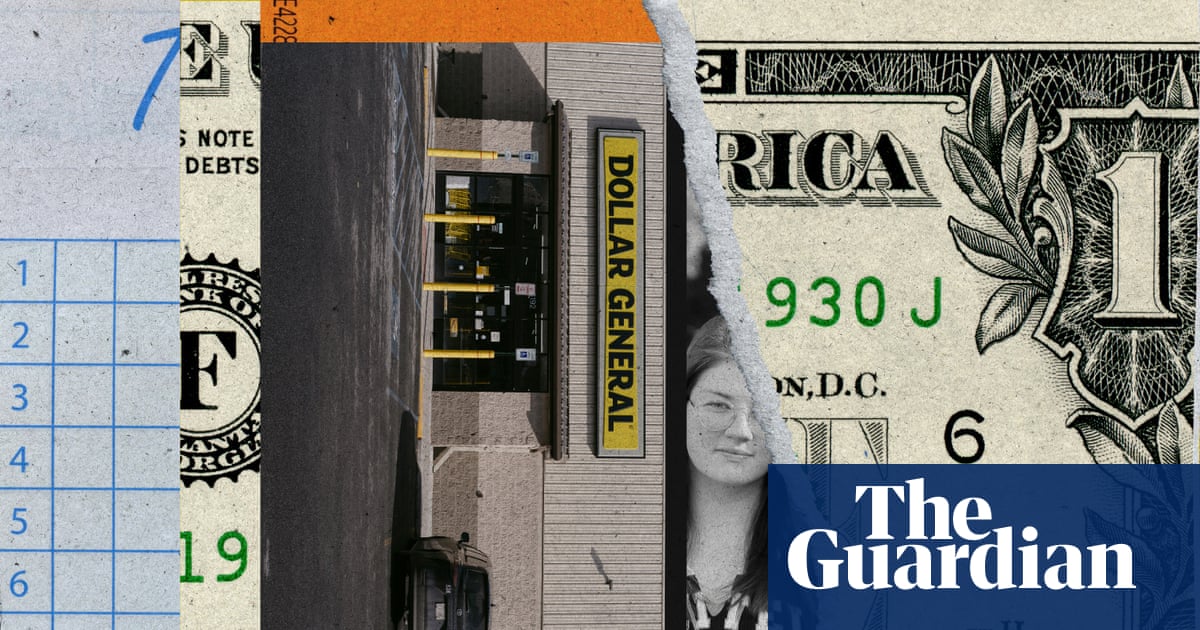

On a cloudy winter day, a state government inspector named Ryan Coffield walked into a Family Dollar store in Windsor, North Carolina, carrying a scanner gun and a laptop.
Inside the store, which sits along a three-lane road in a county of peanut growers and poultry workers, Coffield scanned 300 items and recorded their shelf prices. He carried the scanned bar codes to the cashier and watched as item after item rang up at a higher price.
Red Baron frozen pizzas, listed on the shelf at $5, rang up at $7.65. Bounty paper towels, shelf price $10.99, rang up at $15.50. Kellogg’s Frosted Flakes, Stouffer’s frozen meatloaf, Sprite and Pepsi, ibuprofen, Klondike Minis – shoppers were overpaying for all of them. Pedigree puppy food, listed at $12.25, rang up at $14.75.
All told, 69 of the 300 items came up higher at the register: a 23% error rate that exceeded the state’s limit by more than tenfold. Some of the price tags were months out of date.
The January 2023 inspection produced the store’s fourth consecutive failure, and Coffield’s agency, the state department of agriculture & consumer services, had fined Family Dollar after two previous visits. But North Carolina law caps penalties at $5,000 per inspection, offering retailers little incentive to fix the problem. “Sometimes it is cheaper to pay the fines,” said Chad Parker, who runs the agency’s weights-and-measures program.
The dollar-store industry, including Family Dollar and its larger rival, Dollar General, promises everyday low prices for household essentials. But an investigation by the Guardian found that the prices listed on the shelves at these two chains often don’t materialize at checkout – in North Carolina and around the country. As the cost of living soars across America, the customers bearing the burden are those who can least afford it – customers who often don’t even notice they’re overpaying.
These overcharges are widespread.
Dollar General stores have failed more than 4,300 government price-accuracy inspections in 23 states since January 2022, a Guardian review found. Family Dollar stores have failed more than 2,100 price inspections in 20 states over the same time span, the review found.
Among these thousands of failed inspections, some of the biggest flops include a 76% error rate in October 2022 at a Dollar General in Hamilton, Ohio; a 68% error rate in February 2023 at a Family Dollar in Bound Brook, New Jersey; and a 58% error rate three months ago at a Family Dollar in Lorain, Ohio.
Many of the stores that failed state or local government checks were repeat violators. A Family Dollar in Provo, Utah, flunked 28 inspections in a row – failures that included a 48% overcharge rate in May 2024 and a 12% overcharge rate in October 2025.
The chains’ pricing disparities are drawing increasing attention. In May, Arizona’s attorney general announced a $600,000 settlement to resolve a consumer-fraud investigation against Family Dollar. In October, Colorado’s attorney general settled with Dollar General for $400,000 after its stores failed 15 out of 23 state inspections. Dollar General has also settled with New Jersey, Vermont and Wisconsin, and both companies have settled with Ohio.
Linda Davis, a 64-year-old Family Dollar shopper in Dayton, Ohio, called the state attorney general’s office in February after walking home from the dollar store and discovering that 12 of her 23 purchases had rung up incorrectly. “I’m adding it up in my head as I’m shopping,” she told the Guardian. “But I was way off and I didn’t know why … I thought: Where did I miscalculate? I’ve [only] got so much cash on me.”
Davis, who lives on Social Security, said she could shop elsewhere, but that would involve paying for a bus ride. “I don’t have money like that,” she said.
Both Family Dollar and Dollar General declined interview requests and did not answer detailed lists of questions from the Guardian. Instead, both sent the Guardian brief statements.
“At Family Dollar, we take customer trust seriously and are committed to ensuring pricing accuracy across our stores,” the company said. “We are currently reviewing the concerns raised and working to better understand any potential discrepancies. We continue to be focused on providing a consistent and transparent shopping experience.”
Dollar General said it was “committed to providing customers with accurate prices on items purchased in our stores, and we are disappointed any time we fail to deliver on this commitment”. In one court case in Ohio, Dollar General’s lawyers argued that “it is virtually impossible for a retailer to match shelf pricing and scanned pricing 100% of the time for all items. Perfection in this regard is neither plausible nor expected under the law.”
The Guardian’s examination of inspection failures by the two chains was based on record requests to 45 states and more than 140 counties and cities in New York, Ohio and California, along with court documents and public databases.
In nearly half of US states, information about whether customers are being overcharged was limited or unavailable. Many states do little or nothing to monitor retail stores’ pricing practices. Some, like Maryland, Idaho and Washington, do no random inspections, responding only to consumer complaints. Illinois, South Carolina and others don’t inspect at all. In 2020, auditors in Kansas revealed that these inspections were a low priority in many states. “Consumers can check price accuracy themselves,” they wrote.’
Even in states with tougher enforcement, financial penalties don’t always solve the problem: In the 23 months after Dollar General agreed in November 2023 to pay Wisconsin $850,000, its stores failed 31% of their price inspections. During the same period, Wisconsin’s Family Dollar stores failed 30% of their state inspections.
According to industry watchers, employees and lawsuits, overcharges often stem from labor practices within the dollar-store sector. When a company changes prices, the registers are updated automatically. But the shelf prices are not: someone needs to remove the old labels manually and replace them with new ones. In an industry known for minimal staffing, workers don’t always have time to put up the new shelf tags.
In many instances, customers may not notice that they are being charged more than what’s listed on the shelf. If they notice at the register, they may decide to put those items back – or ask a store employee to honor the shelf price.
Dollar General, in its statement, said its store teams “are empowered to correct the matter on the spot”. But customers and current and former employees said that while some dollar stores will correct the price, others refuse to make fixes at the register – and turn away customers who return later and request a refund.
“Overcharging even by a small amount per item can strain a really tight budget,” said Elizabeth M Harris, acting director of the New Jersey division of consumer affairs. “If you’ve ever gone into any store … with a child like I have, there’s chaos at the checkout counter and you’re not really paying attention.” With items being rung up quickly, she added, “consumers are trusting that the retailer is actually charging them the price that’s displayed.”
Her state settled in 2023 with Dollar General for $1.2m after finding more than 2,000 items rung up as overcharges across 58 stores.
Even if the overcharges paid by dollar-store customers are accidental, they still reflect the industry’s decision not to correct a problem it has known about for years, according to Kennedy Smith, a researcher at the non-profit Institute for Local Self-Reliance, which works to protect communities from negative impacts of big corporations.
“If they’re called on it, they’ll say, ‘Oh yeah, our mistake,’” Kennedy said. “Until they’re called on it, they’re happy to let those scanner errors bring in the millions.”
‘The cheap stuff’
When consumers feel economic pain, as they do now thanks to rising costs exacerbated by tariffs, price gouging and other inflationary pressures, one place they turn to are dollar stores. These one-stop centers for inexpensive food, clothing and housewares tend to sell in small quantities, one $1 chicken-noodle-soup can at a time. And they are relatively easy to get to: 75% of Americans live within 5 miles of a Dollar General, according to the company.
The industry’s largest player is flourishing. Todd Vasos, the CEO of Dollar General, told investors in August that his company’s quarterly sales had increased 5% over the same period last year. Some of that growth, he said, came from middle- and higher-income shoppers tightening their belts. But the company’s low-income “core customers” were spending more at the chain too.
Those customers have been the industry’s niche from the beginning. When a 48-year-old former tobacco farmer and traveling salesman named James Luther Turner opened JL Turner and Son Wholesale Dry Goods, Shoes, Notions and Hosiery in Scottsville, Kentucky, in 1939, his mission was “to sell the cheap stuff to the poor folks”. (Someone else had cornered the market on “selling the good stuff” to Scottsville’s rich folks.)
By 1955, Turner and his eldest son, Hurley Calister “Cal” Turner Sr, were overseeing 36 stores in small southern towns. Cal Sr decided that year to co-opt the “Dollar Days” sales at big department stores and to open outlets featuring a single low price of $1. Adopting a name that nodded to the general store, he designed a bold black-and-yellow sign and that June christened the first Dollar General in Springfield, Kentucky.
Dollar General now operates over 20,000 stores in 48 states – more than any other retailer of any kind in the US. (It has long since abandoned its $1 price limit.) Though it has more than 195,000 employees and net sales of $40.6bn, the company still calls itself “America’s neighborhood general store”.
Family Dollar began in 1959 in Charlotte, North Carolina, and now operates 8,000 stores nationwide. For most of the past decade, it was owned by yet another chain, Dollar Tree, but the two brands divorced last summer.
What Dollar General and Family Dollar have in common is a conspicuous presence in places that don’t offer a lot of other retail: low-income urban neighborhoods and rural towns like Windsor.
A predominantly Black county seat of 3,400 on North Carolina’s coastal plain, Windsor used to be a retail hub. “All the streets were full on a weekend,” recalled Russell Parker, a 66-year-old retired pilot. “There were people everywhere, people playing music.” And people spending money: at the fish market, the cobbler, the independent groceries, the automotive-supply store. But today Windsor’s downtown – like many rural main streets – is pocked with empty storefronts. The town never fully recovered from Hurricane Floyd, in 1999. “Every young person that graduates from high school gets on the first thing smokin’ to somewhere else,” Parker said.
One supermarket remains on the edge of town. Shopping for clothes often means driving to the next county, at least for those who drive. But Windsor does have three stores that help fill the gap: a Dollar General and two Family Dollars.
At the Family Dollar that failed multiple inspections, some regulars remain vigilant. Chris Outlaw, a 54-year-old hemodialysis technician, shops there because it’s near his house and workplace. Experience has taught him to buy only a few items at once and to examine his receipts. Not all his neighbors do the same. “I’ve seen people in there with baskets full,” he said. “You can just imagine how much of that stuff didn’t ring out right, and they had so much they couldn’t catch it.”
‘Big old savings’
Customers walking into Dollar General stores are often greeted by a bright yellow sign blaring “Hello, Low Prices”– and by as many as 10,000 items cramming shelves and, often, cluttering the aisles.
“They will send you more than what you need of any product,” said Stephanie, a former lead sales associate in Louisiana. “Your shelf can only hold 10 Glade air fresheners, right? But they will send you 50.”
Rarely is there enough staffing, current and former employees say, to complete all of the tasks expected of them, including stocking shelves, ringing up sales, looking out for shoplifters, mopping floors – and updating price changes and sales stickers.
More than two dozen current and former employees of the chain in 15 states interviewed by the Guardian agreed that price discrepancies are the byproduct of the company’s employment policies. (Most, including Stephanie, spoke on the condition of anonymity because of fear of retaliation.)
Often there are only one or two people on duty. “You’re lucky if you get to work two to four hours of your eight- to 13-hour shift with another human being,” a former assistant manager in Illinois said.
Every Tuesday, employees are supposed to print and post hundreds of shelf stickers representing price changes already updated in the computer system. On Saturdays, stacks of sales stickers arrive; often, workers are expected to remove all the previous week’s stickers by 5pm and put up new stickers – as many as 1,000 of them – before closing up that night. Stickers fail to get put up, they fall off easily, and they are confusing, with some sales instant and others linked to coupons. “I threw away tags sometimes, to keep me or a coworker out of trouble,” Stephanie admitted.
A former store manager at a Dollar General in Connecticut noted that many of his customers were poor or disabled enough that they got by on public assistance. “I didn’t want people to get screwed over, but I knew that it was happening,” he said. “If I’m in the store, I’m gonna try to do the best I can for them. But at the end of the day, they’re still probably gonna get overcharged for a few things.”
Dollar General, in its statement, said it schedules time each week for “price change execution”, among other measures to ensure accuracy.
Ten current and former employees in eight states claimed that – along with allowing pricing errors caused by understaffing and overstocking – some Dollar General stores engage in a tactic designed to fool customers: special sales that don’t actually lower the price of an item. A manager from Florida, for example, sent the Guardian two photos of price stickers for Café Bustelo ground coffee. In the first photo, a sticker said “SALE” in white block letters against a red background. It advertised a markdown from $7.95 to $6.50. In the second photo, the top sticker had been peeled away to show the original price: $6.50.
A sales associate from Illinois sent photos showing cutlery with what he said was a fake original price of $8.50. “It’s trying to say that you’re making this big old savings by buying this item here,” explained the employee, “when it’s actually always been $6.95.”
Dollar General declined to comment on these workers’ claims.
‘We have little choice’
When the Ohio attorney general, Dave Yost, sued Dollar General in 2022, he submitted 114 pages of customer complaints as part of the case.
One of them came from Melanie Hutzler, who lives in Canton without a car and whose mobility is limited by arthritis and multiple sclerosis. Hutzler, 51, relies on government food assistance and said she was cautious about spending money. At the time of her complaint, she could reach two food stores on foot. Getting to the Save A Lot grocery required crossing a busy road, but getting to a Dollar General did not.
“Every single time we went into that store, something would ring up wrong,” she told the Guardian. “They never had a manager there that would fix the prices.” Hutzler said she would walk the cashier over to the shelf and point out the listed price, only to be told, “There’s nothing we can do about it.”
Other Ohioans expressed similar frustrations. “My 87-year-old mother and I have frequented Dollar General for years, and there have been innumerable times we have made purchases that were well higher than advertised,” wrote Robert Hevlin of Dayton. “My mother and I have literally lost thousands over the years with this company, but both of us being on Social Security, we have little choice in where we shop.”
In September 2023, Yost reached a $1m settlement with Dollar General, which he said had error rates at some stores that ran as high as 88%. In February 2024, he announced a $400,000 settlement with Family Dollar to resolve similar allegations. Most of that money went to charitable organizations that distribute food and personal-care items.
Both chains agreed in the settlements to tighten their pricing practices. Yost’s office continues to receive complaints. A Dollar General customer in Garfield Heights said in February that he was charged $6.35 for a carton of eggs with a shelf sticker of $5.10, but the “cashier was too busy having a personal call on her cell phone to address the price discrepancy”. The same month, a Family Dollar shopper in Genoa reported being charged $2.65 for cough medicine listed on the shelf at $1.50. “I was told by the cashier that there was nothing that could be done about it,” the complaint said.
Over in Missouri, state officials are pursuing a lawsuit that accuses Dollar General of “deceptive” pricing practices. The suit, filed in 2023, says 92 of the 147 stores the state checked failed their inspections, with discrepancies as high as $6.50 an item.
The companies declined to comment on these state lawsuits.
Dollar General has also been hit with private lawsuits, including several filed by its shareholders. In a document filed in August in federal court in Nashville, lawyers for Dollar General investors argued that understaffing, poor inventory control and overcharging were all interrelated.
The investors allege that the company deceived them by portraying itself as financially sound. In truth, the court filing says, “Dollar General’s inventory management processes were broken, which caused a massive bloat of excess product to clog the company at both its distribution centers and stores, and its workforce had been slashed.” These problems gave rise to price discrepancies and other “dire consequences”, the court filing asserts.
The filing includes the stories of 36 former employees who claimed direct knowledge that Dollar General managers and executives knew about the problems. Several reported notifying the top leadership directly. “All the prices were off in the stores,” said one of those ex-employees, a manager who monitored inventory levels in Ohio and Pennsylvania. She claimed to know firsthand, based on calls she participated in, that company vice-presidents and regional directors were aware of the “huge” price mismatches.
Dollar General, in response, said that the testimony of a handful of ex-workers does not prove that it misled investors. In their “years-long search for fraud”, the company’s lawyers claimed, the shareholders “came up empty”.
Earlier this year, a federal judge in New Jersey halted a class-action lawsuit against Dollar General filed by a shopper who said he was overcharged for groceries. Dollar General argued that when customers create accounts – for example, by downloading the company’s mobile app – they agree to use arbitration to resolve disputes and forfeit the right to file class-action suits. The judge agreed.
This victory for Dollar General threw up an obstacle for customers seeking justice. “Who’s going to bring a consumer arbitration with a $225 filing fee over a 50-cent overcharge?” asked Marc Dann, a former Ohio attorney general whose law firm filed the New Jersey case. “They’ve essentially closed the door to the courthouse to people.”
Dann’s firm did reach a settlement with Dollar General in another case this fall, though the details have not been made public.
‘This endless cycle’
The dollar-store chains describe themselves as mission-driven companies. “Our stores are conveniently located in neighborhoods, and often in ‘food deserts’ where other stores choose not to locate,” Family Dollar says on its website. Dollar General takes pride in offering value to families who, according to CEO Vasos, “have had to sacrifice even on the necessities”.
The industry’s critics say the cause and effect are reversed. “Dollar stores are often seen as a symptom of economic distress,” said the Institute for Local Self-Reliance’s co-executive director, Stacy Mitchell. “What we found is that they’re, in fact, a cause of it.” Sometimes, she said, a chain dollar store will open near an independent grocer and skim off enough of its business that it is forced to close. That limits the availability of fresh produce and forces shoppers to buy more packaged and processed foods.
In a statement, Dollar General said its stores often “operate along with local grocers and business owners to collectively meet customers’ needs”. It added that 7,000 of its 20,000 stores sell fresh produce and that the company also partners with local food banks “to further help nourish our neighbors in need”.
The people enduring the effects of hollowed-out local economies – and getting hit with overcharges at dollar-store chains – include residents of Essex county, New York. The county, tucked among the stately pines of the Adirondack Mountains, has a population of 37,000. It has five Dollar Generals and two Family Dollars. All seven regularly fail pricing-accuracy tests. The Dollar General in Port Henry, which sits on the shores of Lake Champlain, was fined $103,550 for failed inspections between November 2022 and June 2025.
Over the course of seven inspections, 279 out of 700 tested items were overcharges – a combined error rate of just under 40%. One inspection yielded a 78% error rate, including overcharges on Flintstones vitamins, Peter Pan peanut butter and Prego pasta sauce.
The Port Henry store is 5 miles from the Mineville Dollar General, which occupies a lonely stretch of country road across from an auto-repair shop with spare parts littering its lawn. Down the block, an abandoned church presides over a stretch of grass that looks like it hasn’t been mown for years.
Aside from a whiskey warehousing operation and a health center, opportunities for employment are limited. The high-security prison built atop the iron mine for which Mineville is named closed in 2022, taking 100 jobs with it.
The local playground is littered with trash, cigarette butts and the occasional syringe. The town “is nice from the outside”, said Kaitlyn Miller, a 26-year-old Port Henry resident who lives with her mother, six-year-old daughter and two-year-old son. But “you hear about a lot of crack-den places, like blowing up or getting busted.’” Drug use is rampant in the county, which is 92% white. “Everybody around here seems to be on pain meds or buying someone else’s, because they’re also working themselves to death.”
When it comes to grocery shopping near Miller’s home, the choice is between the two Dollar Generals and a gas station/convenience store. “We live in a food desert,” she said, “even though you would think living in all this farmland, we would have more access.”
There is a Walmart 30 minutes away, in Fort Ticonderoga. Miller said she recently bought salmon there only to arrive home and discover that the $20 piece of fish had gone bad. “So I had to go to Dollar General and get the Stouffer’s,” she said, adding that she feels “caught in this endless cycle of never having food that will nourish me and my family, and instead having to get 2,000 grams of sodium because at least it has meat”.
The region’s economic straits put regulators in a bind when it comes to overcharges. Daniel Woods, the county’s director of weights and measures, said in 2023 that he didn’t always assess the full penalty on violators. “We’re not trying to put people out of business,” he told a local newspaper. “In some towns that’s their [only] store. I don’t want to pull that away from people, but at the same time, I’m trying to fix the problem.”
On the way out
When Coffield, the North Carolina inspector, visited the Windsor Family Dollar in April 2023, the pricing issues seemed to have abated. Of the 300 items he scanned, he only found five overcharges: incontinence pads, laundry sanitizer, two coffee products and, again, Red Baron pizza. With an error rate below the state’s 2% threshold, the store passed its inspection, and it did so again in November 2024.
But customers still reported problems. Chris Outlaw, the hemodialysis technician, stopped by the Family Dollar earlier this year and noticed a sale: a $1.25 savings on five bags of Cheez Doodles. He bought them but discovered on the way out that he had been charged the regular price. The manager refused to refund the difference, Outlaw said, because he had already walked through the exit door.
Another time, he saw some discounted socks near the counter that he thought would make good Christmas gifts. “I was like, ‘Oh, I like these socks, so I’ll probably give them to somebody,’” he recalled. “Nice, plushy socks.” But they rang up at a higher price, so he left the store without them.
During a visit in August, a Guardian reporter found the Windsor Family Dollar closed for much of the afternoon. “Be Back Soon!” read a handwritten sign taped to the door. Two waiting customers said that they frequently paid prices higher than the shelf listing, including a cook whose nearby restaurant buys some of its ingredients there. “It is aggravating,” she said. “Very aggravating.”
Workers reopened the doors after a few hours. Inside, carts of unshelved dog food and other merchandise blocked the aisles. The Guardian compared the prices of 15 items. Two of them rang up higher than advertised, including a frying pan set that was $10 on the shelf and $12 at the register. Though the cashier offered to honor the lower prices, that was still an error rate of 13% – more than six times the state’s standard.