



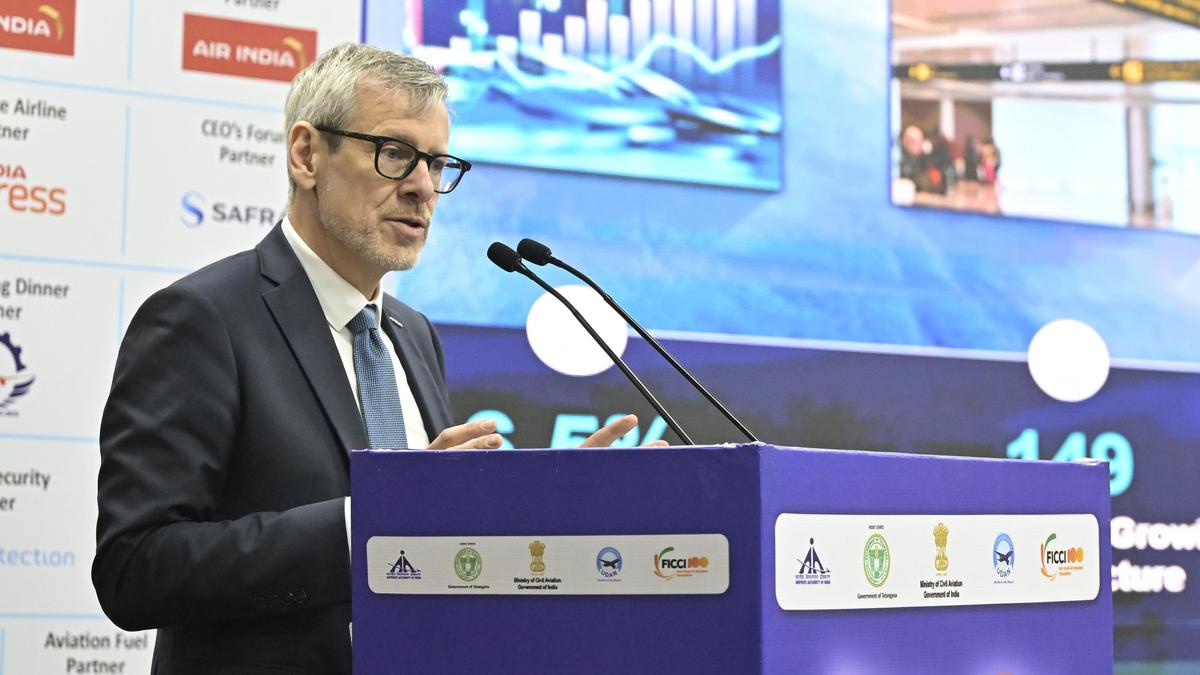

Jürgen Westermeier, president and MD, Airbus India & South Asia, addresses a media briefing on the Indian aviation market at Wings India 2026 at Begumpet Airport in Hyderabad on Thursday (January 29, 2026)
| Photo Credit: SIDDHANT THAKUR
India is projected to emerge as the world’s third largest aviation market within the next decade, driven by rapid fleet expansion, rising passenger demand, infrastructure growth and deepening industrial capabilities, Airbus said on Thursday (January 29, 2026).
Addressing a press briefing at Wings India 2026, Jürgen Westermeier, president and managing director of Airbus India and South Asia, described India as one of Airbus’ most critical global markets. More than 10% of the company’s annual aircraft production is already delivered to India. “This is expected to grow further as the country’s aviation ecosystem expands at scale,” he said.
Currently the fifth largest aviation market, India is projected to rise to third place globally over the next 10 years, with a compound annual growth rate of 8.9%. Airbus estimates that trips per capita will double from 0.13 to 0.27 during this period, translating into around 400 million trips originating from India.
850 aircraft in India currently in service
Over the past decade, the number of operational airports in India has more than doubled to around 150, backed by sustained government investment in aviation infrastructure. The sector is supported by a workforce of about 23,000 professionals. Airbus, however, described India as still a ‘nascent market’, with only 850 aircraft currently in service and relatively low air travel penetration compared with other regions.
Over the last 10 years, India’s fleet has doubled to 850 aircraft, while the number of routes has tripled. “Looking ahead, more than 1,700 aircraft are on order by Indian carriers, with Airbus accounting for 72% of the backlog, or 1,248 aircraft. Indian airlines have also strengthened their position in international traffic, which now stands at 47%, nearly 10% higher than a decade ago,” Mr. Westermeier said.
Fleet, capacity and cargo expansion
To accommodate future demand, the number of airports in India is expected to increase to around 200 over the next 10 years. The country’s fleet is projected to triple to about 2,200 aircraft, pushing annual passenger capacity beyond 450 million seats, nearly four times current levels. Capacity growth will be driven not only by an increase in aircraft numbers but also by the induction of higher-capacity aircraft such as the A321 and additional widebody jets.
With regards to cargo, Airbus estimates that annual freight capacity of Indian carriers will exceed 5,000 kilotonnes over the next decade, nearly three times present levels.
MRO and services market to triple
The rapid expansion of fleets will boost the maintenance, repair and overhaul sector. Airbus projects India’s MRO market to grow from $3 billion today to $9.5 billion over the next 10 years, spanning airframe, component and engine services. “Airbus is committed to supporting the development of an indigenous MRO ecosystem through training, provision of materials and tools, consulting services and partnerships with regional players,” Mr. Westermeier added.
Training and workforce requirements
By 2035, India is expected to require around 35,000 pilots and a similar number of technicians. While the country currently has more than 40 flying schools, over 50 basic maintenance training schools and more than 30 full-flight simulators, additional training capacity will be necessary to meet future demand.
From sourcing to full aircraft assembly
Airbus also outlined the evolution of its industrial footprint in India in three phases. Between 2015 and 2020, the company leveraged Indian engineering and digital capabilities to deliver global services, reaching a sourcing volume of around $0.5 billion. In the second phase, the focus shifted to manufacturing parts and components within India. Over the past five years, production has scaled from detailed parts to complex components, including doors for the A220 aircraft.
The third phase marks a transition to full aircraft assembly. Airbus is establishing a final assembly line for the H125 helicopter, with its inauguration scheduled next month. In addition, the first Indian-made and assembled C295 aircraft is slated for delivery in the third quarter of 2026.
Published – January 29, 2026 03:59 pm IST