
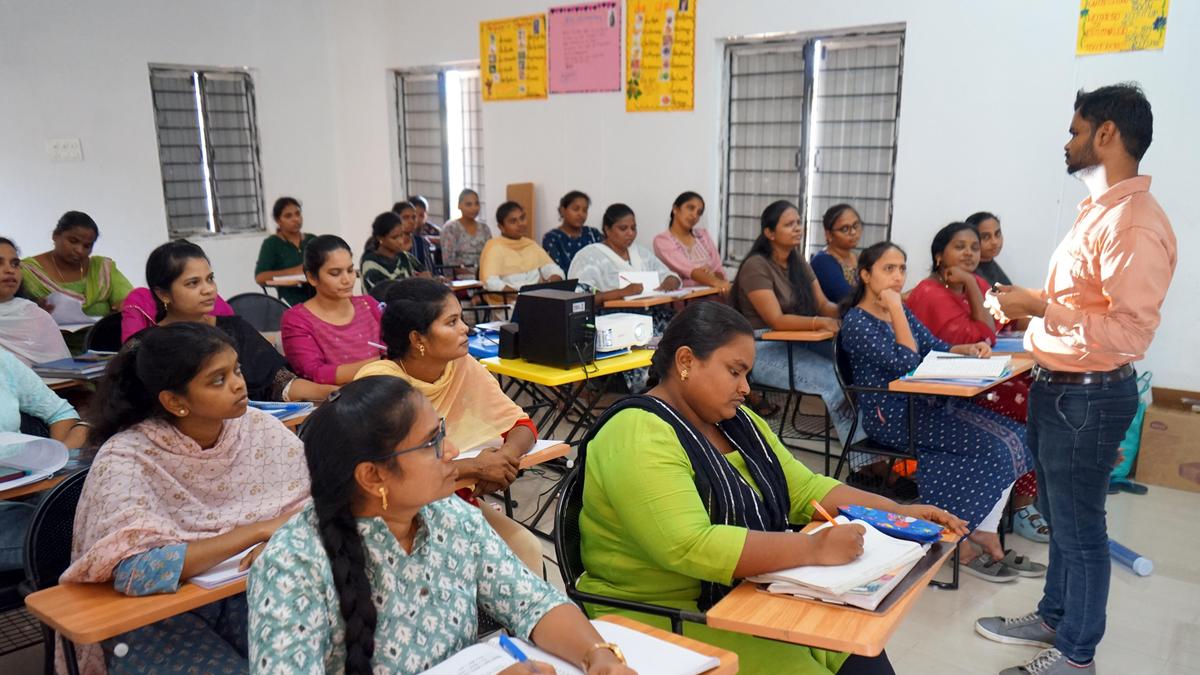

A quiet excitement wafts out of a classroom at the Government Nursing College in Guntur district in Andhra Pradesh. The students have their eyes glued firmly on the face of their teacher as she prepares a question. “Tell me what you’ve learnt so far in Deutsch (German).”
A symphony of voices emerges from the other side. With their eyes rolling in uncertainty and lips breaking into shy smiles, the students, many from poor families in the State’s hinterland, shape simple German sentences with visible effort. Laughter occasionally ripples through the room, as they share relief, pride and the joy of learning something profoundly new.
The young trainees are nursing graduates drawn from districts across Andhra Pradesh, learning German under the International Skilling programme rolled out by the State government, through A.P. State Skill Development Corporation (APSSDC) and its subsidiary, the Overseas Manpower Company Andhra Pradesh (OMCAP).
“It’s not easy,” admits G. Venkata Lakshmi, a native of Timmapuram village in Bheemunipatnam mandal in Visakhapatnam district. “But every new word feels like a step closer to my goal. I never thought I’d be speaking German,” says the 32-year-old, who packed her bags and headed to the nursing college in Guntur to attend German classes after working as a nurse at a private hospital in Visakhapatnam for a year.
G. Sandeep, a 35-year-old nursing graduate recently enrolled for German classes, hoping to secure employment in Germany. Back home at Jammalamadugu in Kadapa district, he has a 10-month-old son, his “bundle of joy,” whom he finds it almost impossible to part from. Yet, Sandeep says a well-paid job abroad seems like the only way out of the severe financial crisis his family is facing. “I hate the thought of going away from my family, but I have to do it for their happy and secure future,” he says softly.
Language breaks down barriers
As part of Skill International Initiative, the APSSDC and OMCAP have roped in partners like Indo Euro Synchronisation and Hallo Language Centre, to implement German training-linked international placement programme for nursing professionals in Andhra Pradesh.
The training is open for B.Sc, M.Sc Nursing students and post-B.Sc Nursing graduates with a minimum experience of six months. Hundreds of youths are being trained under this fully funded programme, which helps them secure placements in Europe, particularly in healthcare, hospitality and technical trades.
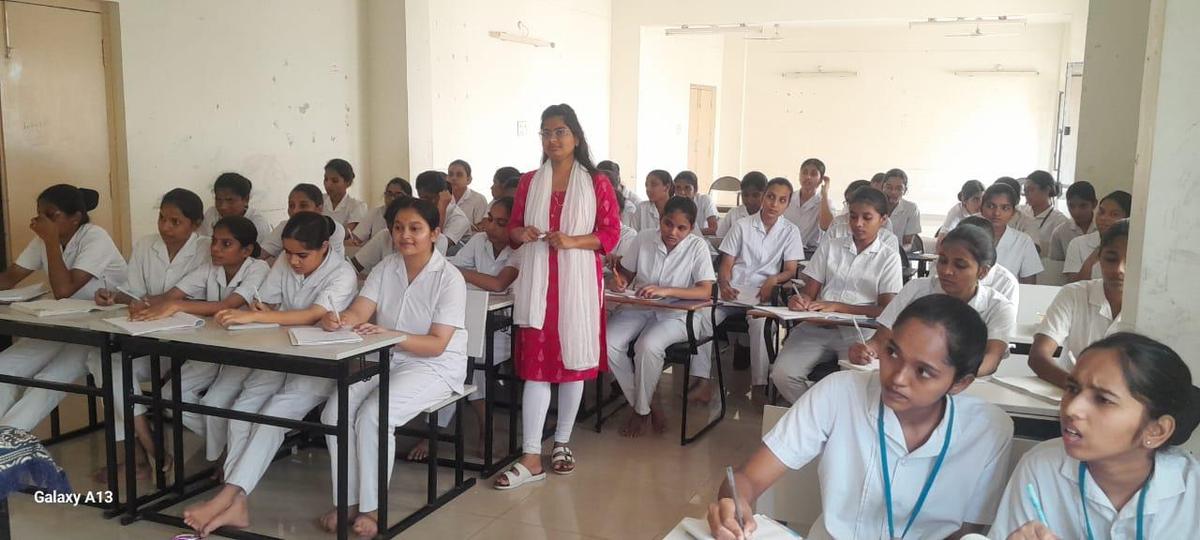
Students being taught German at the Government College of Nursing in Nellore district.
| Photo Credit:
T. Vijaya Kumar
APSSDC officials say it was initially difficult to convince nursing graduates to enrol for the Skill International Initiative. The Corporation’s Executive Director D. Manohar recalls the series of brainstorming sessions with college principals and training partners to understand what the State’s nursing graduates truly wanted and what held them back from considering overseas opportunities.
The discussions moved beyond logistical challenges and the team discovered that many young people hesitated at the thought of working abroad because of limited exposure to the idea. “We found that there was no real tradition of overseas placements, except in a few districts like Kadapa and East and West Godavari,” said the official, explaining that most youth didn’t know how to begin and some even feared how society might judge them.
To help them overcome their psychological barriers, the department printed pamphlets, organised awareness camps and officials travelled from one college to the other. Yet, the classrooms remained thinly filled until the idea of language became the bridge.
Realising that the language route would open new doors, the State launched in 2024 Project Vasudha, a German language training and placement programme for nursing graduates. “The results are encouraging. Out of the 50 nurses who completed training, 10 are already placed in Germany, and 2,713 more are undergoing language training,” says MD and CEO of the State Skill Development Corporation Ganesh Kumar.
To tap into the benefits of language proficiency, the government went a step further and, through G.O. No. 121 this year, directed all the 13 government nursing colleges in the State to include foreign language training in their B.Sc (Nursing) curriculum. Training in more languages like Italian, Japanese and English (OET/IELTS) would be included soon, the G.O. reads.
Challenges
Most candidates struggle with grammar and gender, two of the trickiest aspects of German, but Y. Divya, the language trainer at the Government Nursing College in Guntur district, says German is a “structured” language. “Once you understand its logic, it actually feels mathematical,” she adds.
“The problem is that in German, every noun has a gender—masculine, feminine or neuter,” says Y. Hyny, 27, a trainee from Bhimunipatnam. “But there are very few logical rules to rely on. So, in most cases, you just have to memorise them”.
Teaching a foreign language comes with its own challenges. Many of the candidates lack even a basic understanding of English grammar, which makes it difficult for them to grasp the nuances of German. As a result, the learning process is often slow and requires extra patience and guidance, explains Divya. The minimum marks to pass the exam is 60.
A significant number of trainees also drop out. Some lose interest or struggle to keep up with the lessons while personal or domestic problems force others to discontinue their classes.
Online training
Parallelly, Project Sarvasethu was launched to provide online German training to ITI students with the help of Indian diaspora professionals in Germany. Currently, 150 ITI students are learning German.
“At first, I thought learning German online would be schwierig (difficult), but now it feels spannend (exciting)!” chuckles U. Ramesh, an ITI student from Tekkali in Srikakulam district. He says it’s fun to see how his pronunciation is improving day by day. “My notebooks are filled with German words written beside Telugu meanings and my phone is full of recorded pronunciations,” he says.
V. Prajwala from Kalasapadu village in Kadapa district belongs to a batch of 30 young overseas job aspirants learning German at Social Welfare hostel opposite BR stadium in Guntur district. The 25-year-old feels that the authorities should spread greater awareness about overseas job opportunities to ensure better participation. “Neither I nor any of my friends knew about the initiatives of the Skill Development Corporation,” she admits.
Prajwala says she is determined to make the most of this opportunity to break the cycle of poverty that has burdened her family for generations. She adds that she knows many young nurses who want to learn German but are unable to quit their current employment and undergo the 8-month training owing to family and financial commitments.
Her friend, Matti Amruthavalli from Bhimavaram in West Godavari district, recently wrote her A1-level German exam and is confident of securing a decent score. “Despite facing serious financial hardships, my parents gave me everything they could, ensuring I never lacked what I needed. Now, it is my turn to give back to them,” she says.
Ganesh Kumar says that the State Skill Development Corporation has set up 192 skill hubs across the State, covering all the 175 Assembly segments. “Over the past year alone, around 4.1 lakh youth were trained in various sectors, equipping them with the skills needed to secure both white- and blue-collar jobs,” he says.
The Corporation’s quarterly job melas have so far led to the placement of 92,000 candidates in companies across the country.
Moreover, 100 Chief Minister’s Skill Excellence Centres (CM-SECs) in government and private engineering colleges and 485 Employability Skill Centres in degree colleges help students stay industry-ready.
Future plans
To expand their training programmes, the APSSDC and OMCAP have signed MoUs with 10 training partners and Letters of Intent with five organisations, forming a network that spans cities like Guntur, Tirupati, Visakhapatnam, Kurnool, Rajamahendravaram and Anantapur.
The Social Welfare and Tribal Welfare departments have also joined the initiative, with 155 candidates from marginalised communities currently undergoing specialised training.
Need for employment
After the bifurcation of Andhra Pradesh, there has been an overarching need to create fresh employment opportunities, as most industries remained concentrated in Hyderabad, the former capital. To bridge this gap, the State government has shifted its focus towards skilling the workforce for overseas employment, particularly in European countries that offer promising career avenues.
The Society for Employment Generation and Enterprise Development in Andhra Pradesh (SEEDAP), one of the largest skilling organisations in the country and the nodal agency for implementing various Union and State government skilling programmes, also organises comprehensive German training from Level A1 to B2, delivered by native German trainers. Of the two batches with 56 youth, 18 have been placed in Germany. “Another two batches with 60 youth are undergoing training,” says the Society’s Chief Executive Officer P. Narayana Swamy.
The government is keen on utilising this opportunity because nursing career in Germany includes high demand, diversified roles, competitive compensation and benefits, avenues for career progression, and a vibrant tapestry of cultural diversity, says Swamy.