

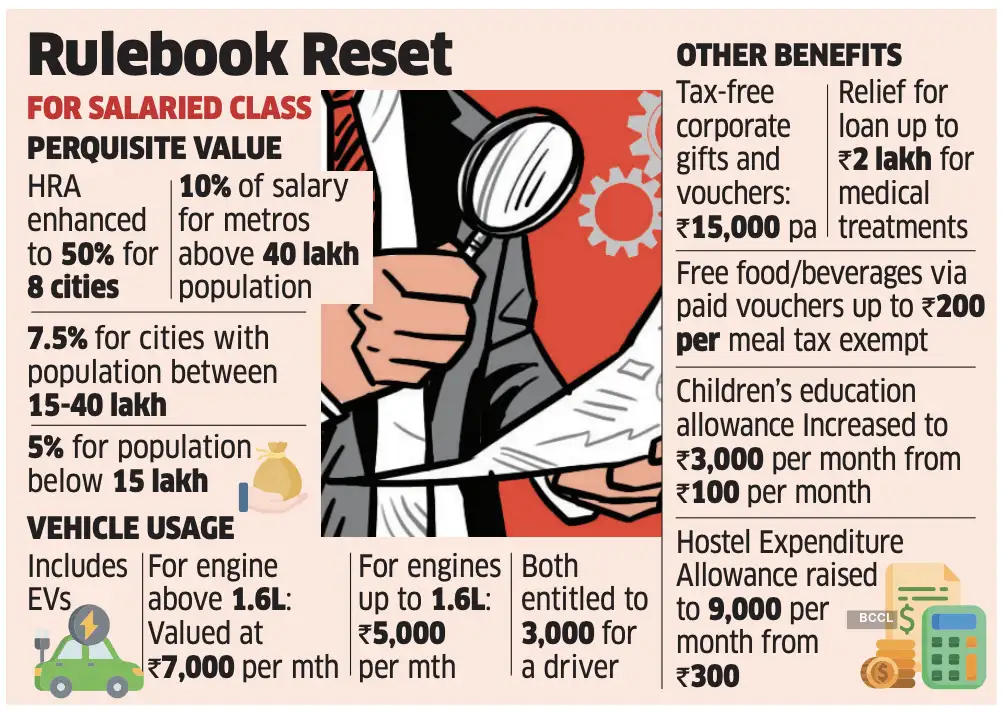
The rules have raised house rent allowance limits to 50% of salary in eight major cities including Mumbai, Delhi, Kolkata, Chennai, Hyderabad, Pune, Ahmedabad and Bengaluru, while mandating disclosure of landlord-tenant relationships.
They have expanded perquisite benefits, extending exemptions like food coupons and employer-provided cars to new tax regime, while explicitly including electric vehicles under the concessional valuation slab for employer-provided motor cars.
“The new rules should greatly help employers and employees, given the recalibrated and realigned limits for various employee perquisites and exemptions,” said SureshKumar S, partner at Deloitte India.

While these benefits are largely applicable for people in the old tax regime, employees under the new regime should also benefit, he said.
The framework has tightened disclosure requirements for salaried taxpayers, foreign portfolio investors and cross-border entities, placing greater onus on auditors and companies, signalling a shift toward a more compliance-driven regime aligned with global standards.
In a key change, the rules have introduced “hard thresholds” for professionals undertaking complex certifications such as fair market valuation and transfer pricing.
CAs must now have at least 10 years of experience, with minimum annual receipts of ₹50 lakh for individuals and ₹3 crore for firms.
Timelines for filing of tax deducted and collected at source correction statements have been reduced to two years from six, underscoring the push for faster processing and near real-time compliance.