Oil prices hold over $100 as Middle East conflict rages on: ‘A high stakes stalemate’
Oil prices held above $100 per barrel through Monday morning as key attacks from both sides of the Iran war targeted key infrastructure and showed no signs of an offramp for what has become the largest energy crisis since at least the 1970s. Futures on Brent crude (BZ=F), the international pricing benchmark, held above $100/barrel,…
Oil prices held above $100 per barrel through Monday morning as key attacks from both sides of the Iran war targeted key infrastructure and showed no signs of an offramp for what has become the largest energy crisis since at least the 1970s.
Futures on Brent crude (BZ=F), the international pricing benchmark, held above $100/barrel, while those on US benchmark West Texas Intermediate (CL=F) traded above $96.50 after cracking the key $100/barrel mark late Sunday night.
Over the weekend, key actions from both sides of the war pointed toward further escalation.
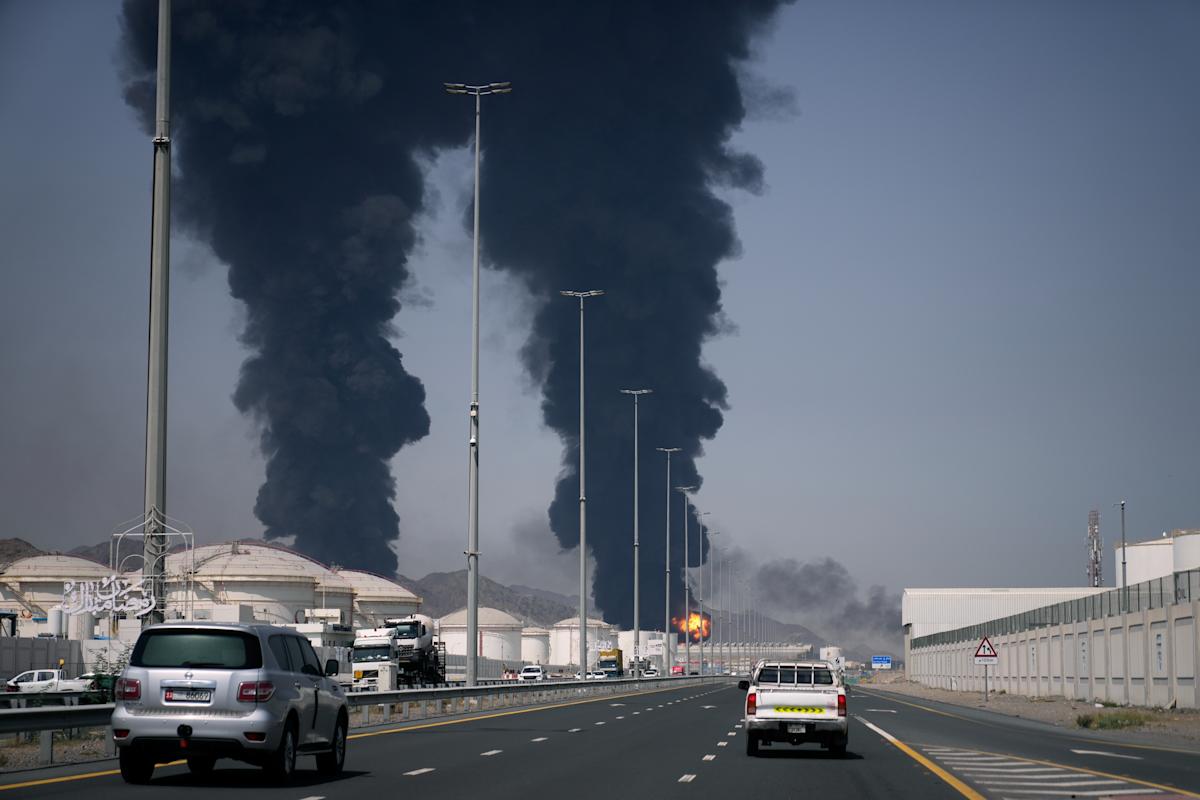
Late Friday night, the US struck a litany of military assets on Kharg Island, the Iranian regime’s primary oil export terminal, with threats to strike oil infrastructure on the island if the conflict continues. At the same time, drone strikes from Iran on Saturday and Monday have halted oil loadings at the key port of Fujairah in the United Arab Emirates as the conflict continues to threaten the wider Gulf region’s energy industry.
The Strait of Hormuz, the world’s most important shipping lane for oil, remains essentially closed to all but a handful of Indian LPG tankers that made the crossing over the weekend. President Trump through the weekend called for other world leaders to step up their own efforts to reopen the Strait of Hormuz, but those international partners have so far deferred on any concrete promises or actions.
Market sentiment has also been shaped by diplomatic developments, including reports that former President Donald Trump is working to assemble a coalition response to the crisis — even if early signs are that those efforts have been unsuccessful.
The sum of these factors has helped push prompt futures into steeper backwardation and lifted freight rates and insurance costs for vessels operating in the region, amplifying the upward pressure on benchmark prices.
In a client note on Monday, Morgan Stanley equity research director Martijn Rats announced that he has raised his oil-price forecast for the second quarter to an average of $110/barrel on Monday, up from $80/barrel previously. In the third quarter, he now sees an average of $90/barrel, up from $70/barrel.
“The result is a high stakes stalemate that markets are struggling to price,” Capital analyst Daniela Hathorn wrote in a client note Monday morning. “Energy flows remain significantly constrained, and as long as that persists, the risk of a prolonged global energy shock remains elevated.”
A plume of black smoke rises from an ongoing fire near fuel depots at the port of Fujairah. (Photo by Fadel SENNA / AFP via Getty Images) ·FADEL SENNA via Getty Images
Beyond geopolitics, the rally is increasingly feeding into broader macro expectations as central banks prepare to deliver key policy decisions this week.
Economists broadly expect the Federal Reserve, the European Central Bank, and the Bank of England to leave interest rates unchanged as officials assess how the energy shock from the Iran war could reshape the outlook for inflation and growth.
At the Fed, policymakers are likely to signal that higher oil prices have increased uncertainty around the US economic trajectory, with updated forecasts expected to show somewhat stronger inflation alongside softer growth and a modest rise in unemployment. While rate cuts are still anticipated later this year, economists say the latest surge in energy costs could delay the timing of easing.
In Europe, officials are expected to strike a similar wait-and-see tone. The ECB is likely to emphasize vigilance over inflation risks linked to the jump in energy prices while maintaining a data-dependent approach to policy. Meanwhile, the Bank of England is also expected to hold rates steady, with analysts now seeing rate cuts pushed further into the second half of the year as higher oil and gas prices cloud the near-term inflation outlook.
The evolving central bank response underscores how the oil market rally is now reverberating across global financial conditions, with investors watching bond yields and currency moves for clues about how long-term borrowing costs may remain elevated.
US Treasury yields have climbed in recent sessions as investors reassess the likelihood of near-term monetary easing, reflecting concern that sustained strength in energy prices could feed into inflation expectations even as growth risks mount.
Even still, investors may be underpricing the risk of potential growth slowdowns triggered by the economic fallout of the Iran war, Bank of America global economist Antonio Gabriel wrote in a client note Monday morning. Even as inflation concerns have risen alongside energy prices, which are likely to feed into headline inflation in the coming months, the US dollar has rallied, and US equities are less than 5% off their highs — bets that could be threatened by a drawn-out conflict.
“While a quick resolution to the conflict is certainly [possible], we view the conflict extending into 2Q as an equally likely outcome, and a more protracted war cannot be ruled out,” Gabriel wrote.
“Markets seem to be pricing a largely transitory shock … In our view, the more disruptive scenarios for global growth are underpriced,” he wrote.
Markets may be underpricing a more protracted war, according to Bank of America global economist Antonio Gabriel. ·Bank of America Global Research
Jake Conley is a breaking news reporter covering US equities for Yahoo Finance. Follow him on X at @byjakeconley or email him at jake.conley@yahooinc.com.
Click here for in-depth analysis of the latest stock market news and events moving stock prices
Read the latest financial and business news from Yahoo Finance