



When it comes to artificial intelligence (AI) hyperscalers, Oracle (ORCL 3.93%) is often overshadowed by its cloud services counterparts: Microsoft, Alphabet, and Amazon. While the “Magnificent Seven” members get most of Wall Street’s attention, Oracle has quietly built an impressive AI empire of its own over the last few years.
During the company’s fiscal third quarter (ended Feb. 28), Oracle’s revenue and earnings both grew at least 20%. This is the first time the company has achieved such growth in 15 years.
At the center of Oracle’s AI narrative is its remaining performance obligations (RPO), which now sit at $553 billion. The question smart investors are asking is whether Oracle really has a tidal wave worth half a trillion dollars waiting to come through its doors, or if this figure is a lofty moonshot.
Below, I’ll break down Oracle’s role in AI to help investors understand what’s fueling the company’s backlog. From there, a deep dive into the company’s most recent earnings report should reveal whether Oracle stock is poised for explosive growth.

Image source: Getty Images.
How is Oracle involved in AI?
Rather than building generative AI models and chatbots, Oracle has established itself as a critical enabler of AI infrastructure. The company’s roots in enterprise applications provide it with a natural advantage: Large corporations have a history of trusting Oracle with sensitive data. This makes the company’s segue into managing AI workloads a natural extension of its existing ecosystem.
The core pillar supporting the company’s AI ambitions is Oracle Cloud Infrastructure (OCI) — a full-stack suite of cloud services integrating compute power, storage, networking, and other services needed to train and deploy AI models.

Today’s Change
(-3.93%) $-6.11
Current Price
$149.41
Key Data Points
Market Cap
$430B
Day’s Range
$147.96 – $153.25
52wk Range
$118.86 – $345.72
Volume
889K
Avg Vol
27M
Gross Margin
64.30%
Dividend Yield
1.34%
AI infrastructure comes with a high price tag
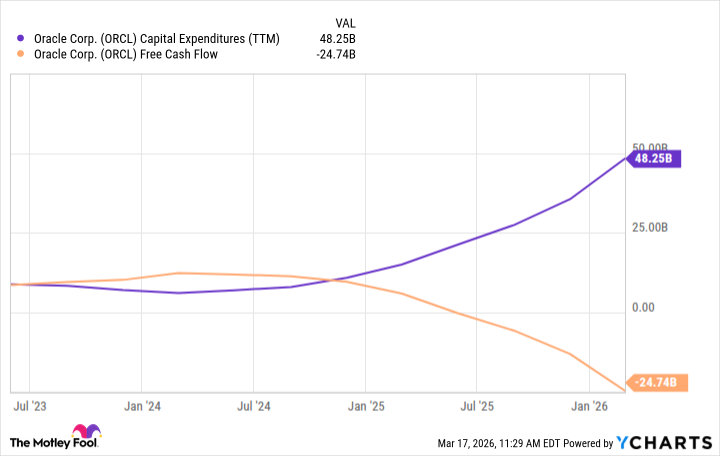
The primary risk in building the OCI platform is capital intensity. Building data centers, procuring clusters of graphics processing units (GPUs), and architecting power infrastructure requires enormous upfront investment.
Oracle has funded its AI projects through a combination of debt and reallocating cash flow from its legacy software businesses. The opportunity cost here is deliberate: Capital expenditures (capex) are rising sharply, placing pressure on free cash flow.
Data by YCharts.
Is Oracle’s $553 billion backlog real or fake?
While Oracle hasn’t revealed the specific breakdown of its backlog, industry reports suggest that some of the company’s landmark AI customers include start-ups such as xAI and OpenAI — the latter of which signed a $300 billion cloud deal.
Wall Street has identified two issues here. First, it would appear that Oracle’s backlog is highly concentrated among a small cohort of hyperscaler customers. Second, OpenAI in particular is nowhere near sustained profitability — calling into question whether the company can even fund its cloud commitments.
While these concerns make sense on the surface, Oracle’s latest earnings should put these fears to rest. Despite the impact surging AI expansion has on cash flow, Oracle’s revenue and earnings per share (EPS) are still growing at historic levels.
Smart investors understand that Oracle’s core margins across software remain healthy and scalable — providing the company with robust sources of cash to fund ongoing infrastructure build-outs. This model validates the company’s backlog as cloud revenue transitions into a higher-margin, recurring revenue engine for the business.
In the long run, Oracle’s backlog sets the stage for growing free cash flow — providing the company with a durable leadership position in the cloud infrastructure landscape after utilization fully comes online.