


The U.S. is currently home to 10 companies valued at $1 trillion or more. These are:
- Nvidia: $4.4 trillion.
- Apple: $3.8 trillion.
- Alphabet: $3.6 trillion.
- Microsoft: $3 trillion.
- Amazon: $2.3 trillion.
- Meta Platforms: $1.6 trillion.
- Tesla (TSLA +0.53%): $1.5 trillion.
- Broadcom: $1.5 trillion.
- Berkshire Hathaway: $1 trillion.
- Walmart: $1 trillion.
However, one of them is substantially more expensive than the rest when measured by a key valuation metric. Considering this company’s core business produced shrinking sales in each of the last two years, its premium valuation is increasingly difficult to justify.
That company is Tesla.
Investors have piled into the stock because the company’s future product platforms, like the Cybercab autonomous robotaxi and the Optimus humanoid robot, have enormous potential. But here in the present, 73% of the company’s total revenue still comes from its passenger electric-vehicle (EV) business, where demand continues to decline.
Here’s why I predict Tesla will drop out of the exclusive $1 trillion club before the end of 2026.

Image source: Tesla.
EV sales declined at an accelerated pace in 2025
Tesla delivered 1.79 million EVs to customers in 2024, which was a 1% decline from the previous year. But in 2025, deliveries came in at 1.63 million cars, which was an even sharper year-over-year drop of 9%. This dragged the company’s 2025 automotive revenue down by 10%, which contributed to a whopping 47% plunge in its earnings per share (EPS). Earnings typically drive stock prices, but more on that later.
Tesla’s EV sales could soften even further in 2026, as it plans to pull two of its premium cars (the Model X and the Model S) out of the lineup. This will allow the company to focus its efforts on cheaper, higher-volume models like the Model Y and the Model 3, which will improve its competitive position against some of China’s low-cost manufacturers like BYD (BYDDY +5.75%).
BYD currently sells its entry-level Dolphin Surf EV for under $27,000 in Europe, for example, whereas Tesla’s Model 3 starts at over $40,000. As a result, the Chinese brand has rapidly taken market share and even outsold Tesla globally in 2025 for the very first time.
The Cybercab and Optimus are a long way from commercialization
Tesla CEO Elon Musk doesn’t want to participate in a race-to-the-bottom price war in the EV business, so he’s shifting the company’s focus to autonomous vehicles and robotics instead. He unveiled the Cybercab robotaxi last year, which will use Tesla’s full-self-driving (FSD) software to autonomously haul passengers and even small commercial loads.
In theory, Tesla could build a ride-hailing network and deploy millions of Cybercabs, where they would produce a very high-margin revenue stream around the clock. By some estimates, this might be an even bigger financial opportunity than the passenger EV business. Cathie Wood’s Ark Investment Management, for instance, predicts robotaxis will generate a staggering $34 trillion in enterprise value by 2030 because they could offer consumers a very low-cost way to travel.
However, Tesla’s FSD technology is only approved for unsupervised use in Austin, Texas right now, and a broader rollout will take a significant amount of time due to strict regulations. The Cybercab is expected to enter mass production this year but might be grounded before it even hits the road without wider FSD approval.

Today’s Change
(0.53%) $2.09
Current Price
$398.82
Key Data Points
Market Cap
$1.5T
Day’s Range
$381.40 – $401.57
52wk Range
$214.25 – $498.83
Volume
4.2M
Avg Vol
65M
Gross Margin
18.03%
The size of the market opportunity for humanoid robots is less clear because it’s a brand new industry. However, by 2040, Musk thinks the number of robots like Optimus will exceed the human population because of their versatile applications in factories, offices, and households.
Tesla will ramp up production of Optimus over the next couple of years in its Fremont, California factory, where it will have spare capacity after phasing out the Model X and Model S EVs.
Tesla’s valuation opens the door to a significant correction
I mentioned earlier that Tesla’s earnings plummeted by 47% to $1.08 per share in 2025. According to conventional wisdom, Tesla stock should have suffered a sharp decline after its earnings took such a massive hit, but it hasn’t happened. This is problematic because its stock now trades at a sky-high price-to-earnings ratio (P/E) of 377.
That makes Tesla stock more than 11 times as expensive as the Nasdaq-100 index, implying it’s heavily overvalued, relative to a basket of its big-tech peers. The below chart displays the P/E ratios of all 10 American companies with valuations of $1 trillion or more and proves that Tesla’s valuation is in a completely different universe right now:
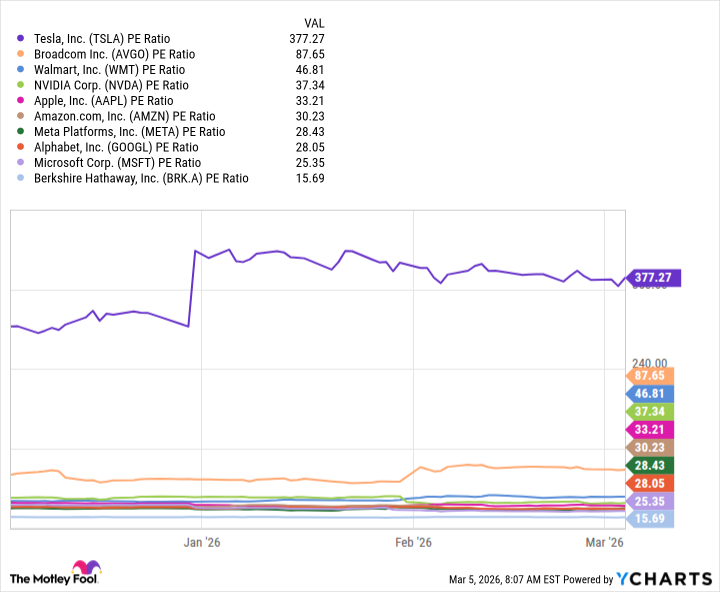
TSLA P/E Ratio data by YCharts.
Tesla stock would have to plunge by 77% from here just to trade in line with the next-most-expensive stock, Broadcom, which has a P/E ratio of 87. I’m not suggesting that will happen, but Tesla only needs to decline by 34% to drop out of the $1 trillion club. If its EV sales continue to shrink, or if investors sense delays to the Cybercab and Optimus product rollouts, I think a decline of that magnitude is certainly possible during 2026.
