

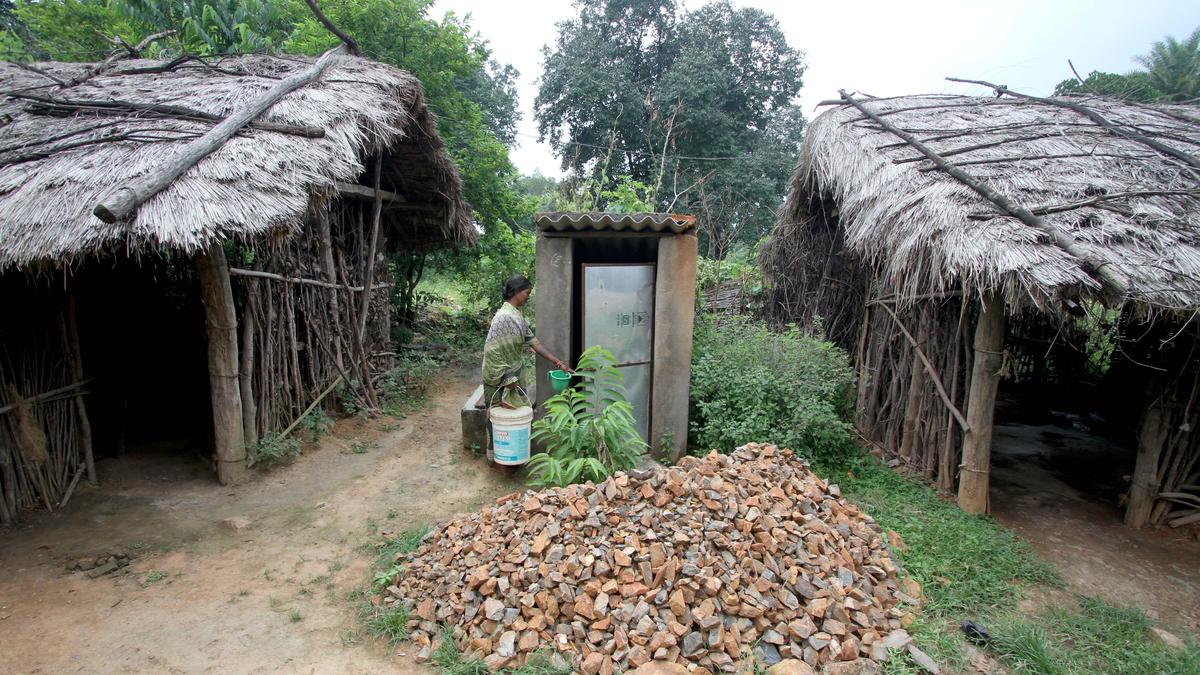


When the Swachh Bharat Mission (‘Clean India Mission’) was launched in 2014, its vision was both simple and transformative; to ensure that every household in India had access to a toilet. In just a decade, this vision has become reality. More than 12 crore household toilets have been built in rural India, and every village has declared itself Open Defecation Free (ODF). This achievement has improved public health, reduced indignities faced by women and vulnerable groups, and marked a turning point in India’s development journey.
Focus on waste management
Yet, the success of the sanitation mission has also revealed the next frontier. Toilets are only the starting point. The real challenge lies in managing the resultant faecal waste. In most rural households, septic tanks and pits serve as the primary form of containment. Over time, these fill up and must be desludged at regular intervals. Without safe systems for collection, transport, and treatment, the gains of the ODF movement risk being undermined. It is this challenge that defines the transition to Swachh Bharat Mission (Grameen), or SBM-G, Phase II, with its focus on ODF Plus.
ODF Plus goes beyond toilet construction to ensure the sustainability of outcomes through solid and liquid waste management, behavioural change, and safe sanitation service chains. The progress has been encouraging. As of October 2025, more than 5.68 lakh villages, nearly 97% of India’s total, have been declared ODF Plus. But faecal sludge management remains one of the most critical gaps in the sanitation chain, especially in peri-urban and rural areas.
Maharashtra has been at the forefront of experimenting with innovative approaches to address this gap. The State has invested in more than 200 faecal sludge treatment plants in urban areas and encouraged co-treatment in 41 sewage treatment plants. These facilities are a backbone of treatment infrastructure to cities, but the challenge lies in extending their benefits to the villages that surround them. It is here that urban-rural partnerships show great promise.
At the gram panchayat level
In Satara district, Maharashtra, such a partnership was put into practice. Satara city’s faecal sludge treatment plant, with a capacity of 65 kilo litres a day (KLD), was operating below full capacity. Recognising this, four villages, Jakatwadi, Songaon, Kodoli, and Degaon, have been brought under an arrangement that will allow them to access the city’s treatment plant.
Their septic tanks, often never desludged or emptied only at exorbitant rates by informal operators, will be serviced at regular intervals and in a safe way. A private service provider is to be engaged by the gram panchayats, under a contract, to provide scheduled desludging services every five years.
The costs will be recovered through a modest sanitation tax levied by the gram panchayats, ensuring affordability and accountability. A formal agreement between the Satara Panchayat Samiti and the Satara Municipal Council will allow authorised desludging vehicles from the gram panchayats to access the faecal sludge treatment plant and treat the sludge at no cost , making the arrangement sustainable and mutually beneficial.
But not every village can be linked to a treatment system of a city. Some will have to treat their waste independently. An example is Mayani, a large village in Khatav taluka. With the high demand for desludging services, the gram panchayat has agreed to introduce scheduled desludging every five to seven years, managed by either a private operator or local self-help groups.
In addition, Mayani has been selected for the development of a cluster-level faecal sludge treatment plant under the SBM-G, designed to serve around 80 surrounding villages. This approach shows that rural clusters can pool resources to develop standalone treatment infrastructure that meets their needs, while remaining financially and technically viable.
Comment | The politics of waste management
The demonstration of urban-rural linkages and the standalone faecal sludge management business model in Satara district will promote the adoption and the institutionalisation of safe, sustainable sanitation services across rural Maharashtra. It also aims to show that sustaining the gains of ODF and effectively integrating faecal sludge management into rural sanitation require strong collaboration between urban and rural governments, private and public actors, and citizens and institutions.
A model that can be scaled up
If scaled up, such models have the potential to transform not only villages in Maharashtra but also rural communities across the country. By doing so, India can ensure that its sanitation gains are not only celebrated today but can be sustained for generations to come. The true measure of Swachh Bharat will not only be the toilets built but also the systems created to manage them — systems that protect peoples’ health, preserve the environment, and uphold the dignity that this mission set out to achieve.
Aasim Mansuri is Principal Researcher and Center Head-Strategy, Center for Water and Sanitation, CRDF-CEPT University. Dhruv Bhavsar is Principal Researcher and Center Head, Center for Water and Sanitation, CRDF-CEPT University. Upasana Yadav is Senior Program Lead, Center for Water and Sanitation, CRDF-CEPT University. Kasturi Joshi is Program Lead, Center for Water and Sanitation, CRDF-CEPT University. Jinal Chheda is Senior Research Associate, Center for Water and Sanitation, CRDF-CEPT University
Published – January 03, 2026 12:08 am IST

/Alphabet%20(Google)%20Image%20by%20Markus%20Mainka%20via%20Shutterstock.jpg "How to Make a 2.0% Income Yield in GOOGL Stock Over the Next Month")
