
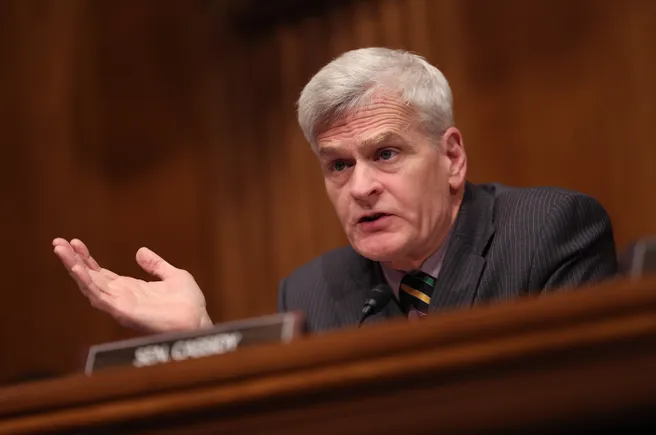

Republicans and Democrats agree that Congress needs to move fast if it wants to shield consumers from looming premium hikes in the Affordable Care Act exchanges. But a hearing of an influential Senate committee on Wednesday didn’t provide any assurances that Congress will be able to get its act together before the end of the year.
“I’m hoping that we can find a bill that can get 60 votes that can fix the problem of the exchanges for January 1, 2026,” said Sen. Bill Cassidy, R-La., during the meeting. “We can push for big ideas, grandiose ideas on the right or the left, but we’ve got to have a solution for three weeks from now.”
The Senate Health, Education, Labor and Pensions Committee’s hearing on healthcare affordability is the latest in a string of public hearings, backdoor meetings and bill introductions as Republicans and Democrats scramble to work out a solution to expiring financial assistance for ACA plans.
Both sides acknowledge that something needs to be done. But Democrats have been unable to convince their colleagues across the aisle to support the easiest solution — a temporary expiration of the subsidies as-is while Congress hammers out more comprehensive reform.
The heightened subsidies were enacted during the coronavirus pandemic and are set to expire at the close of 2025. Without them, premiums will double on average for subsidized ACA enrollees next year and some 4 million Americans are expected to go uninsured.
During the HELP hearing, some Republicans appeared open to a clean extension given the impending premium pain, including Sens. Lisa Murkowski of Alaska, Josh Hawley of Missouri and Jon Husted of Ohio.
“We have a few days to prove that we care. That we’re going to try,” Husted said.
But conservatives also tossed out a flurry of alternate reforms, complicating the likelihood of the clean extension that state regulators and marketplace experts say is Congress’ only viable path forward to fully shield the millions of Americans on the exchanges from looming premium hikes.
Enrollees have just 12 days until the deadline to sign up for coverage starting Jan. 1. In comparison, it would take state and federal marketplaces months to build, test and deploy the IT systems needed for many of the Republican proposals, Jason Levitis, a senior fellow in the left-leaning Urban Institute’s health policy division, testified at a Senate Finance Committee hearing last month.
Still, Republicans have continued to debate alternatives, such as funding cost-sharing reduction subsidies, expanding availability of ACA alternatives like short-term limited duration health plans and funneling federal dollars into tax-advantaged savings accounts tied to bronze plans. Cassidy in particular has supported the latter proposal, which he argues will give consumers more control over their healthcare spending and bring down costs overall.
Many conservative senators cast the proposals as necessary to reform the ACA, pointing to evidence of fraud in the exchanges and arguing that America’s healthcare affordability crisis can be traced back to the 2010 law.
Republican witness Joel White, the president of the Council for Affordable Health Coverage, testified that the ACA forced Americans into an insurance market with less choice and higher costs, while making it more difficult for small employers to offer coverage.
“The ACA poured gasoline on the healthcare cost fire,” White said. “Adding more subsidies won’t fix these underlying problems, it only reinforces them.”
Democrats agreed the ACA is not perfect. But things were worse prior to the law, which required insurers to cover preventative care at no cost for the first time — a major win for Americans, even if deductibles and other costs remain high, they said.
“It is a medical bankruptcy prevention insurance. It means that if you have a $10,000 deductible but you have a crisis, an injury, an accident, an illness that costs more than that, you won’t lose everything,” said Sen. Tammy Baldwin, D-Wis. “We can definitely improve the ACA — we can improve the entire system — but the solution is not to let 4 million people not be able to afford it anymore.”
As part of the negotiations to reopen the government in the fall, the Senate agreed to vote on a subsidy bill in mid-December. The vote is expected late next week. But it’s still not clear what, exactly, will be up for a vote, especially since Republicans remain divided on whether to renew the subsidies or not. Some conservatives are also pushing for an extension to include a ban on abortion coverage in the exchanges, a non-starter for Democrats.
It’s also unclear whether any piece of legislation will garner enough support to pass the Republican-led House or gain President Donald Trump’s signature — especially after the president spent the weeks leading up to Thanksgiving railing against the ACA’s subsidy structure.
The White House was expected to roll out its own plan to address the subsidy expiration but it was scrapped following opposition from Republican lawmakers, according to CNN.