Spending capacity of ministries in focus as fund offtake falters
- Finance
 ThePostMaster
- 0
- 5 minutes read


Similarly, combined savings in 10 crucial schemes, including those on housing, drinking water, internship and employment, were to the tune of ₹1.25 lakh crore, showed the revised estimates for FY26 presented in the latest budget documents. The savings reflect the downward revision of spending from the budget estimates.
These shine the spotlight on poor offtake, warranting a review of the spending capacity of various departments and ministries and their implementation strategies, and the redeployment of resources where necessary, experts said.
To be sure, most of these savings have been redeployed in other programmes, and the central government’s overall expenditure for the current fiscal is just ₹1 lakh crore lower than the initial target of ₹50.65 lakh crore.
Senior finance ministry officials termed poor utilisation as the most important reason for the downward revision of spending targets for various ministries and departments. However, they also added that in certain cases, reprioritisation of expenditure and exigencies required some resources to be diverted towards some other programmes.
One of the officials said spending in some of the schemes that are implemented with state backing was impacted, as some states either held back funds or delayed their mandated contributions.

“Of course, there are also issues specific to each scheme and ministry or department. But yes, implementation could be better in many cases, and that’s something we have been taking up with various ministries,” another official said.
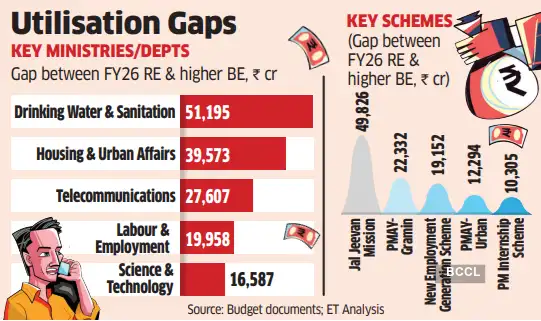
An ET analysis of 19 ministries and departments showed that the revised estimate of their FY26 expenditure is pegged at ₹2.70 lakh crore, against the budgeted ₹ 4.64 lakh crore. Similarly, the FY26 spending targets of 10 key schemes have been revised down to ₹82,091 crore from ₹2,07,499 crore.In absolute terms, the ministries and departments that witnessed sharply lower fund utilisation from the budgeted levels for FY26 and hence contributed to savings include drinking water and sanitation (₹51,195 crore), housing and urban affairs (₹39,573 crore), telecommunications (₹27.607 crore), labour and employment (₹19,958 crore), science and technology (₹16,587 crore), and MSME (₹11,072 crore).
Some others were ministries of electronics and information technology, tribal affairs, skill development and entrepreneurship, corporate affairs, women and child development, social justice and empowerment, development of the north eastern region, pharmaceuticals, tourism, minority affairs, consumer affairs, fisheries, pharmaceuticals, and food processing. The savings/expenditure compression in these departments were in the range of ₹793 crore to ₹5,793 crore.
Similarly, the schemes where poor offtake led to the downward revision of their FY26 spending targets are Jal Jeevan Mission/National Rural Drinking Water Mission (by ₹49,826 crore), Pradhan Mantri Awas Yojana-Gramin (₹22,332 crore), New Employment Generation Scheme (₹19,152 crore), Pradhan Mantri Awas Yojana-Urban (₹12,294 crore), PM Internship Scheme (₹10,305 crore) and Pradhan Mantri Gram Sadak Yojana (₹8,000 crore).
Others, such as Programme for Development of Scheduled Tribes, Pradhan Mantri Anusuchit Jaati Abhyuday Yojana, PM Young Achievers Scholarship Award Scheme for Vibrant India for other backward classes and post-matric scholarship for Scheduled Castes, saw their allocations reduced in the range of ₹360 crore to ₹1,559 crore.
