

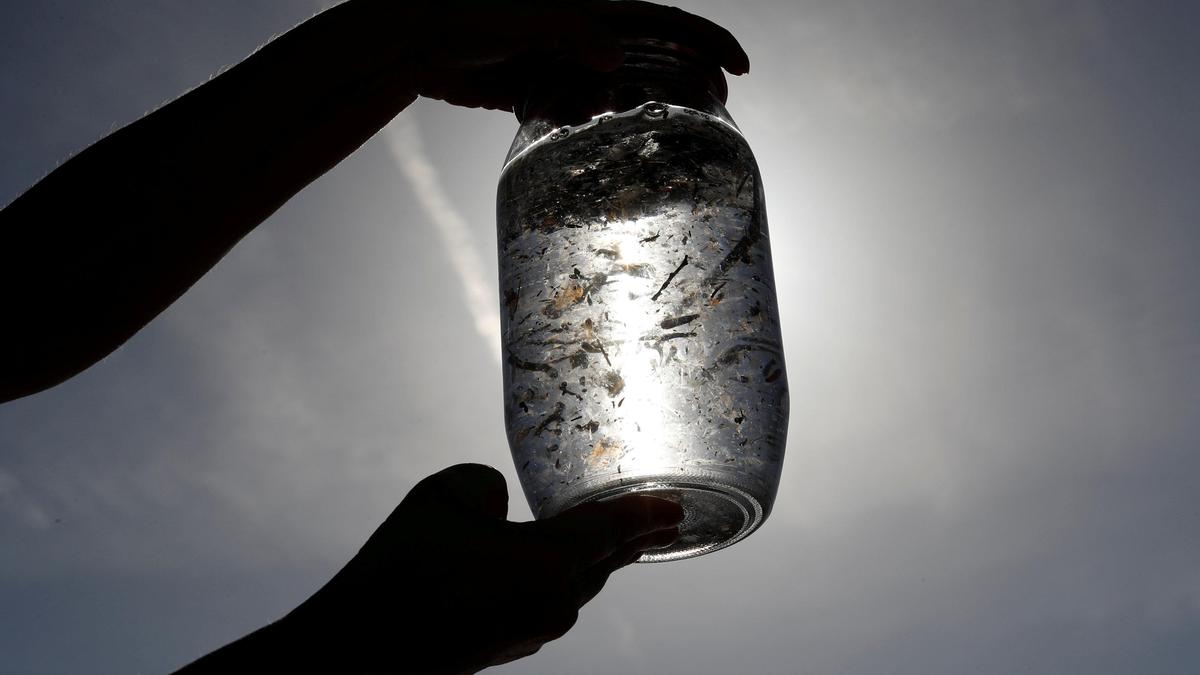
Sample of water with plastic particles. File
| Photo Credit: Reuters
The Tamil Nadu government has informed the Madras High Court of having requested the Indian Institute of Technology -Madras (IIT-M) to conduct a scientific study regarding the harmful effects of microplastics on human health due to consumption of food products such as milk, coffee, tea and hot sambar sold in plastic pouches.
A special Division Bench of Justices N. Sathish Kumar and D. Bharatha Chakravarthy was informed that Health Secretary P. Senthilkumar had written a letter to Additional Advocate General (AAG) J. Ravindran on Thursday (January 22, 2026) informing about the request made to IIT-M for conducting a study on the subject.
The letter read that, pursuant to the insistence of the court to conduct a detailed research regarding the effects of microplastics on human health, the Commissioner of Tamil Nadu Food Safety and Drug Administration department had sought the assistance of IIT-M to undertake a detailed study.

It was while hearing a batch of environment-related cases with the assistance of amici curiae T. Mohan, Chevanan Mohan, Rahul Balaji and M. Santhanaraman that the Division Bench had come across an interim report of a research undertaken by PSG Institue of Medical Sciences and Research in Coimbatore.
The report stated that microplastics were small plastic fragments and they comprise several elements, including Bisphenol A (BPA), a chemical compound used in the production of plastics. BPA is an endocrine disruptor, and its presence in the environment raises concerns about potential health impacts, the report added.
Since BPA could interfere with hormone functions, the institute had decided to measure its levels in cord blood so that it could serve as a valuable biomarker for epidemiological studies examining the long-term health effects of prenatal BPA exposure and help in the regulation of BPA in consumer products used by pregnant women.

The study participants were pregnant women whose informed consent was obtained before collecting the samples. After delivery, the leftover cord blood was collected and analysed. The analysis of 10 samples found the BPA concentration to range from 0.43 to 1.1578 µg/kg body weight (bw) in the cord blood samples.
“The average concentration was 0.7194 0.2 µg/kg body weight. As per current guidelines, these concentrations were above the recommended tolerable daily intake (TDI) value of 0.2 ng/kg bw/day,” the report read. Shocked to know about it, the judges said: “If plastics can pollute even the placenta of a mother, then the authorities concerned must look into the issue with the seriousness it deserves.”

The judges suo motu impleaded the Union Health and Family Welfare Ministry as well as the State health department as respondents to one of the cases pending before them and directed both of them to study the ill effects of microplastics on human health before taking policy decisions on the issue.
Published – January 24, 2026 04:47 pm IST