
Three weeks after flash floods in Texas’ Hill Country killed more than 100 people, state lawmakers chastised Kerr County leaders for rejecting money a year earlier to create a warning system that could have alerted residents to rapidly rising water.
Several lashed out as a Kerr official representing the local river authority tried to explain why it declined money from a $1.4 billion state fund to help guard against destructive flooding.
One state senator on the special legislative committee tasked with investigating the deadly floods called the decision “pathetic.” Another said it was “disturbing.” State Rep. Drew Darby, a Republican from San Angelo, said the river authority simply lacked the will to pay for the project.
But Kerr leaders were not the only ones who rejected the state’s offer, ProPublica and The Texas Tribune found. In the five years since the fund’s launch, at least 90 local governments turned down tens of millions of dollars in state grants and loans.
Leaders from about 30 local governments that the news organizations spoke with said the state grants paid for so little of the total project costs that they simply could not move forward, even with the program’s offer to cover the rest through interest-free loans. Many hoped the state program would provide grants that paid the bulk of the costs, such as the ones from the Federal Emergency Management Agency, which typically supply at least 75%. They believed that they could raise the rest.
Instead, many were offered far less. In some cases, the state offered grants that paid for less than 10% of the funding needed.
In Kerr’s case, the state awarded a $50,000 grant for a $1 million flood warning system, or roughly 5%. It said the river authority could borrow the rest and repay it over the next three decades, but local officials were not sure they would be able to pay back the $950,000 — and failure to do so could carry state sanctions.
City officials in Robinson, located between Dallas and Austin, sought about $2.4 million in funding to buy and tear down homes directly in the floodway. The state offered $236,000 and required that the city conduct an engineering study that would have eaten up more than half of those grant funds, the city manager told the news organizations.
The state also proposed giving the East Texas city of Kilgore a fraction of what Public Works Director Clay Evers had anticipated for a drainage study aimed at minimizing flooding. The city needed the money, Evers said, but the state’s offer required a far larger match than the council members had planned to set aside based on the federal grant system as a guide. The state also required the city to go through a second application process to secure the grant, which Evers said would further strain resources.
So, Evers dropped out.
Four years after he turned down the state funding, Evers watched in shock as lawmakers lambasted Kerr leaders. It could have just as easily been him trying to defend a choice he never wanted to make in the first place.
“I don’t have this unlimited pot of money,” Evers said. “That is an incredibly difficult decision, and when the impossible, improbable, traumatic happens, how do you defend the decision you just made?”
Several Texas leaders who created and oversaw the fund defended the program as a significant investment and said that local communities must also be willing to invest in flood warning and mitigation projects.
Local officials, particularly those in smaller, rural communities, said a limited tax base, along with continued state restrictions on their ability to raise new taxes, have made it difficult to fund necessary projects.
After learning of the newsroom’s findings, two lawmakers and a former state employee who helped launch the fund expressed concerns over the high number of communities that turned down the money. Though state Rep. Joe Moody, a Democrat from El Paso, and Darby said that the state can’t pay for the entirety of every project, they acknowledged lawmakers created a flawed system.
“I absolutely know that what we’re doing now is not adequate for the people that we represent,” Moody said. “It’s OK for us to admit that the system isn’t good enough. We shouldn’t be afraid of saying that. The question then is, what are we going to do about it?”
Moody and Darby said the state program merits a thorough review by lawmakers during the next legislative session in 2027.
“It is a frustrating prospect that we have this program that’s designed to be important to help people’s lives, and the Legislature determined it to be a priority, and we put money in, and to find it still in the bank accounts, and not being deployed,” Darby said. “We need to fix it.”
Too little for some
Lawmakers in 2019 approved the Flood Infrastructure Fund, making Texas one of the few states in the country with a dedicated program to invest in helping cities and counties pay for flood prevention projects, experts said.
The investment was a response to the destruction wrought by Hurricane Harvey two years earlier. Applicants seeking to qualify for grants must meet criteria that includes securing supplemental federal funding, showing that they have a median household income below the statewide average or meeting a narrow definition of a rural community that is more restrictive than the ones used by other Texas programs.
Lawmakers tasked the Texas Water Development Board with creating a ranking system for proposed projects and determining how much each community would receive. The board awarded $670 million to 140 projects, with the largest grants going to applicants that had the lowest median household income.
That meant communities like Kerr, which have higher median income, received far less money than other areas with needs deemed less pressing.
A spokesperson for the water board defended its grant distribution, saying the aim was to fund as many projects as possible across the state. While the agency had received some feedback from communities that felt the offer was too low to be a feasible avenue for them, spokesperson Kaci Woodrome said it was challenging to attribute their choice to turn down the money to a single root cause.
Tom Entsminger, a longtime water board employee who helped launch the fund, said he and his colleagues were charged with figuring out how to divvy up the money before they knew how many local agencies would apply, what projects they would propose or how much they would cost. He said there wasn’t a “specific logic behind” the exact grant amounts “that anybody would have defended.”
“We had to just get through that funding cycle before we knew that it was too little for some folks,” he said.
The state began a second round of funding last year, but its leaders made few changes to the rubric used to distribute it. So far, they have seen similar results.
Entsminger, who left the state agency in 2021 for a consultant job, considers the program an overall success. Still, he said the fact that local governments, many of which were rural or had fewer than 20,000 residents, declined the state funding shows the board’s grant process likely needs to be reviewed. About $100 million went unused for years, the newsrooms found.
Among local governments that rejected the money was the Trinity Bay Conservation District, which provides water services to 6,000 customers in two rural counties in Southeast Texas. It would have received 9% of the nearly $12 million needed to fund projects that would widen a local bayou and reduce flooding in the area. The 300-resident town of Rose Hill Acres, also in Southeast Texas near Beaumont, was offered a 14% grant for its $12 million flood mitigation efforts.
Another such community was Kilgore, which has fewer than 14,000 residents.
The city needed $575,000 to assess and create an updated map of its drainage system. Without it, Evers had to rely on maps left by previous city officials in a green spiral notebook dated 1965 that kept him guessing which outdated pipes he needed to replace before they failed.
Dozens of pipes had collapsed since 2018, when his office began tracking the destruction that creates sinkholes in residents’ yards, church property and, in the worst-case scenarios, the middle of busy roads. The chaos forced Evers to triage emergency funds to fix the most dangerous basketball-sized holes across the city, only for another to pop up in a citywide game of Whac-a-Mole.
“It’s only accelerating. Every year that passes, the infrastructure that’s still in the ground gets a year older,” Evers said. “I’m trying to get ahead of it.”
The announcement of the state water development board program gave him hope that he could secure enough money for needed projects. But that feeling quickly deflated when the board published its master list ranking all the projects and outlined how much funding each would get.
Kilgore was offered a grant covering 13% of the drainage study’s cost. To stay in the running for the grant, the program required applicants to submit a separate lengthy application, which Evers said would have required him to hire a pricey consultant. The board had ranked Kilgore so low among hundreds of projects that Evers felt the city’s chances of getting the money were slim.
Evers faced a choice that many other applicants recounted to the newsrooms: spend more resources for a chance at some state money or cut their losses now.
“We are disappointed in our ranking,” Evers wrote in an email to the water development board in which he declined to move forward with the application. “Our small town needs apparently pale in comparison to the other 200 projects ahead of us.”
Still waiting
After stepping away from the state program, Evers searched for other funding sources as the need for a drainage study became more pressing. Pipes kept breaking, flooding streets and homes, and forcing the city to tap into dwindling emergency funds.
Finally, Evers landed a $300,000 federal grant this year. It didn’t cover the full cost of the project, but Evers said he would start by examining the most flood-prone neighborhoods and then try to scale up.
“It won’t be 100%, but it’ll be enough to where I can at least have some semblance of a plan to begin,” he said. “I got lucky.”
But Kerr has not been as lucky.
Tara Bushnoe, general manager of the Upper Guadalupe River Authority, which applied for and then declined funding from the state program, said in an email that the agency approved incrementally using money from its budget for a flood warning system, but having a complete system with all planned sirens to alert residents could take years.
Immediately after the deadly floods, state leaders promised to help, saying they would allocate additional funding specifically for such warning systems.
“We’re not going to be able to stop everybody from dying,” said state Sen. Paul Bettencourt, a Houston Republican. “But we could have gotten a lot of people out of the way if they had heard those sirens and went to higher ground, and that’s the best thing you can do, is try to save lives as a legislator.”
This summer, lawmakers passed Bettencourt’s legislation that would provide $50 million for flood sirens in some Texas counties.
But Kerr County, whose devastation after the floods spurred the state to infuse dollars in the first place, won’t automatically get help to pay for its warning system.
State lawmakers put money into a new fund with a new selection process that will be open to a few dozen flood-prone counties.
Kerr leaders will again have to apply.
Pratheek Rebala of ProPublica contributed data reporting.
This article first appeared on The Texas Tribune.
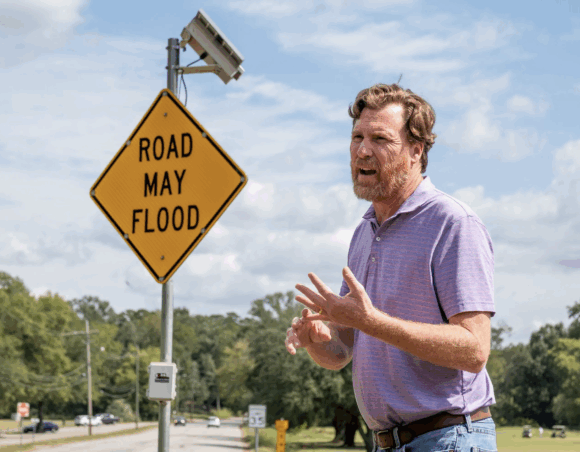
Photo: The public works director for the East Texas city of Kilgore, Clay Evers, was able to install a flood gauge and flashing signage along Houston Street as a warning to drivers. Michael Cavazos for The Texas Tribune and ProPublica
Topics
Mergers & Acquisitions
Texas
Legislation
Flood
Leadership