

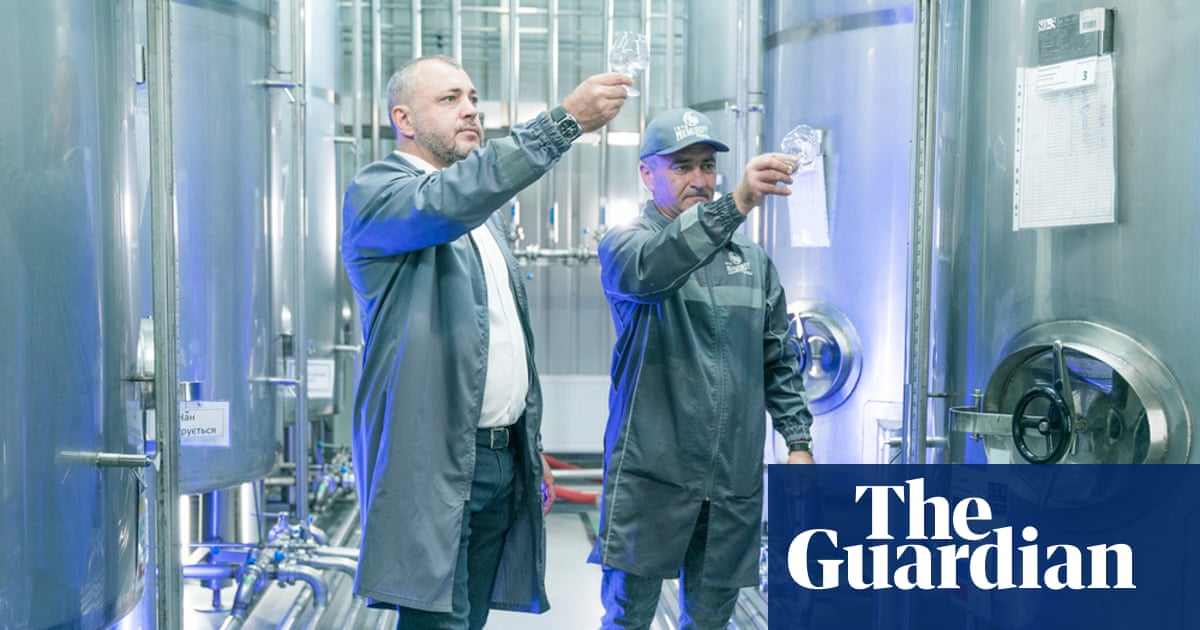


Businesses in Ukraine are “not sitting and waiting for the war to end” and are working to expand despite bombs hitting shipments out of the country, according to a leading vodka exporter to the UK.
Yuriy Sorochynskyi, the chief executive of Ukraine’s largest spirits export brand, Nemiroff vodka, has said its products have continued to flow to big chains including Tesco and Sainsbury’s as it copes with the harsh realities of almost four years of war.
Late last year one of the brand’s shipping containers, holding 17,000 bottles, was hit by bombing at the Ukrainian port of Odesa. A supplier’s shipment was also recently hit.
“We had one or two containers destroyed in port by missile attacks,” he said. “This is now business as usual.”
Since Russia’s full-scale invasion of Ukraine in February 2022, keeping production of major exports going, from vodka to grain and sunflower seeds, has been an important part of the country’s ability to fight back.
With Russian vodkas pulled from most supermarket shelves across Europe in support of Ukraine, the brand has grown rapidly. In the UK sales rose 24% last year to £6.25m, and it is now one of the fastest-growing premium vodka brands.
Nemiroff has sponsored Ukraine’s heavyweight boxing champion Oleksandr Usyk and partnered with the Premier League football clubs Aston Villa, Fulham, West Ham and Everton. The brand is now listed in Tesco, Sainsbury’s, Waitrose and the Co-op, and in October it returned to the duty free market with products at Heathrow and Gatwick.
More than 40% of the brand’s sales are now in the west, after sales dived from about 10m cases globally in 2010 to 2.4m cases in 2022 following its exit from the Russian and Belarusian markets. Global sales have partly recovered, to 4.4m cases this year, as Ukrainian demand has held up and exports to the west expanded.
Sorochynskyi said the company ceased sales in Russia, one of its biggest markets where its products were produced under licence, which was terminated immediately after the invasion of Ukraine.
Since the start of the war, keeping production going has involved measures such as buying a gas generator, so that the factory can keep going as Ukraine’s power stations have come under attack, and finding spare space to rehouse its bottle top supplier, an Italian company that had a subsidiary in Sumi in the north-east of Ukraine, close to the Russian border, which took a direct missile hit in August last year.
Nemiroff was also providing bottling facilities for some competitors with the aim of “supporting business in Ukraine”, said Sorochynskyi. “There are a huge number of examples of competitors helping each other out in order to survive.”
Another potential move on the horizon is the provision of bathing facilities for workers who are struggling to wash at home amid power cuts and shortages because of attacks on power infrastructure.
Sorochynskyi said that life is particularly tough for those living in flats in cities as they are less likely to be able to set up their own energy sources such as wood-burning stoves or solar panels. As a result, he said, it is not uncommon to see queues of cars heading for shopping centres, as much for the electrical supply or wifi as for shopping.
Nemiroff, whose distillery and bottling plants are located in its namesake city of Nemyriv, in Vinnytsia oblast in the east of the country, where there has been a distillery since 1752, is owned by the siblings Yakov and Bella Finkelstein, along with Anatoliy Kipish. The three have controlled the company since it was privatised by the state in the 1990s. Another shareholder, the Glus family, was ousted after an internal battle for control in 2013.
As ports have come under attack, Sorochynskyi said Nemiroff has been forced to reroute shipments more than once.
“Now we are mostly shipping out by truck. Before 2022 we used a lot of sea containers but we stopped that when the Black Sea was blocked. It took us four months to find an alternative.”
The Ukrainian government, helped by the EU, is also building up railway infrastructure to help provide other freight routes. New railway lines with the European standard gauge of track will allow easier exports via train.
A track to the borders with Hungary and Slovakia opened in September and one to Poland is set to open in 2027. Facilities to help take goods to Romania’s Black Sea ports have also been ramped up.
Production halted for about a month in the early days of the war and exports were also held up as the borders were overloaded with refugees and the movement of military equipment.

