
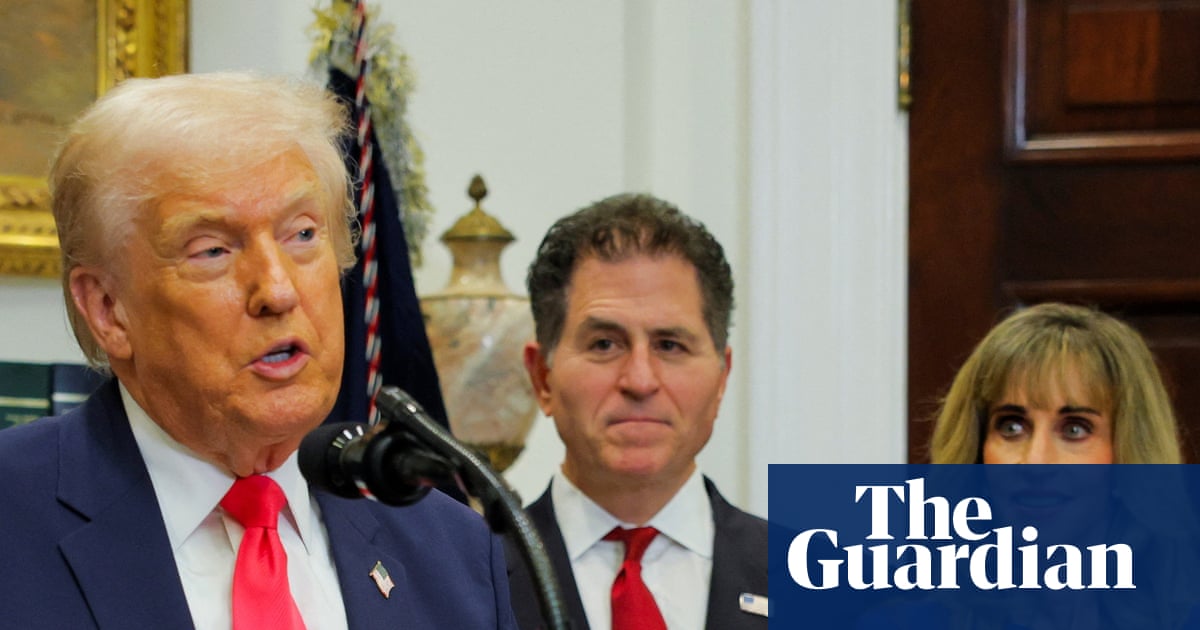

Pity the billionaire class. The 0.001% are so unpopular these days that when tech billionaire Michael Dell and his wife announced the donation of $6.25bn into the “Trump Accounts” of 25 million children, one of the largest single philanthropic donations in American history, Dell had to hurry to assure us that his was not at all about currying favor with Donald Trump.
“I don’t think this is in any way a partisan activity,” Dell told the New York Times.
Perhaps. Still, the gargantuan contribution to Trump’s pet program – a federal payment included in his Big Beautiful Bill Act of $1,000 into an account bearing his name for every kid born during his presidency – does nothing to dispel the creeping feeling that philanthropy is not quite the do-gooder thingy it’s long been billed to be but rather a tool to curry favor with those in power.
One can’t but recall Timothy Mellon, one of Trump’s big backers who donated $130m to help the government pay troops during the shutdown, earning himself the presidential title of “patriot”. There’s also the gaggle of techies who contributed a cool $1m a piece toward Trump’s inauguration shindig. And there’s the collection of crypto billionaires, tech giants, media companies, sports team owners, etc, who chipped in to finance Trump’s $300m ballroom where the East Wing of the White House used to be.
If there is something positive about this moment, it is that the eagerness with which rich individuals and their companies have lavished money on the president’s priorities is shining a light on philanthropists’ longstanding practice of dressing up self-serving objectives – from making friends with politicians to getting their descendants into the Ivy League – as investments in the public good.
Trump didn’t invent this. A study a few years ago by economists at the University of Chicago, Boston University and the University of British Columbia found that the charitable contributions by many of the nation’s largest companies – either among the Fortune 500 or part of the S&P 500 stock index – were strategically directed to charities sponsored by members of Congress.
The study was titled Tax-Exempt Lobbying: Corporate Philanthropy as a Tool for Political Influence. It included nuggets like the Exelon Corporation’s donation of $25,000 to an effort to build a Boys and Girls Club spearheaded by Joe Barton, the top Republican member of the House energy and commerce committee.
The foundations of JPMorgan Chase, Bank of America and Wells Fargo all donated to the Washington State Farmworker Housing Trust, which Patty Murray, the senior senator from Washington state, helped establish. In 2010, the Walmart Foundation gave $6,000 to the Joe Baca Foundation, when Representative Baca was sitting on the House financial services committee and Walmart was battling Visa and Mastercard over credit card fees.
These things might all have been coincidences. But the research detects fishy patterns: corporate foundations tend to make philanthropic donations in the same congressional districts where their political action committees (Pacs) make political contributions to their favoured candidates. They donate more to charities in districts represented by members with seats on a committee relevant to the company. And they trim their giving when the member leaves Congress. A non-profit is more than four times more likely to receive grants from a corporate foundation if a politician sits on its board.
None of this should be surprising given the way philanthropy is set up in the US, as a tax break for the rich and their corporations to funnel money into pet projects that may not be profitable, in a narrow sense of the word, but clearly provide a return, whether it’s the beneficiary’s name in gilded letters on the façade of the public library, points toward corporate social development goals or the favor of a member of Congress.
Charity in the US last year added up to over $592bn – about 2% of GDP, the same it has been for years. As a believer in taxation and government redistribution, it rubs me the wrong way that taxpayers are subsidizing this largesse, which can be spent free of democratic checks and balances.
The public subsidy of philanthropy looks increasingly ridiculous as giving becomes the province of the very, very rich, who are directing their charity to increasingly outlandish propositions.
Consider Meta’s Mark Zuckerberg, who has formally repositioned his philanthropic arm, axing work it was doing in housing and education for low-income students to focus pretty much exclusively on the intersection of biology and AI, with the stated objective of one day curing all disease.
Launched around the reasonable idea that charity should be designed to maximize benefits, regardless of whether they materialize in Africa or one’s own neighborhood, the principle of “effective altruism” embraced by the tech aristocracy from Silicon Valley has taken a deep sci-fi turn, to favor investments that provide benefits far away in the future. Investing to save a few million from malaria, in this view, is a waste compared to, say, saving humanity from apocalypse a hundred or a thousand years from now.
Dell may not be that invested in science fiction. Still, his $250 contribution to 25 million children is as unlikely to be life-changing as the $1,000 the federal government is supposed to deposit into the Trump Accounts of all kids. (A much better idea would be to amend the child tax credit to ensure America’s poorest families could benefit.)
At least his money is going to children in the present, you might say. But the multi-billion-dollar gift from this one-time advisor to president Trump and his wife (“two special people”, in Trump’s words) will probably mostly benefit the donor.