US jobs report beats forecasts with 130,000 increase in January – business live | Business
- Business
 ThePostMaster
- 0
- 117 minutes read

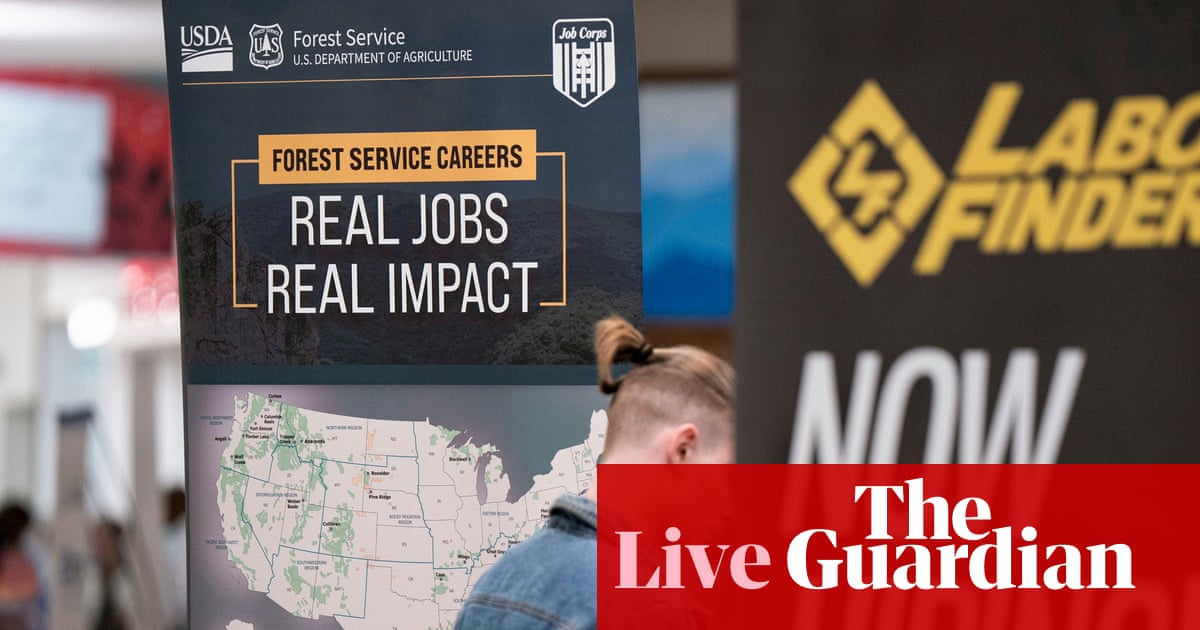
Introduction: Markets brace for US jobs report, with White House telling investors ‘they shouldn’t panic’
Good morning, and welcome to our rolling coverage of business, the financial markets and the world economy.
It’s non-farm payrolls day! The eagerly-awaited US jobs report is out today, and the White House has been trying to moderate expectations.
Peter Navarro, senior counselor for trade and manufacturing to Donald Trump, was speaking on Fox News last night.
We have to revise our expectations down significantly for what a monthly job number should look like. When we were letting in 2 million illegal aliens a day we had to produce 200,000 [jobs] a month for steady stay.
Now 50,000 a month is going to be more like what we need. Wall Street, when this stuff comes out, they can’t rain on our parade, they just have to adjust for the fact that we’re deporting millions of illegals.
When asked whether the number would be weak, he rowed back and said no, but stressed that investors need to expect smaller numbers in future.
[A person can’t be illegal – see here.]
Navarro: “The jobs report comes out tomorrow. We have to revise our expectations down significantly for what a monthly job number should look like … Wall Street has to adjust for the fact that we’re deporting millions of illegals out of the job market.” pic.twitter.com/j7aFJkMGFh
— Molly Ploofkins (@Mollyploofkins) February 10, 2026
This comes after a warning from National Economic Council director Kevin Hassett on Monday. “One shouldn’t panic,” he told CNBC on Monday. “You should expect slightly smaller job numbers.”
The data release, delayed from last week, is expected to show the economy created 70,000 jobs in January, after 50,000 in December.
Derren Nathan, head of equity research at Hargreaves Lansdown, said:
The FTSE 100 is set to open up, after a lacklustre close on Tuesday. On quiet days for earnings reports and economic data points, the index tends to act as a barometer for commodity prices. Gold prices have strengthened slightly and are at close to two-year highs, supported by strengthening sentiment around US rate cuts this year. Copper and oil are also providing a light tailwind today.
US stock futures are erring on the side of optimism ahead of jobs data expected later on. Hopes for a rate cut by the Fed next month have improved slightly after American retail sales unexpectedly flatlined in December, with shares in Costco, Target and Walmart all ending down on Tuesday.
The next steer for rate setters will be US non-farm payrolls data due later today. Forecasts are for an increase in hiring from 50,000 in December to 70,000 in January. That’s still a relatively light number, but anything lower could see markets gain more confidence in the scope for three rate cuts this year. Changes to the benchmark are also in play today, which are expected to see hiring rates for last year revised downwards.
Economists at Deutsche Bank said:
Our US economists see nonfarm payrolls coming in at +75k, with the unemployment rate staying at 4.4%. Remember as well that today’s report will include the annual benchmark revisions to payrolls, which could rewrite some of the trends over recent history.
We already got the preliminary number in September, which said that payrolls were -911k lower as of March 2025. However, that number can be different from the preliminary release, and last year’s preliminary benchmark revision was -818k but the final number was a smaller -589k, so not as negative as first thought.
The Agenda
1.30pm GMT: US non-farm payrolls for January (previous: 50,000; forecast: 70,000)
5.30pm GMT: Bank of England policymaker James Talbot gives speech
Key events
US jobs report beats forecasts with 130,000 increase in January
US employers hired 130,000 more workers in January, which was stronger than expected (and despite warnings from the White House of smaller numbers because of its deportation programme).
Non-farm payrolls figures from the Bureau of Labor Statistics showed the unemployment rate dipped to 4.3% last month from 4.4% in December. Economists had pencilled in an increase of 70,000 jobs, and forecast the rate would stay at 4.4%.
US stock futures are extending gains following the report.
The oil cartel Opec has stuck to its forecast that world oil demand for crude from the wider Opec-plus producer group, including Russia, will drop by 400,000 barrels a day in the second quarter, from the first three months of the year.
Global demand for OPEC+ crude will average 42.2m bpd in the second quarter, OPEC said in its monthly report report, down from 42.60 million bpd in the first quarter. Both forecasts were unchanged from last month’s report.
The Opec+ group comprising OPEC nations, plus Russia and other allies, began raising oil output last year after years of cuts, and paused production hikes in the first quarter of 2026 amid predictions of a glut.
Eight Opec+ members meet on 1 March where they are expected to make a decision on whether to resume the hikes in April. In the report, OPEC also stuck to its forecasts that world oil demand will rise by 1.34m bpd in 2027 and by 1.38m bpd this year. The 2026 forecast is higher than that of other analysts such as the International Energy Agency.
Opec+ pumped 42.45m bpd in January, down 439,000 bpd from December, driven by reductions in Kazakhstan, Russia, Venezuela and Iran, according to the report.

Heather Stewart
Tax minister Dan Tomlinson was up before the Treasury select committee this morning, trying to explain to MPs why ministers ended up having to offer a relief package for pubs last month, after changes made in the budget caused an angry backlash.
Tomlinson told MPs that the chancellor could have spent longer explaining the policy – which many businesses subsequently discovered would result in higher bills due to new valuations, despite Reeves hailing reductions in the “multiplier,” which determines how much they pay.
“In hindsight, should the chancellor have spent many many minutes, instead of a few sentences, on business rates? Potentially,” Tomlinson acknowledged.
He also suggested that next time a revaluation takes place, in 2029, the results should be published much earlier – instead of companies not discovering until after budget day what they might need to pay.
“My advice to future people in my role in 2029 would be to publish the rateable values many months before the budget so that people can see the rateable values and engage with them ahead of policy decisions,” he said, adding, “the main lesson is that business rates is a very complicated tax.”
Tomlinson said wider questions about the £34bn a year business rates system, including the impact of consumers’ rapidly changing shopping habits, would be up for discussion in the government’s high street review, expected to be published ahead of the autumn budget.
US stock index futures are pointing to a flat to slightly lower open on Wall Street later, as investors wait for key US jobs data, the delayed non-farm payrolls report for January.
The average forecast from economists is a 70,000 increase in hiring last month, up from a 50,000 rise in December. The uptick in job growth is expected despite a sluggish labour market, due to tariff uncertainty and tighter immigration enforcement.
Markets are still pricing in the first interest rate cuts of the year in June, when Donald Trump’s Federal Reserve chair nominee, Kevin Warsh, is expected to take the reins at America’s central bank, pending approval from the US senate.
Mohamed El-Erian, Allianz adviser and former boss of investment management company Pimco, said on X:
Good morning and welcome to Jobs Report Day in the US.
The consensus forecasts are for a monthly employment gain of 65,000, an unemployment rate of 4.4%, and a 3.7% annual increase in average hourly earnings.
As we head into this release, there are two additional factors to note:…— Mohamed A. El-Erian (@elerianm) February 11, 2026
Ford overtaken by China’s BYD in global sales
Ford Motor Co. has fallen behind Chinese manufacturer BYD in global vehicle sales for the first time last year.
Ford’s wholesales dropped almost 2% last year to just under 4.4m, below the 4.6m vehicle sales BYD reported in January.
Figures from the US carmaker, released yesterday, showed that BYD has moved up to sixth place in the global sales ranks, one place ahead of Ford, according to Bloomberg News, which compiled a table of the top 10 from company filings.
While Ford sold more cars in the US last year than in 2024, it lost ground in Europe and China, where domestic carmakers such as BYD, Xiaomi and Geely Automobile Holdings took market share from foreign firms by selling affordable electric vehicles.
BYD exported 1.05m in 2025, and aims to increase that to 1.3m this year, as its cars have become more popular in the UK and the rest of Europe, South America and Asia.
However, in China government subsidies are being cut and regulators have warned manufacturers they will get harsh penalties if they continue their aggressive discounting.
Japan’s Toyota Motor Corp. was the No. 1 carmaker for the six year running, with global sales rising 4.6% to 11.3m in 2025. Volkswagen was in second place with nearly 9m vehicle sales, down 0.5%, followed by South Korea’s Hyundai-Kia, US firm General Motors and Peugeot and Opel owner Stellantis.
Ranking below BYD and Ford, Geely and Japanese carmakers Honda and Nissan rounded off the top 10 carmakers.
Oil prices rise over 1% on US-Iran tensions, stronger demand
Oil prices have climbed more than 1% amid US-Iran tensions and signs of stronger demand.
Brent crude, the global benchmark, is up nearly $1, or 1.4%, at $69.77 a barrel, while US West Texas Intermediate crude gained almost 1.5% to $64.91 a barrel.
Relations between the US and Iran remain tense. Tehran told the US not to allow Israel to destroy the chance of reaching an agreement over Iran’s nuclear programme amid speculation that Benjamin Netanyahu intends to use a hastily arranged White House meeting with Donald Trump today to divert negotiations.
And Trump said on Tuesday he was considering sending a second aircraft carrier to the Middle East, as Washington and Tehran prepare to resume negotiations.
USB oil analyst Giovanni Staunovo said:
Ongoing tensions in the Middle East continue to support prices, although so far there has been no supply disruption.
He also said crude raws from the stocks held independently in the Amsterdam-Rotterdam-Antwerp refining and storage hub suggested a tight market.
Tamas Varga, associate analyst at the broker PVM Oil, said:
While rhetoric remains belligerent at times, there are no signs, at least for now, of escalation, and the US president believes that Iran will ultimately want to strike a deal on its nuclear missile programme.
Barratt shares fall after it warns of ‘subdued’ market
Barratt Redrow shares plunged after Britain’s biggest housebuilder reported lower profits and warned of a subdued market.
In contrast with rival Bellway, which talked of “clear signs of improvement” in housing demand yesterday, Barratt Redrow sounded less optimistic.
The builder is the second-biggest faller on the FTSE 100 index this morning, down 5.3%.
Chief executive David Thomas said:
During the first half we delivered a resilient performance in a subdued market while making strong progress integrating Redrow. As that integration nears completion, our focus is on disciplined execution. We are embedding our proven operating model across the enlarged group, delivering operational excellence, strengthening efficiency, and positioning Barratt Redrow to deliver volume growth, margin progression, and capital returns through the cycle.
However, while progress made on planning reform is encouraging, a stable and supportive demand environment is essential to enable increased delivery at scale across the sector.
Barratt, previously the UK’s No 1 housebuilder, took over Redrow in 2024 in a £2.5bn deal.
The company’s adjusted profit before tax fell by nearly 14% to £199.9m in the six months to 28 December.
However, there were some positive signs. It completed 7,444 homes in the first half, 4.7% more than a year earlier. It sold 0.55 homes, on average, at each of its sites, similar to last year, and this rose to 0.59 homes a week in the new year. Forward sales as of 1 February were also higher than a year earlier, at 11,168 homes versus 10,093 homes.
The firm still expects to complete 17,200 to 17,800 homes in its financial year, which runs until June. It was founded by Sir Lawrie Barratt in 1958, when he could not afford the four-bedroomed house he wanted, so he decided to design and build it himself.
Richard Hunter, head of markets at the trading platform interactive investor, said:
Along with its peers, Barratts suffered an extended period of uncertainty from buyers ahead of the budget, although once this hurdle was overcome, many customers then decided to complete before the end of the calendar year.
Even so, the currently unstable political environment continues to weigh on consumer confidence, while affordability concerns remain in sharp focus particularly for first-time buyers. That being said, mortgage availability constraints are easing and the possibility of interest rate cuts later this year could help to spark the sector as a whole into life.
Any such relief is for the future, however, and the budget hangover is plain to see.
Wealth manager, insurance and price comparison site stocks hit by AI fears
Wealth managers and price comparison sites are the latest companies to be knocked by fears that their businesses will be affected by new artificial intelligence (AI) tools.
Shares in UK wealth management firms tumbled this morning, after Californian AI firm Altruist Corp launched a service which it said helps advisers create personalised tax strategies by reading a clients’ pay stubs, account statements, and other documents.
UK wealth manager St James’s Place slid 9% in early trading, while rival Quilter fell 4.8% and AJ Bell lost 5.3%. Investors worry that agentic tools (autonomous AI systems that use large language models) that can sort tax affairs, or provide advice, could hit their revenues.
The insurer Hiscox is down 2.1%. European insurance stocks and price comparison sites already fell yesterday, mirroring moves in US insurance brokers, after the Masschusetts-based online insurance platform Insurify released an AI-powered comparison tool built on ChatGPT that allows users to compare car insurance quotes directly.
“Fresh casualties from AI advances are falling on the investment landscape,” warned Susannah Streeter, chief investment strategist at Wealth Club.
The big reveal from tech start-up Altruist Corp, which is led by former Wall Street professionals, is a new tool helping financial advisers personalise tax strategies for clients and deal with all the admin. The worry is that this is just the tip of the iceberg and fresh efficiencies will be unleashed by AI to disrupt the financial advice and investment industry and reduce the fees which can be charged. As the AI cards are shuffled, the pile of potential losers is mounting up, and speculation about which sector will be hit next is rife.
Shares in two of the UK’s largest price comparisons continue to fall. The owner of Moneysupermarket, Mony Group, fell 2% in early trading, after they closed 12% down yesterday, when the shares fell to their lowest level in 13 years.
Go.Compare owner Future is trading 2.7% lower, following the previous day’s 3.6% fall.
In addition, Spain-based digital insurer Tuio is to provide home insurance quotes directly to ChatGPT users and other companies are expected to follow suit, adding to fears that consumers seeking car, home and travel insurance could turn to chatbots to gather and compare quotes.
London Stock Exchange Group shares jump on reports of Elliott stake
Shares in the London Stock Exchange Group jumped 7% after it emerged that the activist investor Elliott Management has built a stake in the company and is engaging with the board to improve performance, according to a source cited by Reuters.
LSEG shares are now up 1.5%, after losing more than a third of its value in the past 12 months, including a sell-off in global software stocks last week that wiped out nearly $1tn in combined value.
The data and analytics group, which also runs the London Stock Exchange, has been hit by concerns that rising competition and artificial intelligence tools will squeeze its income.
The source said Elliott, a New York-based hedge fund known for its attempts to shake up listed companies, has been in talks with LSEG to help engineer an improvement and urge it to consider a fresh share buyback, confirming an initial report by the Financial Times.
This marks a fresh campaign by the US investor after it pressured BP to overhaul its strategy, tighten its operations and boost cashflow.
Heineken to cut up to 6,000 jobs
Heineken said it will cut up to 6,000 jobs globally and issued a lower estimate for profit growth in 2026 than last year, as the Dutch brewer and other companies grapple with weak demand for beer.
The world’s second-biggest brewer by market value, which makes Heineken, Tiger and Amstel, outlined plans to reduce its global workforce by 5,000 to 6,000 over the next two years – almost 7% of its 87,000 headcount.
Beer sales across the industry have struggled amid stretched consumer finances, geopolitical turmoil and bad weather. In some countries, people are drinking less because of concerns over the health impact of alcohol, and the popularity of weight loss drugs like Wegovy and Mounjaro, which have led to changing diets and lifestyles.
Heineken’s finance chief Harold van den Broek said:
We really do this to strengthen our operations and to be able to invest in growth.
Some of the job cuts will be in Europe and other non-priority markets that offer fewer growth prospects, he said, and some will come from previously announced measures targeting Heineken’s supply network, head office and regional business divisions.
The company is looking for a new chief executive after the surprise resignation of Dolf van den Brink in January.
It is expecting slower profit growth of 2% to 6% this year, compared with the 4% to 8% it predicted in 2025. The brewer reported a better-than-expected rise of 4.4% in organic operating profits last year.
Introduction: Markets brace for US jobs report, with White House telling investors ‘they shouldn’t panic’
Good morning, and welcome to our rolling coverage of business, the financial markets and the world economy.
It’s non-farm payrolls day! The eagerly-awaited US jobs report is out today, and the White House has been trying to moderate expectations.
Peter Navarro, senior counselor for trade and manufacturing to Donald Trump, was speaking on Fox News last night.
We have to revise our expectations down significantly for what a monthly job number should look like. When we were letting in 2 million illegal aliens a day we had to produce 200,000 [jobs] a month for steady stay.
Now 50,000 a month is going to be more like what we need. Wall Street, when this stuff comes out, they can’t rain on our parade, they just have to adjust for the fact that we’re deporting millions of illegals.
When asked whether the number would be weak, he rowed back and said no, but stressed that investors need to expect smaller numbers in future.
[A person can’t be illegal – see here.]
Navarro: “The jobs report comes out tomorrow. We have to revise our expectations down significantly for what a monthly job number should look like … Wall Street has to adjust for the fact that we’re deporting millions of illegals out of the job market.” pic.twitter.com/j7aFJkMGFh
— Molly Ploofkins (@Mollyploofkins) February 10, 2026
This comes after a warning from National Economic Council director Kevin Hassett on Monday. “One shouldn’t panic,” he told CNBC on Monday. “You should expect slightly smaller job numbers.”
The data release, delayed from last week, is expected to show the economy created 70,000 jobs in January, after 50,000 in December.
Derren Nathan, head of equity research at Hargreaves Lansdown, said:
The FTSE 100 is set to open up, after a lacklustre close on Tuesday. On quiet days for earnings reports and economic data points, the index tends to act as a barometer for commodity prices. Gold prices have strengthened slightly and are at close to two-year highs, supported by strengthening sentiment around US rate cuts this year. Copper and oil are also providing a light tailwind today.
US stock futures are erring on the side of optimism ahead of jobs data expected later on. Hopes for a rate cut by the Fed next month have improved slightly after American retail sales unexpectedly flatlined in December, with shares in Costco, Target and Walmart all ending down on Tuesday.
The next steer for rate setters will be US non-farm payrolls data due later today. Forecasts are for an increase in hiring from 50,000 in December to 70,000 in January. That’s still a relatively light number, but anything lower could see markets gain more confidence in the scope for three rate cuts this year. Changes to the benchmark are also in play today, which are expected to see hiring rates for last year revised downwards.
Economists at Deutsche Bank said:
Our US economists see nonfarm payrolls coming in at +75k, with the unemployment rate staying at 4.4%. Remember as well that today’s report will include the annual benchmark revisions to payrolls, which could rewrite some of the trends over recent history.
We already got the preliminary number in September, which said that payrolls were -911k lower as of March 2025. However, that number can be different from the preliminary release, and last year’s preliminary benchmark revision was -818k but the final number was a smaller -589k, so not as negative as first thought.
The Agenda
1.30pm GMT: US non-farm payrolls for January (previous: 50,000; forecast: 70,000)
5.30pm GMT: Bank of England policymaker James Talbot gives speech
