

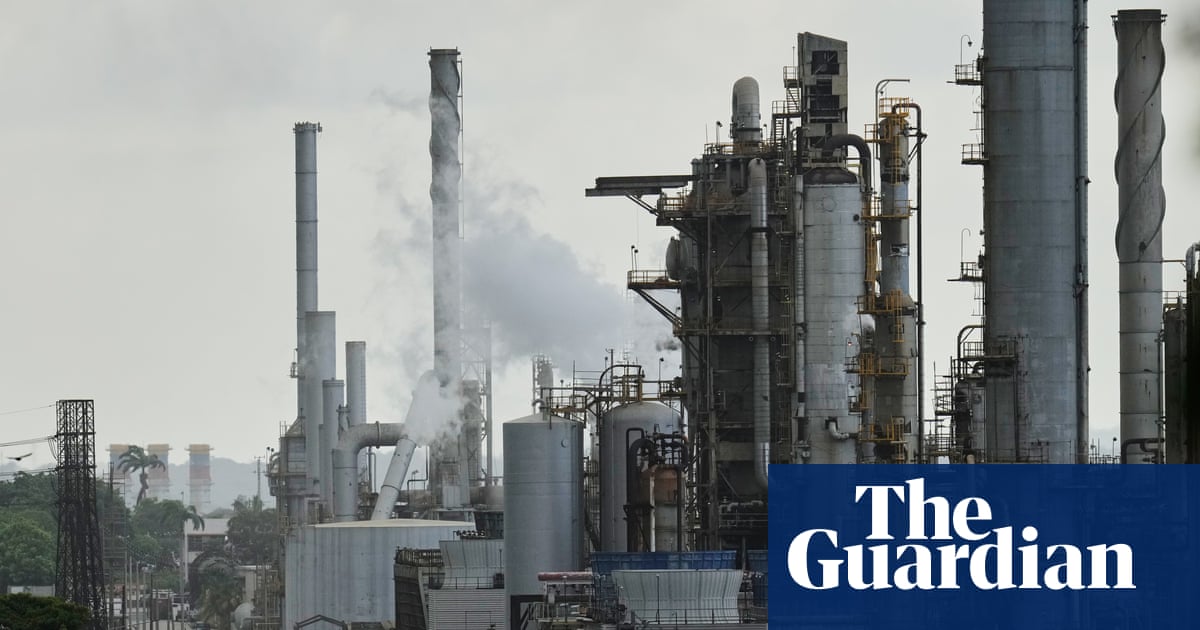

The Venezuelan oil industry has been “a total bust” for a long time, according to Donald Trump. After attacking Caracas and taking the country’s leader captive, Trump promised to take control of Venezuela’s oil industry with the help of America’s biggest oil companies.
Venezuela’s beleaguered oil industry could “make a lot of money” with the might of the US behind it, Trump told the press, claiming that the new regime would invest billions to revive its fortunes.
How much oil does Venezuela have?
Venezuela is believed to have the largest oil reserves of any country in the world. The exact reserves remain uncertain but the state claims they could be as large as 300bn barrels, easily surpassing those of Saudi Arabia. Other estimates suggest Venezuela’s reserves of crude oil could represent about 17% of the world’s total.
But the South American country has only ever pumped a fraction of its potential production. When Hugo Chávez, the populist former president, rose to power in 1999, the country produced about 3.5m barrels of oil a day, making it one of the top 10 crude producers in the world at the time.
A quarter of a century later, neglect, poor infrastructure, under-investment and corruption have eroded the country’s oil industry and its economy. Venezuela’s output is roughly 1m barrels a day – compared with the more than 13m barrels of crude produced daily in the US.
What role could US oil companies play?
Trump has promised that “very large” US oil companies will spend billions of dollars to fix the “badly broken infrastructure”.
The oil companies potentially in line to invest include Exxon Mobil, the largest US oil company, and the Texas-headquartered Conocophillips, both of which were active in Venezeula’s oil industry before it was nationalised by Chávez. Only Chevron, the US’s second largest oil company, has continued to operate in the country.
So far these companies have remained non-committal, with statements from ExxonMobil, Chevron and ConocoPhillips stopping short of confirming the US president’s investment plans.
Jorge León, the head of geopolitical analysis at Rystad Energy, an industry consultancy, said: “My hunch is that if President Trump said this publicly, probably there was already an agreement with the US companies.”
Under the new regime, US oil companies could follow the playbook used in many developing nations by partnering with the state oil company, PDVSA, to develop and produce crude in exchange for a share of the profits. The parlous financial state of PDVSA means US companies are likely to be able to negotiate a good return on their investments.
But even with a united effort of the US president and some of the world’s biggest oil companies, success is not guaranteed. “History shows that forced regime change rarely stabilises oil supply quickly, with Libya and Iraq offering clear and sobering precedents,” Leon added.
What does this mean for Venezuela’s current oil customers?
The vast majority of crude produced by Venezuela, about 80%, is exported via supertankers to China. The world’s biggest oil importer takes the shipments as repayment for loans it extended to the country under Chávez.
China is Venezuela’s biggest lender and, while the total financial support is not known, some estimate that it could include $105bn in loans and other financial commitments to the South American nation between 2007 and 2016.
By wresting control of Venezuela’s oil industry, the US has in effect gained control of billions in expected repayments, and a key source of cut-price energy for China’s developing economy.
The Chinese foreign ministry has condemned the US actions. In a social media post it said it was “deeply shocked” by the “blatant use of force against a sovereign state and action against its president”.
Market observers have speculated that Venezuelan crude could now be redirected to US refineries in Louisiana. This would allow more US crude to be exported on the international market and boost Trump’s mission to establish the US as a world-leading energy superpower.
It is possible that any future oil shipments to China, produced by US oil companies, would be charged at prices closer to the market rate – a blow to Beijing’s efforts to secure energy at the lowest possible cost.
Trump told Fox News on Saturday that China would continue to receive crude shipments from Venezuela, but did not provide details.
What does this mean for the oil market?
The events of this weekend are unlikely to have an immediate lasting impact on the price of crude oil or the cost motorists will pay at the pumps, according to experts at Third Bridge Energy, a US research company.
Volatility is likely when oil trading resumes this week as traders weigh up the impact that a lifting of US sanctions against Venezuelan crude might have on the market against the instability caused by the regime change.
It will take longer for any meaningful increase in the barrels produced by Venezuela to dampen market prices. A return to the country’s crude production heyday at the turn of the century could take years, according to Peter McNally, the global lead analyst at Third Bridge.
“Can Venezuela’s oil output recover?” McNally asked. “Our experts tell us the answer is yes but it will take tens of billions of dollars in investment and at least a decade of western oil majors committing to the country.”

