



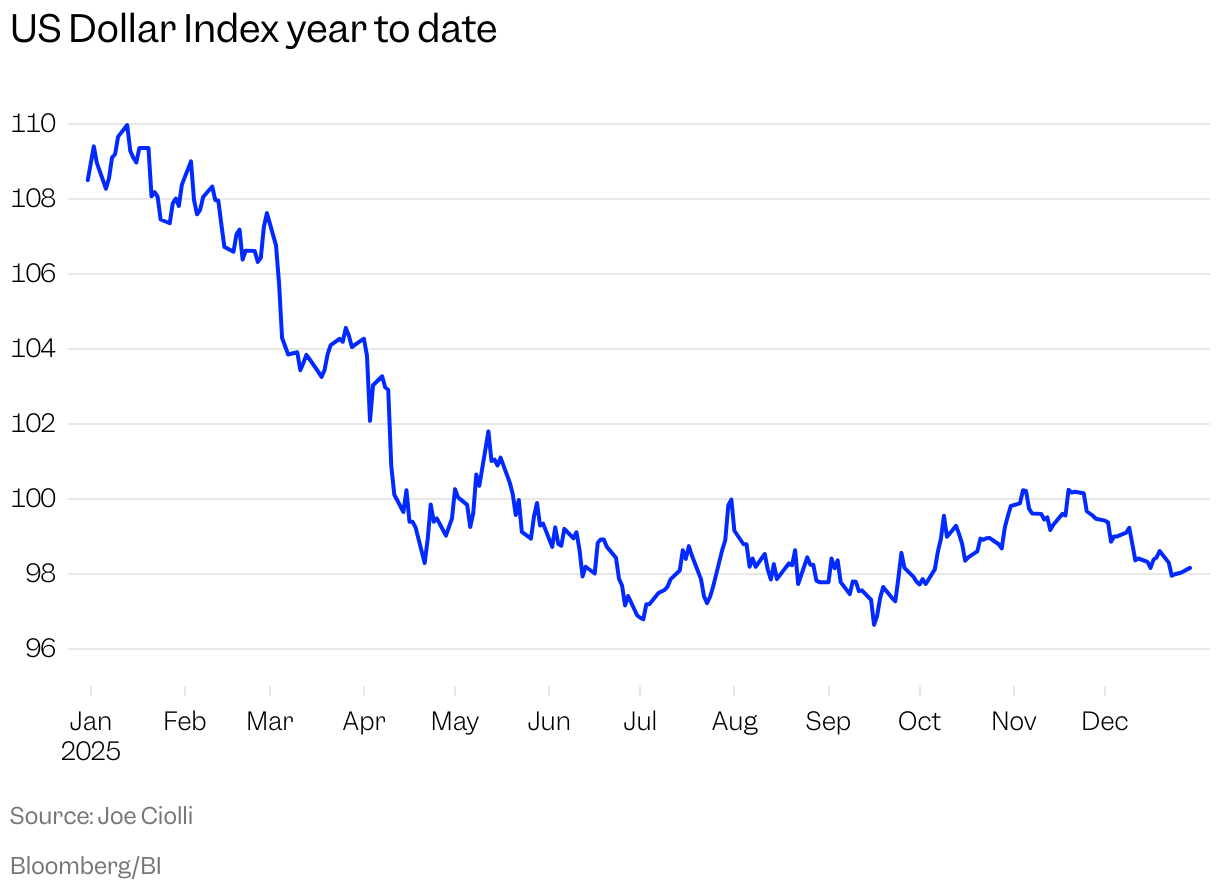
It’s been a weak run for the buck.
The US dollar has declined against all of its main global peers in 2025, and the Dollar Index — which measures the greenback against a basket of foreign currencies — is down 10% this year.
There have been multiple catalysts for the decrease, none more prevalent than the Federal Reserve’s decision to cut interest rates multiple times. Generally speaking, when a central bank lowers rates, holding a currency becomes less attractive.
There’s also the matter of President Trump’s proposed tariff policies, which particularly roiled markets in the first half of 2025. Investors viewed his potential levies as negative for growth and a source of uncertainty, both of which were dollar-negative.
But let’s not get too doom-and-gloom about a weak dollar. There are positives too.
Detailed below are the two pros and two cons of a depreciating currency:
Pro #1: It makes US goods and services cheaper for foreign buyers, which supports jobs in certain industries
© AFP/File Eduardo Munoz Alvarez
A weaker US currency offers other countries more purchasing power, which can boost exports and economic growth. It can also support US industries that depend heavily on exports, like manufacturing and agriculture.
The US exported $125 billion more goods and services in the nine months leading up to September than it did the same period last year, the Census Bureau said this month, an increase of 5%.
President Donald Trump pointed out the benefits of a weaker dollar when speaking to the press in July, suggesting that the US could “make a hell of a lot more money” when the greenback was weak.
“When we have a strong dollar, one thing happens: It sounds good. But you don’t do any tourism. You can’t sell tractors, you can’t sell trucks, you can’t sell anything,” he said at the White House.
“Pushing down the dollar’s value has been a policy priority for the administration as it sought in part to make exports more attractive,” Joseph Brusuelas, the chief economist at RSM, wrote in a note on Monday.
There are also positive implications for the labor market. If export-heavy industries like manufacturing and agriculture are thriving, that can create more jobs.
Pro #2: It boosts earnings of multinational companies who do business overseas — which also boosts their stocks
ANGELA WEISS/AFP via Getty Images
A boost to international sales is inherently good news for US firms that sell goods abroad. That applies to most of the S&P 500, where foreign sales are significant for at least half of the index’s companies, Hogan said.
“I would say the pros and cons for corporate America are more tailwinds than headwinds,” he added.
After the US dollar recorded its worst first half of the year in nearly half a century, Mike Wilson, Morgan Stanley’s chief US equity strategist, said the bank believed a weaker greenback was an underappreciated “tailwind” from an earnings perspective.
“There’s no doubt that a weaker dollar is part of the story for why revision factors have continued to move — even faster recovery than we had expected,” he said, speaking to CNBC earlier in the year.
A cheaper dollar could also be a boon for unhedged international equities, or shares of international stocks in local currencies, BlackRock said in a recent client note. That’s partly because foreign firms are gaining purchasing power as their local currencies strengthen against the greenback.
Con #1: Higher prices for imported goods
Luis Boza/NurPhoto via Getty Images
On the other hand, a weaker currency in the US can translate to higher prices for US consumers of imported goods, or goods with imported parts. That adds to inflationary pressures that already hang in the background with Trump’s tariffs.
Consumer prices rose 2.7% year-over-year in November — below what economists expected, but still above the Fed’s long-run 2% inflation target.
“For everyday Americans, the story is a bit opposite,” Hogan said. “The buying power of your dollar goes down as the value of the dollar goes down against the basket of other currencies. So it does make it harder to keep up with higher cost of goods.”
Con #2: Traveling is more expensive
Heather Diehl/Getty Images
Americans on vacation could also facing higher costs, as a weaker dollar has less purchasing power abroad, Hogan added.
On the flip side, it also makes the US more attractive as a tourist destination for foreigners, who have gained purchasing power.
“There’s puts and takes,” he said. “If you’re planning that European vacation, it’s going to cost you a bit more in that currency translation.”

