


Software stocks are experiencing a harsh sell-off as investors fear the artificial intelligence (AI) trade is reaching a fever pitch.
Software stocks have gotten off to a rocky start to begin 2026. As of this writing, both the S&P 500 and Nasdaq Composite are essentially breakeven on the year. While that performance may seem mundane, it’s held up far better than the software industry. The iShares Expanded Tech-Software ETF has plummeted by 20% so far this year.
I’ll dig into some of the key factors plaguing software stocks right now. Is this an opportunity to buy the dip, or is the artificial intelligence (AI) software trade a falling knife in the making? Read on to find out.
AI infrastructure spending is accelerating
Over the last three years, cloud hyperscalers such as Microsoft (MSFT 2.24%), Alphabet, and Amazon have collectively poured hundreds of billions of dollars into capital expenditures (capex). These funds have been used to procure GPUs and networking equipment to construct AI data centers.
Considering big tech has been able to monetize AI-powered services relatively quickly, Wall Street initially gave big tech a hall pass regarding its infrastructure spending spree.
However, industry research suggests that in 2026, the hyperscalers are going to continue accelerating their AI infrastructure budgets — with forecasts signaling more than $500 billion in cumulative spend.
At this point, some analysts are skeptical that this pace of spending is sustainable — leading to questions about the true return on investment from rising infrastructure budgets.

Today’s Change
(-2.24%) $-9.27
Current Price
$404.00
Key Data Points
Market Cap
$3.1T
Day’s Range
$401.01 – $416.31
52wk Range
$344.79 – $555.45
Volume
1.5M
Avg Vol
30M
Gross Margin
68.59%
Dividend Yield
0.82%
Some valuations look unsustainable
It is not uncommon for software-as-a-service (SaaS) stocks to carry higher valuation multiples relative to other businesses in the technology sector. The recurring nature of SaaS revenue is usually complemented by high gross margins — leading growth investors to place a premium on these businesses.
When it comes to AI SaaS stocks, data mining specialist Palantir Technologies (PLTR 3.72%) stands out among the pack. Even with the ongoing sell-off, Palantir’s forward price-to-sales (P/S) ratio is roughly double that of its next-closest peer within the broader SaaS landscape.
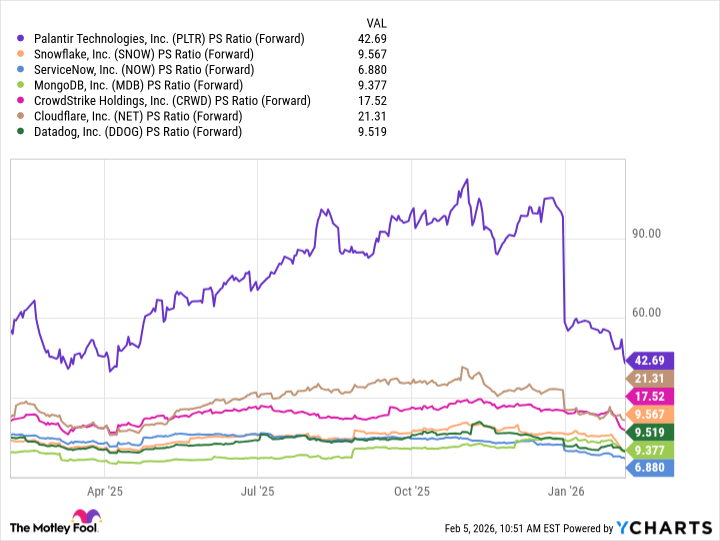
PLTR PS Ratio (Forward) data by YCharts
Despite its impressive growth profile, Palantir is a clear anomaly when it comes to valuation. For this reason, some investors are placing enormous pressure on the company to deliver blowout earnings every single quarter — leaving virtually no room for error and the possibility of a harsh sell-off highly probable.

Image source: Getty Images.
Traditional software models are under pressure
Some investors are also fearful that traditional SaaS models are being threatened by the rise of large language models (LLMs). Models developed by Anthropic and OpenAI have the capability to integrate with existing enterprise software platforms.
The value add here is that LLMs can be directly linked to large volumes of data across various ecosystems, enabling them to aggregate and analyze this information and derive detailed solutions to business problems more efficiently.
Software stocks are volatile, but the best companies will stick around
Broadly speaking, growth stocks are usually hit the hardest and hit first whenever the market enters a correction.
While concerns surrounding infrastructure budgets and soaring valuations make sense on the surface, smart investors understand that many of these companies are extremely diversified. In that sense, these companies are built for difficult economic periods, given their durable, resilient ecosystems.
In addition, while LLMs have ushered in a wave of disruption to the software landscape, the best companies will adapt — using plugins from Anthropic and OpenAI to improve their businesses, not cannibalize them.
With this in mind, I would be a buyer of plummeting software stocks right now. The key is to take positions in blue chip category leaders as opposed to speculative companies with an unproven future.


