


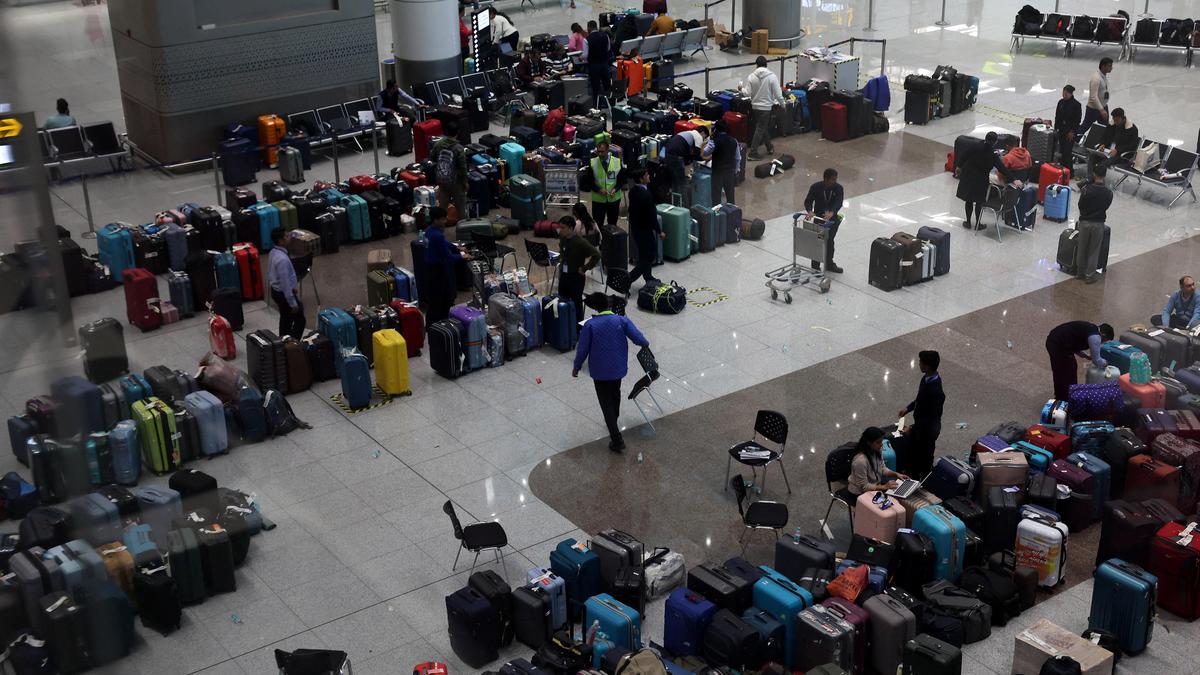
Staff members of IndiGo tag stranded bags and belongings following large-scale flight disruptions, at Terminal 1 of Indira Gandhi International Airport in New Delhi, on December 8.
| Photo Credit: REUTERS
The story so far: In the first few days of December, IndiGo saw a near-total meltdown of its operations, with over 5,000 flights cancelled in the first 10 days, carrying on from delays and nearly 900 flights cancelled in November.
What happened?
The flight disruption at IndiGo was so severe that crew ended up at the wrong stations, passengers’ bags reached destinations even after their flights were cancelled, pilots waited at airports without duty assignments, call centres crashed, and tempers flared at boarding gates as passengers shouted slogans against IndiGo and even held protest marches inside terminals. The airline informed India’s aviation regulator, the Directorate General of Civil Aviation (DGCA), that there were “planning gaps” in rostering pilots and misjudgement in assessing pilot availability, as per the new DGCA rules for pilot rest and duty hours that came into effect from November 1. In fact, things were so bad that the airline pleaded with pilots to return from their sick leave and even offered 1.5 times their daily allowance if they cancelled their privilege leave. These issues combined with minor technical glitches, winter schedule changes, adverse weather, and aviation system congestion. The airline informed the regulator that they were short of 65 pilots-in command and requested for exemptions from the new rules to restore flight operations. Given the massive flight disruptions affecting lakhs of passengers, the DGCA granted exemptions until February 10 for the new rules. As many as 12.5 lakh passengers were impacted due to the cancellations until December 9, with the airline releasing ₹1,100 crore in refunds. It has also offered ₹10k vouchers to severely impacted passengers from December 3 to 5.
What was the backdrop of new rules?
IndiGo’s recent meltdown revives a decades-old clash between airlines and pilots over Flight Duty Time Limitations (FDTL) that govern their rest and duty hours. This latest tiff goes back to April 2019, when the DGCA brought new rules that reversed some of the pilot-friendly provisions in the 2011 rules, especially those governing night duties. The 2011 rules followed the May 22, 2010 Mangalore crash, where the probe report cited cockpit snoring and deep breathing for 1h40m of the 2h5m flight and noted that the pilot-in-command would have been affected due to flying in the ‘Window of Circadian Low’ or the period between 2 am to 6 am when the ability to stay awake reduces. The flight took off from Dubai at 2.30 am IST.
They were also an outcome of the 2011 report of the Nasim Zaidi Committee on FDTL, which was necessitated as Air India for the first time started non-stop services in August 1, 2007 from Mumbai to New York. The report cited evidence from a NASA study and delved in great detail into the impact of fatigue and night flying on one’s body and how sleep debt accumulates and impacts fatigue levels. The 2011 rules specifically barred utilising pilots for night duties on consecutive nights as well as stated in unambiguous language that night landings were capped at 2 hours and that maximum duty hours (which is flight duty combined with and pre and post flight duties) could not exceed nine hours.
But these were reversed in the 2019 rules, which allowed upto two consecutive nights of duty, and used vague language to define maximum flying hours and duty hours for night shift. After pilot bodies went to Delhi High Court, DGCA notified revised norms in January 2024. These were widely welcomed as it raised weekly rest from 36 to 48 hours, and restricted night flying by capping landings to two hours, as well as maximum flying time to eight hours and duty time to 10 hours. But their rollout was paused amid airline warnings of cancellations and the need to recruit more pilots. Pilot bodies once again returned to the Delhi High Court, which in April 2025 ordered phased enforcement from July 1 for most clauses, while those governing night duties were to be implemented from November 1. It is the latter that IndiGo has obtained exemptions on.
The 2019 reversal aligned with the boom in short-haul international flying by airlines, which were adding destinations like Dubai, Jeddah, Riyadh, Abu Dhabi, and wanted to maximize crew use via quick turnarounds without overseas hotels.
Airlines like Air India, Akasa, and SpiceJet didn’t face cancellations due to excess pilots as a result of groundings, delayed aircraft deliveries or unavailability of aircraft. IndiGo’s tight cost controls and hyper-efficiency squeeze their pilots the hardest — leaving razor-thin margins.
What next?
Data indicates that though IndiGo’s market share has consistently increased from 47% pre pandemic to 65% now, its employee cost have dropped from 11% to 8%. So, bridging the leadership-employee disconnect and rebuilding employee morale is crucial, not just with pilots but also cabin crew and ground staff that faced angry passengers.
From the regulator’s side there is a need to expand the understanding of human factors responsible for aviation safety and not dismiss labour issues as employee-employer issues. A deeper malaise is pilot training, where the training programmes of IndiGo and Air India which cost ₹1.2 crore and ₹1.5 crore respectively — 50% higher than market prices and often on par with fees at foreign schools — trap young pilots in decade-long debt bondage often pressuring them to skip incident reports or give up rest for duty.
The government must seize this crisis to strengthen the Passenger Charter of Rights on entitlements for air travellers during flight cancellations and delays. The regulator’s website should transparently list delay, cancellation, and baggage policies in simple formats — like the U.S. Federal Aviation Administration’s airline-specific tables — for informed booking. Finally, fostering market competition and tackling drivers of operational costs for airlines is essential.
Published – December 16, 2025 08:30 am IST


