


One of the most significant technological breakthroughs in the last few years is AI. It started with chatbots writing essays and creating cute images. Now it’s everywhere. It’s above my pay grade to comment on what AI will do to jobs, the macroeconomy, or the markets. I can only share how AI has helped me at the micro level.
The experiences I’m sharing below were with ChatGPT. I used ChatGPT only because it came out first. There are at least four major AI chatbots now. I believe another AI would’ve done just as well. I’m currently experimenting with other AI models to see which one I like better for which tasks.
AI Detected Mysterious Power Usage
I bought a house without an agent last December, but I hadn’t moved in right away. The first month’s electricity bill came and showed that an empty house used more electricity than the house I lived in. I asked AI what could have caused such high usage. It gave me some likely causes and a method to find the culprit: turn off breakers one at a time and watch for large drops at the electric meter.

AI could read the handwriting on the breaker panel to tell me which breaker is more suspicious than another. It taught me how to read the current load from the electric meter to see whether the mysterious power consumption was on the breaker I just turned off.
Sure enough, I found it. The previous owner had ice-melting roof cables running 24/7 without any switch or sensor. My electricity usage dropped by 15 kWh per day after I unplugged the de-icing cables.
AI Reconfigured Water Heater Recirculation
Next came the natural gas bill. It also showed high usage while I had already set the thermostat to 60 when the house was unoccupied. I asked AI again. It quickly zeroed in on the water heater after it asked me about the gas appliances in the house. It turned out that the recirculation setting in the tankless water heater was set to “always on.”
Turning off recirculation would lower the natural gas bill, but it also would make me wait longer for hot water. I asked AI for a compromise. It said my water heater model supports an on-demand mode using wired push buttons (like doorbell buttons) to activate recirculation as needed. Wiring requires too much work. I asked AI for a wireless solution. It told me to make this:
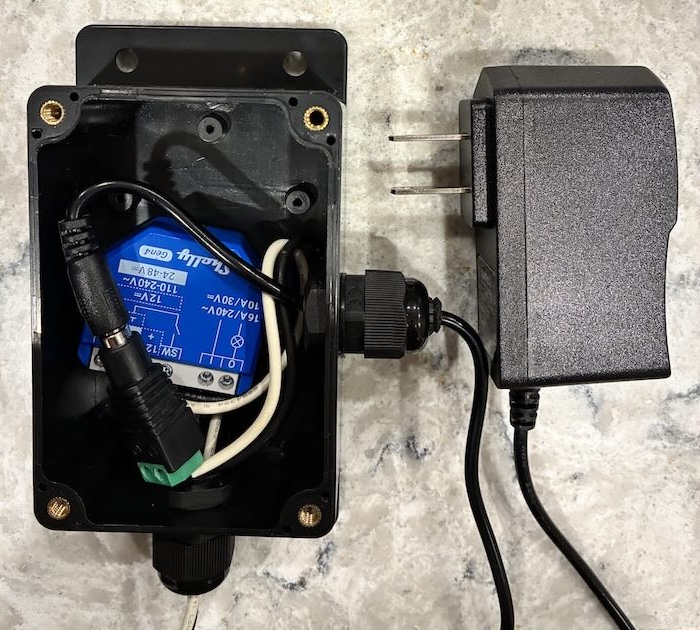
A 12V power adapter powers a Shelly 1 smart relay, stored in a plastic project box, with a hole drilled on two sides to attach cable glands. Wireless motion sensors in the kitchen and bathrooms trigger the smart relay, which activates recirculation. I had never heard of any of these components before, except for the power adapter.

I sent AI this diagram of the control board from the water heater’s instruction manual to ask whether I could skip the 12V power adapter and use the 12V contact in the SIGNAL 1 terminal on the control board. It read the diagram and gave me good reasons why it could work, but it was safer to use an external power adapter and connect the relay to the SIGNAL 2 terminal.

AI’s solution worked. On-demand activation reduced natural gas consumption by 1 therm per day versus running recirculation 24/7.
AI Dimmed Exterior Lights
I gave AI another problem that bugged me. My exterior lights on the sides of the garage door were too bright. I couldn’t simply change the bulbs because the lights don’t have bulbs. They use integrated LEDs. They were controlled by a dusk-to-dawn photocell. I couldn’t put them on a dimmer because there was no switch for them inside the house.
AI told me to look for a junction box where I could place a dimmer. I couldn’t find the junction box it wanted, but I found a switch for a porch light that was also downstream of the photocell. I asked AI whether I could merge the garage lights onto that switch. It gave me a cautious “maybe,” with a list of conditions to confirm behind the switch cover.

I took the cover plate off and sent a photo to AI. It read the wires and confirmed that moving the wires would comply with the National Electrical Code.
Long story short, AI guided me in rewiring the lights at the switch and installing a smart dimmer. Those exterior lights by the garage door aren’t too bright anymore.
AI Knows More Than the Average Person
All of the above may be too basic for some of you, but it was all new to me. I didn’t know what neutral wires looked like before I engaged with AI. I don’t think the average person could have helped me as much as AI. I could have asked an electrician, but AI is free and available 24/7.
AI also answered many questions in vastly different fields. It explained to me why two ducks flew in and out daily with a group of wild geese, and the geese weren’t hostile toward the ducks because they were clearly different species. It also explained why the heads of mallard ducks look green, but the feathers are actually black or charcoal when you look at them on a table.
An electrician can help me with wiring, but I don’t think the average electrician knows about ducks. AI knows more than the average person because it represents the aggregate knowledge of the Internet.
AI Is Better Than Google
Google was a technology breakthrough in the early 2000s. Google made it much easier to find information on the Internet. Most readers of this blog found me directly or indirectly through Google. I’m grateful to Google for connecting all of us, but from a user’s perspective, AI is better than the traditional Google search.
You Google something and find a source. The source may be addressing something related, but not necessarily exactly what you’re looking for. It may require some background knowledge that you don’t have. You Google again and find another source. The two sources may supplement each other, but also contradict. Sometimes you can leave a comment to ask for clarification. The author may or may not reply. I can’t possibly keep up if every reader of this blog asks me a clarifying question. I’m sure many people reading my posts left with unanswered questions.
The user experience with AI is much better. You can ask AI in long paragraphs and give more context. You can upload photos to explain and clarify. AI tailors the answer to your question and context. You can ask follow-up questions. AI remembers the conversation. You can pick up where you left off from days before.
The solutions to my problems in this post all happened over several days. AI pointed me in a direction. I went there and reported back what I found. It then gave me the next steps. It was like having an on-call consultant. I don’t think I could have achieved the same results as easily with traditional Google searches.
Google knows this. Google prominently features its Gemini AI when you use Google Search now. It has to do it to stay relevant.
Ask Follow-Up Questions
You get more out of AI when you keep asking follow-up questions. The more you ask, the more specific the answers will be to your exact needs and constraints.
AI didn’t come up with the entire solution to my water heater recirculation problem in one go. The conversion started with what was burning so much natural gas. After I turned off recirculation, the next question was why that setting was enabled and how I could still get the benefits without running it 24/7.
AI brought up wired buttons. I asked for a wireless alternative. AI gave me the smart relay. When I asked how I would power it, AI said to tap into 110V power. I read the relay’s manual, which said it could also use 12V DC. I asked AI whether that would be a better way. AI said “Yes!” although it didn’t give me this better way when I first asked.
I then asked how to tell which wire from the 12V adapter is positive and which is negative. AI said it’s easier if I use a barrel tip adapter. I asked where to put the relay and the wires. AI told me about the project box and the cable gland.
A full solution only emerged after these rounds of questions.
Don’t Dismiss AI for Inaccuracies
Some people dismiss AI, saying it’s just a probability-based text generator, and it can’t be trusted because it’s often wrong. Indeed, AI isn’t always accurate. The average person or the average Google search result isn’t always accurate either.
Looking up verifiable facts isn’t the best use of AI. AI is best at giving you the common knowledge of an insider. The less you know about a subject, the more you should use AI, because it fills your knowledge gap quickly. You don’t need 100% accuracy when the gap is so huge. A total market index fund or a 60/40 allocation is common knowledge for seasoned investors. We can debate whether they are the best, but they make a good baseline for people unfamiliar with investing.
Are AI’s solutions to my electricity usage, water heater, and lighting problems “the best”? Maybe not, but I only needed working solutions, not necessarily the best solutions. AI got me there quickly.
Dismissing AI only because it’s not always accurate is short-sighted and throwing the baby out with the bathwater.
AI for Finance, Investing, and Taxes
Many questions in finance, investing, and taxes don’t have definitive answers. The “best” move requires knowing the future.
AI doesn’t know the latest development. When the 2025 Trump tax law was still being crafted, AI’s answers were often wrong (so were many media reports). Again, asking AI about verifiable facts isn’t the best use of AI. AI does a better job of explaining things and applying knowledge to specific situations.
I asked AI this fairly complicated question from the Bogleheads forum about Traditional versus Roth contributions for a self-employed person and the interplay with ACA health insurance. Here are the answers from ChatGPT and Claude:
I posted the question verbatim to AI before any human answered it on the forum. AI couldn’t have cheated. If I rate how I would answer the question myself at 100, I would rate AI’s answers at 90+. Those were only AI’s initial answers. The answers will improve with more follow-up questions. I’m sorry to say that the first two replies from humans on the forum weren’t as good as AI’s answers. The discussion would be more productive if humans used AI’s answers as a baseline and built upon them.
Next time you have a question, start with AI. Use AI less for verifiable facts and not for the latest development, but more for how to apply knowledge to your specific situation. The less you know about a subject, the more AI will help. It gives you a good baseline. Keep asking follow-up questions. The more you ask, the better the answers will be. Supplement the good baseline from AI with human sources when necessary, but start with AI.
Learn the Nuts and Bolts
I put everything I use to manage my money in a book. My Financial Toolbox guides you to a clear course of action.
Read Reviews
