


Economists estimate the surplus transfer-often referred to as the central bank’s dividend to the government-in the range of Rs 2.7 lakh crore to Rs 3 lakh crore.
In the FY27 Union Budget, the government has estimated Rs 3.16 lakh crore in dividends from state-owned companies and surplus transfers from the central bank.
Last year, the RBI transferred Rs 2.68 lakh crore, 27% higher than the previous year.
The dividend payout is expected to be supported by gains from foreign exchange interventions and investment income, while a higher-than-estimated payout could stem from a potentially lower contingency buffer, economists said.

Also Read: Current account deficit to widen to 2.3 per cent of GDP in FY27 from 0.9 pc in FY26: Report
The quantum of the dividend will be finalised when the RBI’s board meets in Mumbai on Friday.The RBI did not respond to ET’s request for comment.
RBI dividend payouts have provided a significant boost to the government’s non-tax revenues in recent years. A sharp fall of nearly 10% in the dollar and a 60% rise in gold prices in FY26 have further improved the RBI’s accounting profitability, supporting a higher surplus transfer.
Ease Fiscal Constraints
This elevated dividend will help the government narrow the fiscal deficit, which otherwise risks widening due to a higher import bill amid a depreciating rupee.
The surplus transfer will be decided under the revised Economic Capital Framework (ECF) approved by the RBI’s central board. The framework stipulates that the Contingent Risk Buffer (CRB) be maintained within a range of 4.5% to 7.5% of the RBI’s balance sheet. In FY26, the RBI maintained the CRB at the upper bound of 7.5%. Lowering the buffer could lead to a higher dividend payout.
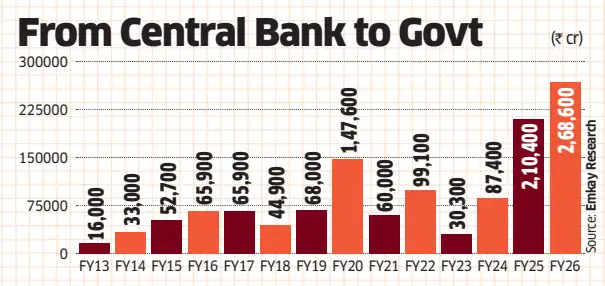
“We estimate a surplus transfer of Rs 2.8 lakh crore, assuming a CRB of 6.5%,” said Sakshi Gupta, principal economist at HDFC Bank.
Barclays expects the payout at ?3 lakh crore, while Emkay estimates it in the range of Rs 2.8 lakh crore to Rs 3.4 lakh crore, depending on the buffer the RBI chooses to maintain.
Also Read: India poised for strong growth revival despite global risks: Morgan Stanley
IDFC First Bank chief economist Gaura Sengupta expects the RBI dividend to remain in line with last year. “Earnings from foreign exchange transactions are expected to be lower, with gross dollar sales at $166 billion in FY26 (till February) compared with $399 billion in FY25. The historical cost of dollar purchases is around 84 in FY26 versus 82 in FY25, which remains below the current spot rate,” she said.
“RBI’s forward book was already large at the start of FY26, limiting its ability to sterilise spot interventions. This resulted in lower gross dollar sales during the year. The West Asia crisis likely increased dollar sales in March 2026, which has been factored into estimates,” she added.
