


On June 5, SpaceX quietly announced that it had entered into a massive compute capacity agreement with Alphabet‘s (GOOG 2.23%) (GOOGL 1.95%) Google. SpaceX is effectively leasing access to a cluster of 110,000 Nvidia (NVDA 3.39%) GPUs, along with supporting CPUs, memory, and related data center hardware. In exchange, Google will pay SpaceX $920 million per month between October 2026 and June 2029.
This deal represents a notable expansion of SpaceX’s ambitions beyond rocket launches and satellite constellations. While headlines around the deal will fixate on SpaceX and Google, there’s a more subtle winner hiding in plain sight.

Image source: Nvidia.
Why did Google turn to SpaceX for compute capacity?
Despite operating some of the world’s most advanced artificial intelligence (AI) data centers, Google still faces pressure to secure additional compute capacity for training generative models. Rather than solely relying on internal build-outs, the deal with SpaceX makes it clear that even Google is choosing to lock in dedicated capacity through alternative infrastructure providers.
If SpaceX is unable to deliver the full GPU commitment by September, Google can terminate the deal or choose to rent capacity at a reduced rate. After Dec. 31, either company can walk away from the deal with 90 days’ notice.
In essence, the SpaceX-Google partnership combines execution deadlines with a strategic need for immediate, high-volume GPU access.
Nvidia is the real winner of the SpaceX-Google deal
While Wall Street will likely celebrate SpaceX’s ability to monetize its AI infrastructure through multiyear, billion-dollar recurring revenue contracts with a hyperscaler, the true beneficiary of this deal is Nvidia.
As noted, the structure of SpaceX’s tie-up with Google specifies Nvidia’s GPUs as the cornerstone of the compute capacity being delivered. This is important to understand because Alphabet has been investing heavily in its own custom silicon — known as Tensor Processing Units (TPUs).
Even so, this deal showcases how the company is still turning to Nvidia’s hardware at scale. I think this choice is telling. In my eyes, it demonstrates that the ecosystem lock-in of Nvidia’s general-purpose GPUs remains unmatched — even as competition from custom chip designs intensifies.

Today’s Change
(-3.39%) $-7.05
Current Price
$201.14
Key Data Points
Market Cap
$5.0T
Day’s Range
$199.92 – $207.22
52wk Range
$140.85 – $236.54
Volume
6.6M
Avg Vol
166M
Gross Margin
74.15%
Dividend Yield
0.14%
Despite the surge in ASICs, Nvidia remains the AI chip king
The rise of custom ASICs from hyperscalers like Google, Microsoft, and Amazon has fueled investor anxiety that Nvidia’s dominance in the chip realm might erode. The theory is that specialized chips tailored to specific AI workloads will eventually displace general-purpose GPUs — squeezing Nvidia’s profit margins and market share.
I think SpaceX’s new agreement with Google undercuts this narrative. Google’s decision to rent Nvidia-powered capacity at this scale could suggest that ASICs are not yet fully capable of replacing the flexibility and software ecosystem that Nvidia GPUs provide. In other words, AI developers and researchers still prefer the plug-and-play performance and vast library of optimization tool kits that Nvidia delivers.
Against this backdrop, I think growth investors are over-indexing on the threats posed by ASICs. These dynamics can be seen by the compression of Nvidia’s forward price-to-earnings (P/E) multiple.
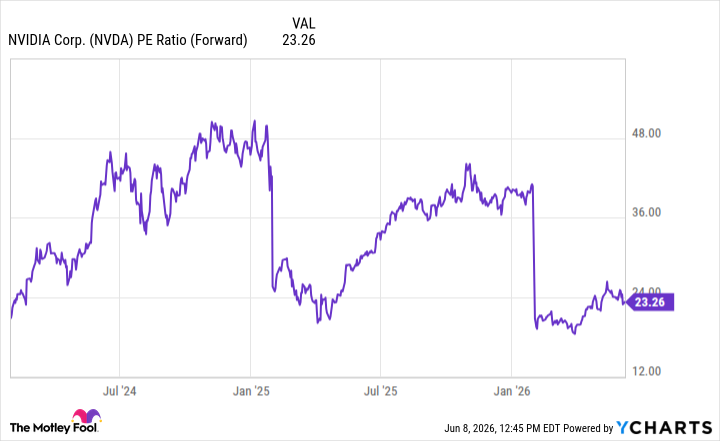
NVDA PE Ratio (Forward) data by YCharts
Nevertheless, as AI workloads expand and applications become more complex, the need for more versatile, high-performance GPUs is intensifying — even among Nvidia’s largest competitors. I think the SpaceX-Google agreement is simply the latest proof that Nvidia’s position in the AI data center chip realm is not just secure but becoming ever more foundational to the industry’s future.
While SpaceX gains a new revenue stream, nobody seems to be talking about the deeper implication here: A leading ASIC developer — Google — is outsourcing its capacity needs to a rival’s technology. While the market hasn’t realized it yet, I think Nvidia has already won the AI chip war in a way that’s becoming increasingly hard to ignore.
All told, this deal is a quiet yet powerful reminder that Nvidia’s grip on AI chip stacks is tighter than many investors realize. Ultimately, Nvidia is further cementing its leading role as the indispensable enabler powering AI infrastructure.
