


The “Magnificent Seven” collectively refers to Nvidia, Apple, Microsoft (MSFT +0.66%), Amazon (AMZN +0.53%), Alphabet (GOOG +2.92%) (GOOGL +2.53%), Meta Platforms (META +1.33%), and Tesla. They are among the most influential companies globally, from a business and stock market standpoint. As of the end of March, they accounted for over 32% of the S&P 500.
It’s often hard to find true value in a Magnificent Seven stock because of their popularity, but Meta is one that’s sliding into value territory. As of market close on May 4, it was trading at 19.8 times its projected earnings over the next 12 months — the lowest valuation of the group.
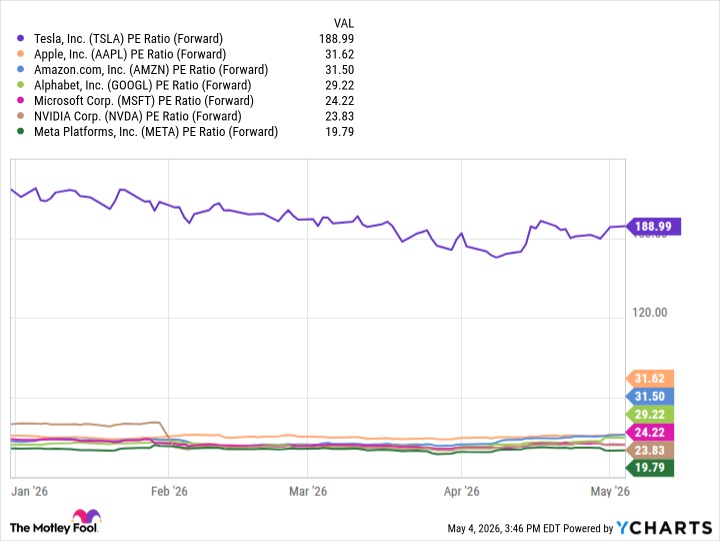
TSLA PE Ratio (Forward) data by YCharts.
However, just because a stock is cheap doesn’t necessarily make it a good investment. Meta’s stock is down nearly 6% this year, but is it due to bad business performance and a weak outlook, or is it due to the market undervaluing the company? I believe it’s much more of the latter.
The ad business is still going strong
Meta’s core business has always been and continues to be advertising. In the first quarter, Meta’s advertising revenue was $55 billion, up 33% year over year, and accounted for nearly 98% of its total revenue.
This jump in advertising revenue was aided by a 19% increase in ad impressions and a 12% increase in average price per ad. People are watching Reels longer on Instagram and videos longer on Facebook.
Most big tech giants have one main engine that generates tons of income, which in turn allows them to fund their other ventures. In Meta’s case, its advertising cash cow has allowed it to invest in (often long-shot) projects like the Metaverse and virtual reality headsets. Now, that cash is going toward its artificial intelligence (AI) push.

Today’s Change
(1.33%) $8.07
Current Price
$613.03
Key Data Points
Market Cap
$1.6T
Day’s Range
$598.12 – $619.87
52wk Range
$520.26 – $796.25
Volume
1.3M
Avg Vol
15M
Gross Margin
81.94%
Dividend Yield
0.34%
The path to becoming a vertical AI company
Meta doesn’t usually get the same level of attention for its AI-related efforts as companies like Amazon, Microsoft, and Alphabet because it doesn’t operate a major cloud infrastructure platform. In fact, it signed a six-year, more than $10 billion deal with Alphabet last year that allows it to use Google Cloud’s computing power to run and train its AI models.
However, the release last month of Meta’s newest AI model, dubbed Muse Spark, is a sign the company should be taken a bit more seriously in the AI world. As Meta describes it, Muse Spark is “scaling toward personal superintelligence.” It outperforms more common models (like GPT, Gemini, and Grok) in a handful of areas, but what matters most for an AI model is its adoption, and with only a month since its debut, how that will play out remains to be seen.
Meta has also begun developing custom application-specific integrated circuits in partnership with Broadcom. It will still need to rely on companies like Nvidia and AMD for GPUs, but developing AI chips in-house will reduce its dependence on them, and offer it a way to begin cutting its computing costs. The company’s goal is to become vertically integrated as quickly as possible and gain greater control over its own AI ecosystem.
This doesn’t come cheap, though, which brings us to our next point.
Why investors aren’t embracing Meta as much as you’d think
Meta turned in a strong Q1 performance that beat analysts’ expectations, so why is the stock still struggling this year? It mostly comes down to Meta’s capital expenditure plans.
Meta said it expects to spend between $125 billion and $145 billion on capital expenditures this year, with most of that going toward constructing new data centers and other AI infrastructure. Its previous estimated range was $115 billion to $135 billion, a spending forecast that itself had drawn some understandable skepticism from investors.
Meta has made some notable missteps (like its massive money-losing bets on the metaverse), so it doesn’t necessarily get the benefit of the doubt when it comes to seemingly excessive spending. However, this time, it is not engaging in a company-specific strategy — most Magnificent Seven companies have similarly major AI infrastructure spending plans.
Even with the increase to its budget, Meta’s projected capex for the year is lower than Amazon’s ($200 billion), Alphabet’s ($175 billion to $185 billion), and Microsoft’s ($190 billion).
In my view, it would be much better for a tech giant to overspend in the AI race and not get left behind than to underspend and get left trying to play catch-up for who knows how long. At its current levels, Meta’s stock has much more long-term upside than downside.
