


Famed investor Warren Buffett was known for his value-investing approach, which influenced the selection of Berkshire Hathaway‘s investments. When Buffett’s hand-picked successor, Greg Abel, took over at the start of 2026, he made significant changes to the portfolio.
Abel dumped many positions and added big names in tech and artificial intelligence, such as Google parent Alphabet. Traditionally, Buffett shied away from the technology sector. But one holdover from Buffett’s days remains in the portfolio, and it sports an impressive dividend yield of more than 6% as of July 13. That stock is the Kraft Heinz Company (KHC 0.59%).
The meaty dividend makes owning shares attractive. Even so, weighing an investment in Kraft Heinz is not straightforward and requires unpacking what’s going on with the company.

Image source: Getty Images.
Kraft Heinz’s shortcomings
Kraft Heinz was once the king of the grocery store. Iconic products, such as its Heinz ketchup and Kraft mac and cheese, were household staples. In fact, Buffett and his company helped orchestrate the 2015 merger between Heinz and Kraft.
Yet after more than a century of success, the combined company was ill-prepared for shifting consumer preferences. Shoppers are moving away from its ultra-processed foods in favor of healthier alternatives.
At the same time, the company underinvested in research and development (R&D) that could have helped it adapt to these changes, and instead opted for cost-cutting. Adding fuel to the fire, Kraft Heinz raised prices amid persistent inflation, prompting consumers to switch to cheaper supermarket private-label brands. This confluence of factors contributed to steadily declining sales.
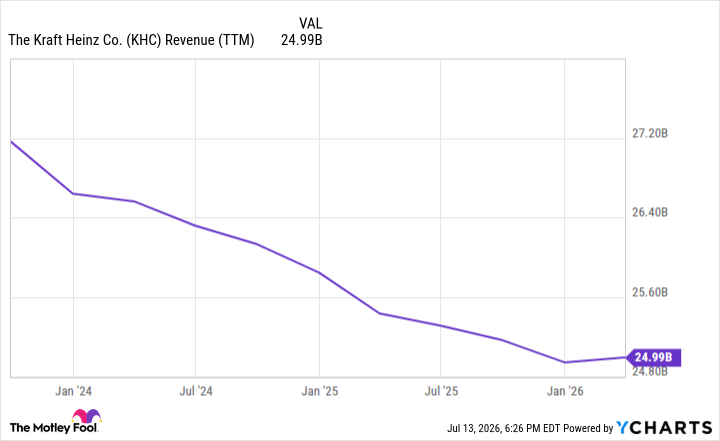
KHC Revenue (TTM) data by YCharts.
The company originally decided the solution was to break apart its businesses. This maneuver was vehemently opposed by Buffett and Abel, prompting them to threaten to sell Berkshire Hathaway’s substantial holdings.
The Kraft Heinz turnaround
Fortunately for shareholders, the packaged food giant replaced its CEO with Steve Cahillane in December, who scrapped the separation plan in favor of a new strategy to galvanize growth. Kraft Heinz is injecting $600 million into R&D and marketing to win back customers. It’s also adding natural ingredients to its products and streamlining operations to maximize supply chain efficiency and accelerate product rollouts.
In the short term, these changes will eat into margins. Over the long haul, this year lays the groundwork for a reversal of fortunes in 2027 and beyond. Since the strategy is new, buying its stock now is a leap of faith that a revenue rebound will eventually arrive. However, you benefit from the dividend’s passive income while you wait.
Currently, the company can support dividend payouts thanks to its robust free cash flow (FCF). In its fiscal first quarter ended March 28, Kraft Heinz grew FCF by nearly 60% year over year to $0.8 billion. FCF provides insight into a company’s available cash to invest in its business, pay down debt, repurchase shares, and fund dividends.

Today’s Change
(-0.59%) $-0.15
Current Price
$25.08
Key Data Points
Market Cap
Day’s Range
$24.79 – $25.16
52wk Range
$21.04 – $29.19
Volume
6.7K
Avg Vol
13.9M
Gross Margin
33.45%
Dividend Yield
6.38%
Kraft Heinz’s revitalization effort has Abel’s support, which is why Berkshire Hathaway retains its holdings. The new direction under Cahillane helped the stock gain 4% year-to-date through July 13.
Yet the stock’s valuation remains lower than a year ago, as indicated by its price-to-sales ratio of 1.2. This makes now a good time to purchase Kraft Heinz stock if you believe its turnaround efforts can revitalize the business over the long run.
